
Why NEC Compliance is Non-Negotiable for Outdoor Power
Adding an exterior electrical outlet is one of the most practical upgrades for outdoor lighting, power tools, and holiday displays. However, outdoor environments expose electrical systems to moisture, UV radiation, and physical damage. The National Fire Protection Association (NFPA) reports that electrical failures account for a significant portion of residential structure fires, with outdoor receptacles being a primary vulnerability when improperly sealed or lacking ground fault protection.
This guide details the exact National Electrical Code (NEC) requirements, material specifications, and installation protocols for safely adding an exterior electrical outlet in 2026. Whether you are extending a circuit from an interior wall or running a dedicated underground feeder, strict adherence to these safety standards is mandatory.
Core NEC Requirements for Outdoor Receptacles
Before purchasing materials, you must understand the governing codes. The NEC strictly regulates damp and wet locations to prevent electrocution and arc faults.
| NEC Article | Requirement | Practical Application |
|---|---|---|
| 210.8(F) | GFCI Protection | All 15A and 20A, 125V outdoor receptacles must have Ground Fault Circuit Interrupter (GFCI) protection. |
| 406.9(B) | Weatherproof Enclosures | Receptacles in wet locations must have an enclosure that is weatherproof whether or not the attachment plug is inserted (While-in-Use cover). |
| 406.4(D) | Receptacle Type | Must be listed as Weather-Resistant (WR) and Tamper-Resistant (TR). |
| 210.52(I) | Placement | At least one receptacle must be accessible at grade level for the front and back of a dwelling unit. |
Selecting Code-Compliant Materials
Standard indoor receptacles will fail rapidly outdoors due to corrosion on the brass terminals and UV degradation of the thermoplastic yoke. You must source specific outdoor-rated components.
1. The Receptacle: WR and TR Rated
Look for the 'WR' (Weather-Resistant) stamp on the metal yoke. WR receptacles feature UV-stabilized thermoplastics and nickel-plated brass terminals to resist galvanic corrosion. They must also be 'TR' (Tamper-Resistant) to meet modern building codes. A reliable, code-compliant choice is the Leviton Decora 15 Amp TR WR Duplex Receptacle (Model R52-05362-0WS), which typically retails between $4.50 and $6.00.
2. The Enclosure: While-in-Use (WIU) Covers
The NEC mandates a 'While-in-Use' cover. Standard flat metal plates or shallow bubble covers that only seal when empty are code violations for wet locations. You need an extra-duty WIU cover, such as the Taymac 1-Gang Non-Metallic Weatherproof Cover (Model PRL1010) ($12.00 - $15.00). These provide at least 3 inches of depth, allowing you to plug in a transformer or heavy-duty extension cord while the hinged door remains fully closed and latched.
3. Sealants and Hardware
Do not use acrylic latex caulk on exterior penetrations; it shrinks and cracks under UV exposure. Use GE Advanced Silicone 2 (Clear) to seal the conduit hub to the siding. For mounting screws, use stainless steel or silicon bronze to prevent rust streaks on your siding.
Wiring Methods: House Penetration vs. Underground Feeds
How you route the wire to the exterior box dictates your burial depth and conduit requirements.
Scenario A: Back-to-Back Interior Penetration
If you are adding an exterior outlet directly behind an interior wall, you can drill through the sheathing and siding. Use a rigid metal or PVC conduit nipple to pass through the wall, sealing both ends with silicone and duct seal putty to prevent moisture and pest intrusion. The interior GFCI can protect the exterior load-side terminals, but installing a dedicated exterior GFCI receptacle is often preferred for easier resetting.
Scenario B: Underground Trenching (UF-B vs. THWN)
If you are running power from a detached structure or a distant breaker panel, you must bury the cable. The Electrical Safety Foundation International (ESFI) emphasizes the importance of proper burial depths to prevent accidental severing during landscaping.
| Wiring Method | Minimum Burial Depth | Pros & Cons |
|---|---|---|
| UF-B Cable (Direct Burial) | 24 Inches | Pros: No conduit needed. Cons: Difficult to pull through tight bends; requires deeper trenching. |
| THWN in PVC Conduit | 18 Inches | Pros: Easier to pull; conduit protects against digging. Cons: Must glue fittings; water can enter conduit. |
| THWN in Rigid Metal (RMC) | 6 Inches | Pros: Shallowest trench; maximum physical protection. Cons: Expensive; requires threading tools. |
Expert Tip: Always lay a strip of bright red or yellow caution tape 12 inches above the buried conduit or UF-B cable. If future landscaping occurs, the shovel will hit the tape before striking the live conductors.
Step-by-Step Installation Protocol
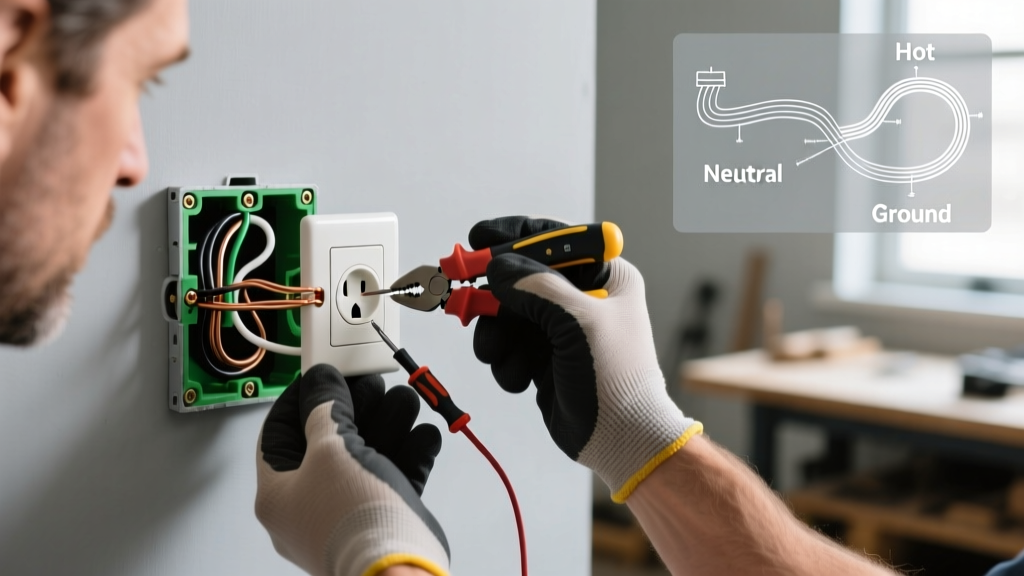
- Kill the Power & Verify: Turn off the breaker and use a non-contact voltage tester (e.g., Klein Tools NCVT-2) on both the hot and neutral wires to confirm zero energy.
- Mount the Box: Use a PVC or cast aluminum weatherproof box. If mounting to wood siding, ensure the box flange overlaps the siding properly. If mounting to masonry, use a masonry bit and Tapcon screws.
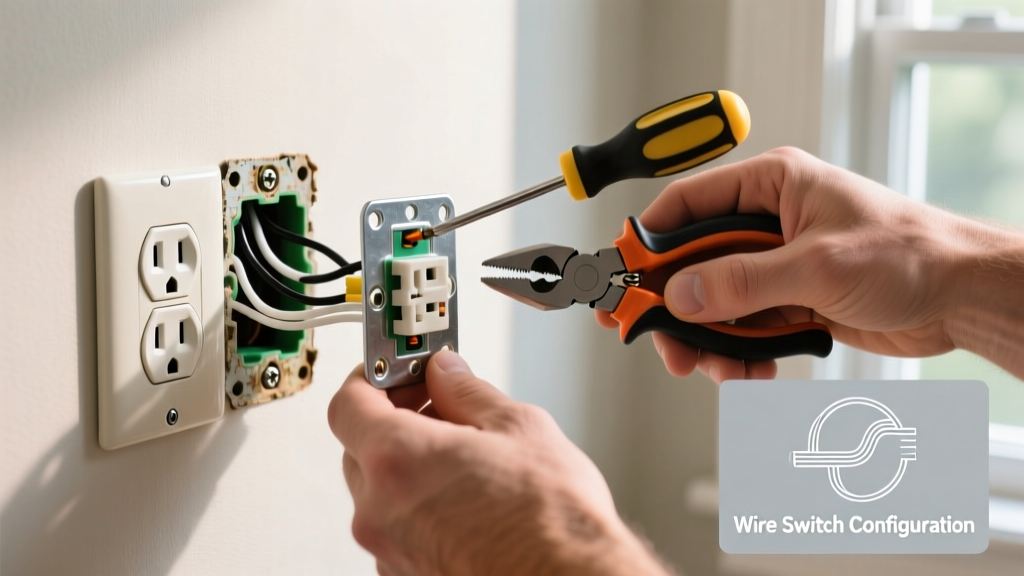
- Strip and Connect: Strip exactly 3/4 inch of insulation from your 14 AWG or 12 AWG solid copper wire. Never use the backstab push-in holes on outdoor receptacles; the thermal expansion and contraction outdoors will loosen them, causing arc faults. Wrap the wire clockwise around the side terminal screws.
- Torque to Spec: Use a torque screwdriver (like the Klein Tools 69000) to tighten terminal screws to the manufacturer's specification, typically 14 in-lbs. This prevents loose connections that lead to melting and fire.
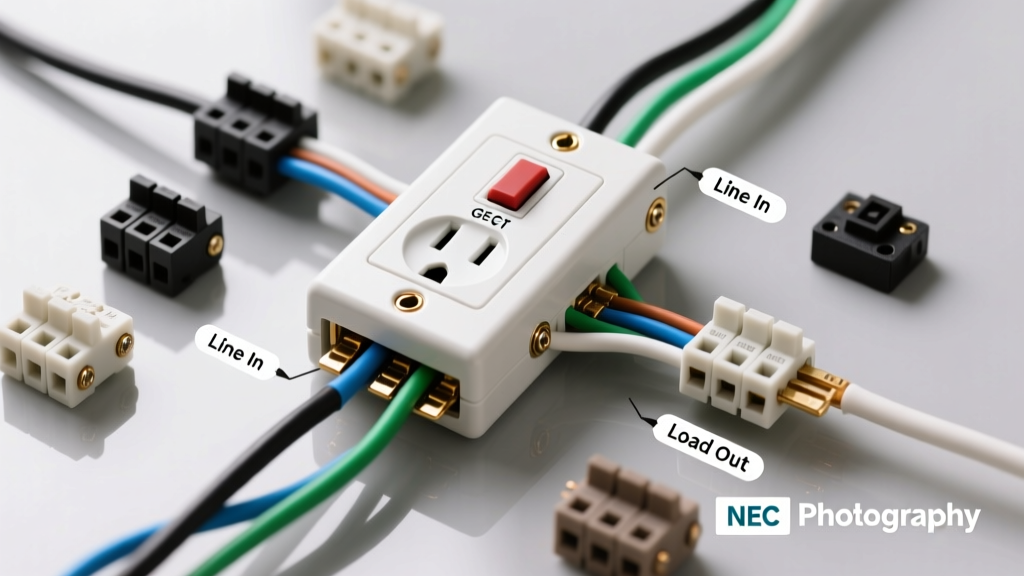
- Install the GFCI: If this is the first outdoor receptacle on the circuit, wire the power source to the 'LINE' terminals. If it is downstream from another GFCI, wire to the 'LOAD' terminals. Ensure the bare copper ground wire is pigtailed to both the metal box (if applicable) and the receptacle's green ground screw.
- Seal the Penetration: Apply a thick bead of GE Silicone 2 around the top and sides of the conduit hub where it meets the siding. Leave the bottom unsealed to allow any internal condensation to weep out (weep hole principle).
Common Failure Modes & Edge Cases
- Condensation Inside the Box: Even the best WIU covers can trap moisture if the ambient temperature swings rapidly. Always drill a 1/8-inch weep hole at the absolute lowest point of the PVC or metal box to allow trapped water to drain.
- GFCI Nuisance Tripping: Outdoor GFCIs are highly sensitive. If you plug in a cheap, unshielded LED landscape transformer with high harmonic distortion, it may trip the GFCI immediately. Use high-quality, UL-listed outdoor transformers to prevent this edge case.
- UV Degradation of PVC: Standard gray PVC conduit is not rated for direct, unpainted sunlight exposure over decades. If the conduit is exposed to the sun, you must use UV-rated PVC (often marked with 'Sun Res') or paint standard PVC with a water-based latex paint to prevent it from becoming brittle and shattering upon impact.
Frequently Asked Questions
Can I use a standard indoor GFCI receptacle if it is inside a weatherproof cover?
No. The NEC requires the receptacle itself to be marked 'WR' (Weather-Resistant). The internal components and face materials of a standard GFCI will corrode and fail the self-test mechanism when exposed to high humidity and temperature fluctuations, even inside a sealed cover.
Do I need AFCI protection for an outdoor outlet?
Generally, no. Arc Fault Circuit Interrupter (AFCI) protection is mandated for indoor living spaces (bedrooms, living rooms, kitchens). Outdoor receptacles require GFCI protection. However, if the outdoor receptacle is wired as a continuation of an indoor living room circuit, the breaker itself might need to be a dual-function (AFCI/GFCI) breaker to satisfy both code requirements.
What is the maximum height for an exterior receptacle?
The NEC does not specify a strict maximum height for general-purpose exterior receptacles, but they must be 'readily accessible' (NEC Article 100). Practically, this means mounting the box between 18 inches and 48 inches above grade. Mounting it higher than 6 feet requires a ladder to access, which violates the spirit of 'readily accessible' for plugging in temporary cords.
By adhering to these NEC guidelines and utilizing UV-stabilized, weather-resistant materials, your exterior electrical outlet will provide safe, reliable power for decades without posing a shock or fire hazard.