
Expanding a circuit to accommodate new appliances, home office setups, or entertainment centers is one of the most common residential electrical projects. However, knowing how to add an electrical outlet to an existing line requires more than just a basic screwdriver and a roll of black electrical tape. It demands a precise understanding of circuit load capacity, National Electrical Code (NEC) compliance, and the use of professional-grade tools. According to the National Fire Protection Association (NFPA), electrical failures or malfunctions are a leading cause of home fires, often stemming from improper DIY wiring and overloaded junction boxes.
In this comprehensive tool and material guide, we break down the exact equipment, wire gauges, and termination techniques required to safely daisy-chain a new receptacle from an existing outlet. Whether you are fishing wire through drywall or upgrading a 15-amp bedroom circuit, this guide provides the actionable specifics you need to execute the job safely and up to code.
The Essential Tool Arsenal
Using the correct tools prevents damaged wire insulation, loose terminations, and catastrophic arc faults. Below is the exact toolkit required for adding a receptacle to an existing branch circuit, complete with specific model recommendations and current market pricing.
| Tool Category | Recommended Model | Est. Cost | Why You Need It |
|---|---|---|---|
| Non-Contact Voltage Tester | Fluke 2AC II VoltAlert | $35.00 | Features a continuous self-test function and dual-range sensitivity to verify the existing line is completely de-energized before cutting. |
| Wire Strippers | Klein Tools 11055 (10-18 AWG) | $28.00 | Precision-machined holes prevent nicking the copper conductor, which can create a hot spot and lead to thermal failure under load. |
| Fish Tape | Gardner Bender 25ft Steel | $22.00 | Essential for routing new NM-B cable through enclosed wall cavities from the existing box to the new cutout. |
| Drywall Saw | Stanley 20-045 FatMax | $12.00 | Aggressive tooth geometry allows for clean, precise cutouts for old-work boxes without damaging hidden studs or existing wiring. |
| Lineman Pliers | Klein Tools 200048EINS | $32.00 | High-leverage joints for cleanly twisting 12 AWG solid copper conductors together before applying wire nuts. |
Material Selection: Wire, Boxes, and Receptacles
Selecting the right materials is dictated by the existing circuit's amperage and the physical constraints of your wall cavity. Never mix 14 AWG wire on a 20-amp circuit; this is a severe NEC violation and a major fire hazard.
1. NM-B Cable (Romex)
- For 15-Amp Circuits (Bedrooms, Living Rooms): Use Southwire Romex SIMpull 14/2 NM-B. The SIMpull jacket reduces friction by up to 50%, making it significantly easier to fish through existing walls. Cost: ~$0.45 per foot.
- For 20-Amp Circuits (Kitchens, Bathrooms, Garages): Use Southwire Romex SIMpull 12/2 NM-B. You must match or exceed the gauge of the existing line. Cost: ~$0.60 per foot.
2. Electrical Boxes
When retrofitting into finished drywall, you need an "Old Work" (remodel) box. The Carlon B114R Single Gang Old Work Box ($1.50) features integrated flip-clamps that secure tightly to 1/2-inch drywall without requiring a stud. Ensure the box has a minimum volume of 18 cubic inches if you are using 12 AWG wire to accommodate the splices.
3. Receptacles and Connectors
- Standard 15A Receptacle: Leviton 5362-W (Duplex, Side-Wired). Cost: $1.20.
- Standard 20A Receptacle: Leviton CR20-W (Commercial Grade). Cost: $3.50. Commercial grades feature heavier brass contacts that resist arcing and thermal creep over time.
- Wire Connectors: Ideal 341 Wire-Nut (Tan/Yellow) for joining three 12 AWG or 14 AWG wires. Avoid push-in connectors for splices; use twist-on wire nuts or Wago 221 series lever nuts for a verifiable, gas-tight connection.
Box Fill Calculations: The Math Most DIYers Skip
CRITICAL NEC WARNING: According to NEC Article 314.16, you cannot simply cram unlimited wires into an existing junction box. When you tap into an existing outlet to feed a new one, you are adding two new current-carrying conductors (the hot and neutral feeding the new box) plus a new equipment grounding conductor. For 12 AWG wire, each conductor counts as 2.25 cubic inches. If the existing box is already at maximum fill capacity, you must replace it with a deeper box or use a surface raceway system. Overcrowded boxes trap heat and cause insulation meltdown.
Step-by-Step: Adding the Outlet to the Existing Line
Follow this precise sequence to ensure a safe, code-compliant installation. The Occupational Safety and Health Administration (OSHA) emphasizes strict lockout/tagout procedures for all electrical work to prevent fatal shock hazards.
- Kill the Power and Verify: Turn off the circuit breaker. Use the Fluke 2AC II to test the existing outlet. Test a known live circuit first to verify the tester's battery is functioning, then test the target outlet on both the top and bottom receptacles.
- Cut the New Opening: Use a stud finder to ensure no studs, plumbing, or existing wiring are behind your target location. Trace the Carlon B114R box on the drywall and cut it out with the Stanley FatMax saw.
- Fish the Cable: Feed the Gardner Bender fish tape from the new cutout to the existing outlet box. Attach the new NM-B cable to the tape, wrap the connection in electrical tape to prevent snagging, and pull it back through the wall cavity.
- Strip and Prep the Wires: Use the Klein Tools 11055 to strip exactly 3/4 inch of insulation from the black and white wires. Do not nick the copper. Strip the bare ground wire to 3/4 inch as well.
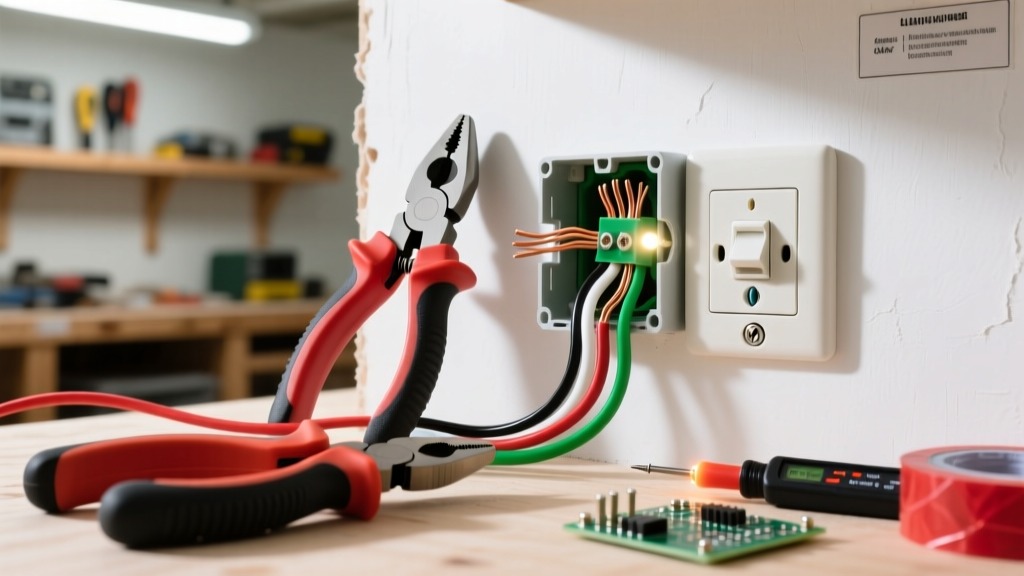
- Make the Splices (The Pigtail Method): Never use the receptacle's internal tabs to pass power to the next device (daisy-chaining through the device itself). Instead, use pigtails. Connect the existing hot, the new hot, and a 6-inch black pigtail together using a Wago 221 lever nut or Ideal Wire-Nut. Repeat for the neutral (white) and ground (bare/green) wires.
- Terminate at the Receptacle: Connect the black pigtail to the brass screw, the white pigtail to the silver screw, and the ground to the green screw. Use the screw terminals (side wiring) rather than the backstab push-in holes, which are notorious for loosening over time and causing high-resistance faults.
- Secure and Test: Push the wires neatly into the back of the box, screw the receptacle to the box, and attach the faceplate. Restore power and test with a receptacle tester to verify correct polarity and grounding.
Code Considerations: AFCI and GFCI Requirements
When learning how to add an electrical outlet to an existing line, you must account for modern protection standards. If you are extending a circuit in a bedroom, living room, or hallway, the entire branch circuit must be protected by an Arc-Fault Circuit Interrupter (AFCI) per NEC 210.12. If the existing breaker is not an AFCI breaker, you may be required to upgrade the panel breaker or install an AFCI receptacle at the first outlet in the circuit.
Similarly, if the new outlet is located within 6 feet of a water source (kitchens, bathrooms, garages, outdoors), NEC 210.8 mandates Ground-Fault Circuit Interrupter (GFCI) protection. In these scenarios, you must either tap into the "LOAD" terminals of an existing upstream GFCI receptacle or install a new GFCI receptacle at the new location. For a comprehensive overview of residential energy and electrical safety standards, refer to the U.S. Department of Energy's guide on home electrical systems.
Frequently Asked Questions
Can I add an outlet to a lighting circuit?
Technically, the NEC allows receptacles on lighting circuits in certain residential applications, but it is highly discouraged. Lighting circuits are typically 15-amp and easily overloaded if you plug in a vacuum or space heater. Always tap into an existing general-purpose receptacle circuit.
What if the existing wires are aluminum?
If you are working in a home built between 1965 and 1973, you may encounter aluminum branch wiring. You cannot directly connect copper pigtails to aluminum wires using standard wire nuts. You must use AlumiConn lugs or COPALUM crimps to transition from aluminum to copper safely. If you find aluminum wiring, consult a licensed electrician.
How many outlets can I put on a single 15-amp breaker?
The NEC does not specify a maximum number of receptacles on a residential 15-amp or 20-amp circuit. However, standard engineering practice limits it to 8 to 10 receptacles to prevent nuisance tripping and voltage drop. Always calculate the expected load of the devices you plan to plug in.