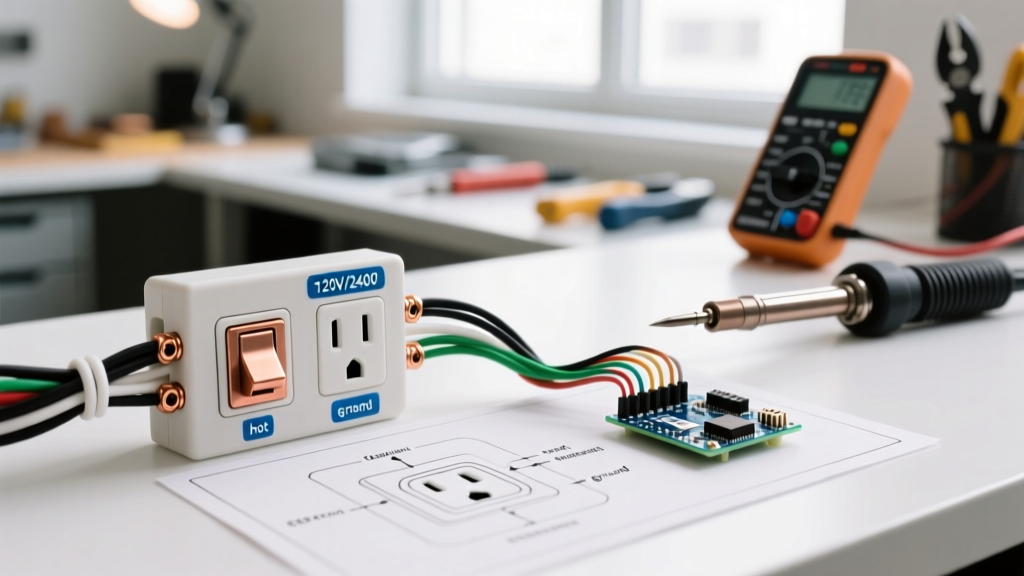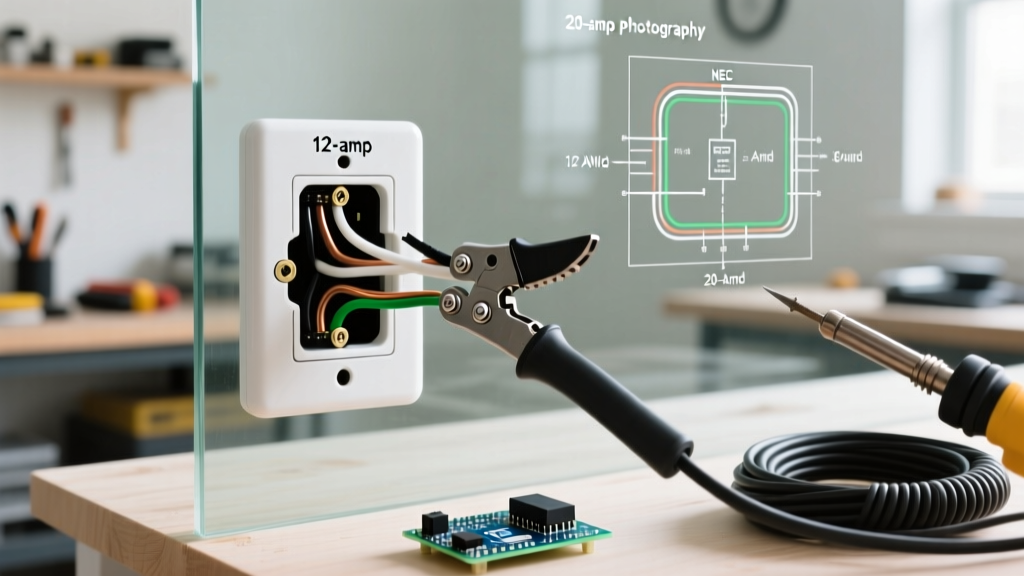

Understanding the 20 Amp Electrical Outlet and Code Compliance
When upgrading a home workshop, kitchen, or laundry room, standard 15-amp circuits often fall short of the power demands required by modern appliances. Installing a 20 amp electrical outlet is the standard solution for high-draw equipment like table saws, microwaves, and air compressors. However, simply swapping a receptacle without upgrading the circuit wiring and breaker is a severe fire hazard and a direct violation of the National Electrical Code (NEC).
According to the U.S. Consumer Product Safety Commission (CPSC), electrical receptacles and wiring are involved in thousands of residential fires annually, many stemming from overloaded circuits and improper gauge wiring. This comprehensive safety guide details the exact NEC requirements, material specifications, and torque standards necessary to install a 20A receptacle safely and legally in 2026.
NEC Code Requirements for 20 Amp Receptacles
The NEC (specifically the 2023 and upcoming 2026 adoption cycles) strictly regulates where and how 20-amp receptacles are deployed. Understanding the distinction between the branch circuit rating and the receptacle rating is critical for passing inspection and maintaining safety.
NEC 210.21(B)(1): Single Receptacle on an Individual Branch Circuit
If you are running a dedicated 20-amp circuit that terminates at a single receptacle (no daisy-chaining to other outlets), the receptacle must be rated for 20 amps. This means you must install a NEMA 5-20R receptacle, identifiable by its distinct T-shaped neutral slot. You cannot legally place a standard 15-amp receptacle on a dedicated 20-amp single-outlet circuit.
NEC 210.21(B)(3): Multiple Receptacles on a 20 Amp Circuit
If your 20-amp circuit supplies multiple receptacles (a multi-outlet branch circuit), the code permits the use of standard 15-amp (NEMA 5-15R) receptacles. This is why modern kitchens feature 20-amp breakers and 12 AWG wire, yet often utilize standard 15-amp duplex outlets. The 15-amp receptacles are internally rated to safely pass through 20 amps of current to downstream devices.
Inspector's Note: Per NEC 210.11(C)(1), all kitchens, dining rooms, and pantries require at least two 20-amp small-appliance branch circuits. These circuits must serve all wall and floor receptacles in these areas and cannot supply lighting or other rooms.
Visual Identification and Plug Compatibility
The physical design of electrical outlets is governed by the National Electrical Manufacturers Association (NEMA) to prevent users from plugging incompatible loads into under-rated circuits.
| Feature | 15 Amp (NEMA 5-15R) | 20 Amp (NEMA 5-20R) |
|---|---|---|
| Neutral Slot | Vertical (parallel to hot) | T-Shaped (horizontal and vertical) |
| Hot Slot | Vertical | Vertical |
| Accepts 15A Plugs? | Yes | Yes |
| Accepts 20A Plugs? | No (physically blocked) | Yes |
| Minimum Wire Gauge | 14 AWG Copper | 12 AWG Copper |
| Breaker Size | 15 Amp | 20 Amp |
2026 Material Specifications and Cost Breakdown
Upgrading to a 20 amp electrical outlet requires heavy-duty materials. Using 14 AWG wire on a 20-amp breaker violates NEC 240.4(D) and will cause the wire insulation to melt before the breaker trips. Below is the required material list and average retail pricing for 2026.
| Component | Specification / Model Example | Estimated Cost (2026) |
|---|---|---|
| Wire | 12/2 NM-B (Romex SIMpull) with ground | $0.65 - $0.85 / linear ft |
| Breaker | 20A Single-Pole (e.g., Square D HOM120CP) | $6.50 - $9.00 |
| Receptacle | 20A Duplex, TR (e.g., Leviton 5362-W) | $3.50 - $5.50 |
| AFCI/GFCI Breaker | 20A Dual Function (if required by local code) | $45.00 - $65.00 |
| Wall Plate | Nylon or Polycarbonate, single-gang | $1.00 - $2.50 |
Tamper-Resistant (TR) Mandate
Under NEC 406.12, all 15-amp and 20-amp receptacles installed in dwelling units must be Tamper-Resistant (TR). TR receptacles feature internal shutter mechanisms that prevent children from inserting foreign objects into the slots. When purchasing your 20A outlet, ensure the packaging explicitly states 'TR'.
Step-by-Step Wiring and Torque Requirements
Proper installation goes beyond simply wrapping wire around a screw. The NEC has heavily emphasized termination torque to prevent loose connections, which are a leading cause of arc faults and electrical fires.
- De-energize and Verify: Turn off the 20-amp breaker at the main panel. Use a non-contact voltage tester (NCVT) and a multimeter to confirm zero voltage at the outlet box.
- Strip the Wires: Use wire strippers to remove exactly 3/4 inch of insulation from the 12 AWG black (hot), white (neutral), and bare (ground) wires. Do not nick the copper conductor, as this creates a weak point that can snap under the screw head.
- Form the Hook: Bend the stripped ends into a tight 'J' hook using needle-nose pliers. The hook should wrap clockwise around the terminal screw so that tightening the screw pulls the hook closed rather than pushing it out.
- Apply Calibrated Torque: NEC 110.14(D) requires terminations to be torqued to the manufacturer's specifications. For a standard Leviton 5362 20A receptacle, the required torque is 14 in-lbs (1.6 N-m). Use a calibrated VDE torque screwdriver to achieve this exact spec.
- Secure the Ground: Attach the bare copper ground wire to the green grounding screw. If using a metal outlet box, a grounding pigtail must also connect the box to the ground wire.
Common Code Violations and Failure Modes
During home inspections, electrical contractors frequently encounter dangerous shortcuts taken by amateur DIYers. Avoid these critical failure modes:
1. Backstabbing (Push-In Terminations)
Many budget receptacles feature push-in holes on the back. While UL-listed for 15A circuits with 14 AWG wire, using push-in terminals for 12 AWG wire on a 20 amp electrical outlet is highly discouraged and often rejected by inspectors. The internal spring clips can weaken over time due to thermal expansion and contraction, leading to high-resistance connections, arcing, and melted plastic housings. Always use the side screw terminals.
2. Missing AFCI and GFCI Protection
The NEC continues to expand Arc-Fault Circuit Interrupter (AFCI) and Ground-Fault Circuit Interrupter (GFCI) requirements. As of the latest code cycles, 20-amp circuits supplying kitchens, laundry rooms, and garages require GFCI protection. Furthermore, living areas, bedrooms, and kitchens require combination-type AFCI protection. If your panel is full, utilize a Dual-Function (DF) breaker that provides both AFCI and GFCI protection in a single slot.
3. Overloaded Neutral on Multi-Wire Branch Circuits (MWBC)
If your 20-amp circuit is part of a shared-neutral MWBC (two hot wires sharing one neutral), the two breakers must be tied together with a handle tie or installed as a single double-pole breaker (NEC 210.4). Failing to do this means an electrician could turn off one breaker while the other remains live, sending 20 amps of return current back through the disconnected neutral wire, creating a lethal shock hazard.
Final Safety Verification
After completing the wiring and torquing the terminals, carefully fold the 12 AWG wires into the back of the junction box. Because 12-gauge wire is significantly stiffer than 14-gauge, use the 'accordion fold' method to prevent the wires from pushing the receptacle out of alignment. Secure the receptacle to the box using the provided #6-32 machine screws, ensuring the strap sits flush against the drywall or plaster ring.
For further reading on residential electrical safety standards and fire prevention, consult the National Fire Protection Association (NFPA) NEC handbook. Always pull a local permit before upgrading branch circuits, as a licensed electrical inspector will verify your wire gauge, torque terminations, and AFCI/GFCI compliance to ensure your home remains safe and insurable.