
The Hidden Dangers of Improper Underground Electrical Wiring
Burying electrical cables is a fundamental part of modern property development, powering everything from detached garages and backyard workshops to landscape lighting and well pumps. However, underground electrical wiring presents unique hazards that above-ground runs do not. Soil acidity, moisture ingress, frost heave, and the ever-present risk of accidental excavation strikes can turn a poorly planned trench into a lethal electrocution hazard or a catastrophic fire risk.
According to the Occupational Safety and Health Administration (OSHA), struck-by incidents involving underground utilities remain a leading cause of severe injury in both residential and commercial excavation projects. Adhering strictly to the National Electrical Code (NEC) Article 300.5 is not just a legal requirement; it is the baseline for keeping your family, future homeowners, and utility workers safe.
CRITICAL SAFETY MANDATE: Call Before You DigBefore breaking ground on any trench, you must contact your local utility notification center. In the United States, dialing 811 is a federally recognized mandate. Utility companies will mark existing public lines for free. Hitting an unmarked municipal high-voltage line can result in fatal arc flashes and tens of thousands of dollars in municipal repair fines.
NEC Trench Depth Requirements: The Compliance Matrix
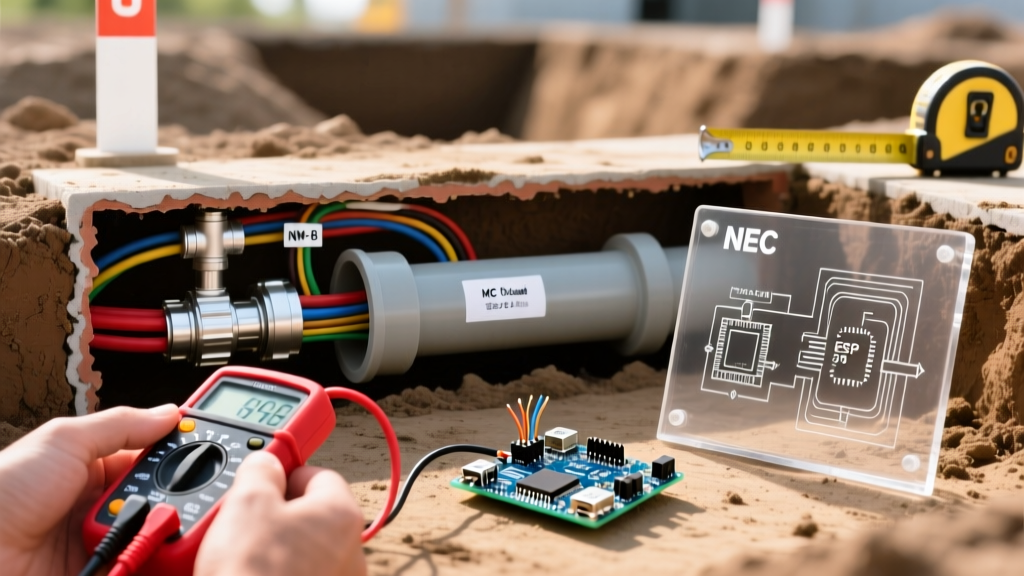
The most common code violation in underground electrical wiring is failing to bury cables at the minimum required depth. The NEC dictates burial depths based on the wiring method, voltage, and overcurrent protection. Shallow trenches expose cables to lawnmower blades, landscaping aerators, and frost heave.
| Wiring Method & Conditions | Minimum Burial Depth | Primary Application |
|---|---|---|
| Direct Burial Cable (Type UF-B) | 24 Inches | Standard residential feeder circuits, landscape power. |
| PVC Conduit (Schedule 40 or 80) | 18 Inches | Main panel sub-feeds, high-amperage EV charger runs. |
| Rigid Metal Conduit (RMC) or IMC | 6 Inches | Commercial sites, areas subject to severe physical damage. |
| 120V-125V, GFCI Protected, Max 30A (Direct Burial) | 12 Inches | Pool pumps, spa equipment, low-draw outbuildings. |
Note: Burial depth is measured from the top of the cable or conduit to the finished grade surface. If you are pouring a concrete slab over the trench, the depth requirements change (typically reducing to 4 inches for PVC under a minimum 2-inch thick concrete pad).
Material Selection: Direct Burial Cable vs. Conduit Systems
Choosing the right material dictates the longevity of your installation. While direct burial cable is faster to install, conduit offers superior long-term safety and upgradability.
Type UF-B (Underground Feeder) Cable
UF-B cable features solid copper conductors encased in a rugged, moisture-resistant polyvinyl chloride (PVC) jacket. A typical 12/2 UF-B cable with ground costs approximately $1.20 to $1.50 per linear foot in 2026.
- Pros: No conduit gluing required; flexible enough to bend around minor obstacles; faster installation for short runs.
- Cons: Highly susceptible to damage from sharp rocks in the backfill; impossible to upgrade wire gauge later without digging a new trench; vulnerable to burrowing rodents in certain soil types.
- Safety Rule: UF-B must be protected by rigid conduit from the bottom of the trench up to at least 8 feet above finished grade where it terminates at the structure.
THWN-2 Conductors inside PVC Conduit
Pulling individual THWN-2 (Thermoplastic Heat and Water-resistant Nylon-coated) wires through Schedule 40 PVC conduit is the gold standard for sub-panel feeds. A 1.5-inch Schedule 40 PVC pipe costs roughly $0.40 per foot, making it highly economical.
- Pros: Complete physical protection from rocks, roots, and shovels; allows for future circuit upgrades by simply pulling new wires; superior heat dissipation compared to bundled UF-B.
- Cons: Requires precise glue joints to prevent water ingress; requires conduit bodies and sweep bends for directional changes.
- Safety Rule: Use long-radius sweep bends (minimum 24-inch radius) rather than sharp 90-degree elbows. Sharp bends cause excessive friction, which can strip the insulation off THWN-2 wires during the pulling process, creating a latent short-circuit hazard.
Step-by-Step Trenching and Backfill Safety Protocol
Proper backfilling is just as critical as the wiring itself. A poorly backfilled trench will settle over time, creating trip hazards and potentially snapping rigid conduit connections.
- Excavation and Bedding: Dig the trench to the required depth plus an additional 4 inches. Line the bottom with 2 inches of sifted sand or stone-free soil. This prevents sharp rocks from puncturing UF-B jackets or stressing PVC joints.
- Laying the Run: Lay the cable or conduit flat. Do not kink UF-B cable; the NEC mandates a bending radius of at least four times the cable diameter.
- Initial Cover and Warning Tape: Cover the wire or conduit with 4 inches of sifted sand. Immediately above this sand layer, lay a continuous strip of red, 6-inch wide detectable warning tape (e.g., Brady ToughStripe). This tape acts as a visual and physical warning for anyone digging in the future with hand tools.
- Final Backfill and Compaction: Fill the remainder of the trench with native soil in 6-inch lifts (layers). Tamp each layer with a manual hand tamper or mechanical plate compactor to prevent future water pooling and soil subsidence.
Transitioning from Underground to Above-Ground
The transition point where underground wiring emerges from the soil is a major vulnerability. Schedule 40 PVC becomes brittle under UV exposure and is easily shattered by weed whackers or lawnmowers.
The Code-Compliant Solution: Transition to Schedule 80 PVC or Rigid Galvanized Steel at least 18 inches below grade, continuing up to 8 feet above grade. Schedule 80 PVC has a thicker wall (0.200 inches for 1-inch pipe vs. 0.133 inches for Schedule 40) and is rated for areas 'subject to physical damage.' Secure the above-ground conduit with UV-rated metallic or heavy-duty nylon straps every 3 feet to prevent wind-load fatigue.
Critical Failure Modes and Edge Cases
Even seasoned electricians encounter edge cases that compromise underground electrical wiring. Understanding these failure modes is key to preventative design.
1. Water Ingress and Nuisance GFCI Tripping
PVC conduit systems are not watertight. Condensation will form inside the pipe, and groundwater will eventually seep through poorly primed joints. If water reaches the junction box or breaker panel, it will cause immediate GFCI nuisance tripping or catastrophic bus-bar corrosion.
Expert Fix: Use Oatey Medium-Bodied Clear PVC Cement on all underground joints, ensuring a full 30-second cure time before moving the pipe. At the lowest point of the conduit run, install a weep hole or a threaded conduit body with a brass drain plug to allow trapped condensation to escape safely into the gravel base.
2. Frost Heave Conduit Shearing
In northern climates, the freeze-thaw cycle causes the soil to expand and contract violently. If a rigid conduit is tightly clamped to a building foundation and buried in frost-susceptible clay, the upward force of frost heave can shear the conduit or rip the fitting right out of the junction box.
Expert Fix: Install a PVC expansion coupling (such as the Hubbell/O-Z/Gedney EJC series) just above grade. This device allows the conduit to slide up to 6 inches vertically without transferring stress to the anchored building termination.
3. Wire Pulling Insulation Damage
Pulling 4/0 aluminum or 2 AWG copper through 100 feet of underground conduit generates massive friction. Dry pulling will tear the nylon coating off THWN-2 wire, exposing the bare copper to the wet conduit environment.
Expert Fix: Always use a high-quality, non-petroleum-based pulling compound like Ideal 31-001 Yellow 77. Petroleum jelly degrades PVC and wire insulation over time. Apply the lubricant generously to the wires just as they enter the conduit mouth, not by pouring it down the pipe.
Final Thoughts on Overcurrent and Grounding
For comprehensive safety guidance and updates on electrical standards, always consult the National Fire Protection Association (NFPA) and your local Authority Having Jurisdiction (AHJ). Remember that all outdoor receptacles fed by underground wiring must be protected by Class A GFCI breakers or receptacles per NEC 210.8(F). Furthermore, any detached structure fed by an underground sub-panel requires its own dedicated grounding electrode system (typically two 8-foot copper-clad ground rods spaced 6 feet apart) bonded to the sub-panel's isolated ground bar. Never bond the neutral and ground bars in a sub-panel; doing so creates a parallel neutral path through the earth, presenting a severe shock hazard to anyone touching the grounding system during a fault.