
Navigating Commercial Electrical Infrastructure
Designing and installing electrical systems for commercial facilities requires a fundamentally different approach than residential wiring. While residential projects typically rely on non-metallic (NM) sheathed cable and single-phase 120/240V power, commercial environments demand robust, scalable, and fire-resistant infrastructure. When evaluating the various types of wiring electrical engineers specify for commercial facilities, the focus shifts to three-phase power, metal conduit raceways, and advanced insulation chemistries.
In 2026, with copper prices stabilizing around $3.80 to $4.20 per pound and commercial electrical labor rates averaging $95 to $145 per hour depending on the metropolitan market, optimizing your wiring strategy is critical for both budget and code compliance. This guide breaks down the core components of commercial wiring, providing master electricians and facility managers with the technical depth needed to make informed specification decisions.
Key Takeaway: The 40% Fill Rule
Regardless of the specific types of wiring electrical conductors you choose, NEC Chapter 9, Table 1 strictly limits conduit fill to 40% when pulling three or more current-carrying conductors. Exceeding this causes heat buildup and increases pulling tension, risking insulation damage.
Conductor Insulation: THHN/THWN-2 vs. XHHW-2
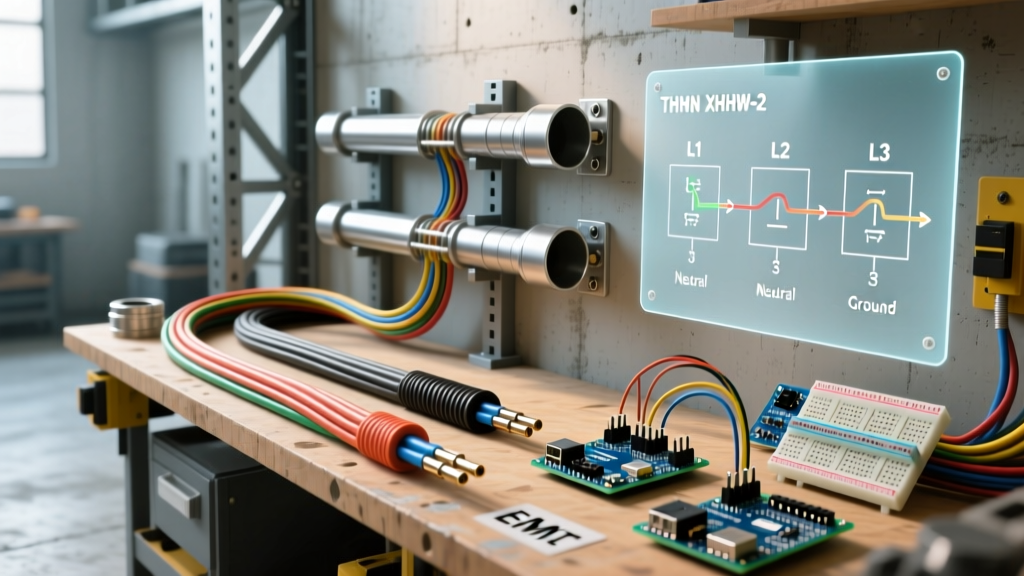
The backbone of any commercial wiring system is the conductor insulation. While residential wiring uses PVC-jacketed Romex, commercial wiring relies on individual conductors pulled through raceways. The two dominant insulation types are THHN/THWN-2 and XHHW-2.
THHN/THWN-2: The Industry Standard
Thermoplastic High Heat-resistant Nylon-coated (THHN) wire is the most common commercial conductor. The dual-rated THWN-2 designation means it is approved for both wet and dry locations at a 90°C temperature rating. The nylon outer jacket provides excellent resistance to oil, gasoline, and mechanical abrasion during the pulling process.
- Best For: General commercial branch circuits, dry indoor raceways, and standard office fit-outs.
- Drawback: The PVC insulation is thicker than cross-linked alternatives, meaning you can fit fewer conductors in a given conduit size.
XHHW-2: The Premium Alternative
Cross-Linked Polyethylene (XLPE) High Heat Water-resistant (XHHW-2) wire is rapidly gaining market share in large-scale commercial projects. Because XLPE is a thermoset material, it offers superior thermal stability and a thinner insulation wall compared to THHN.
- Conduit Space Savings: The thinner jacket of XHHW-2 allows for up to 15% more conductors in the same conduit diameter, potentially allowing engineers to downsize conduit from 1-inch to 3/4-inch, saving significant material costs.
- Bend Radius: XHHW-2 is more flexible and has a smaller bending radius, making it significantly easier to pull through complex conduit runs with multiple 90-degree sweeps.
- Cost Premium: Expect to pay an 8% to 12% premium per linear foot for XHHW-2 compared to standard THHN, though this is often offset by labor savings during pulling and conduit downsizing.
Commercial Conduit and Raceway Systems
Understanding the types of wiring electrical raceways is just as important as the conductors they protect. The National Electrical Code (NEC) outlines specific applications for various metallic and non-metallic raceways. Below is a comparison matrix of the most common commercial conduit systems.
| Conduit Type | NEC Article | Material & Wall Thickness | Avg. Cost per 10ft (3/4") | Primary Commercial Application |
|---|---|---|---|---|
| EMT (Electrical Metallic Tubing) | Article 358 | Thin-wall galvanized steel | $18.00 - $24.00 | Interior exposed ceilings, standard office walls, dry locations. |
| IMC (Intermediate Metal Conduit) | Article 345 | Medium-wall galvanized steel | $35.00 - $45.00 | Exterior building facades, parking garages, mild physical exposure. |
| RMC (Rigid Metal Conduit) | Article 344 | Thick-wall threaded steel | $65.00 - $85.00 | Heavy industrial, hazardous locations, buried concrete encasement. |
| PVC Sch. 80 | Article 352 | Thick-wall rigid nonmetallic | $22.00 - $30.00 | Chemical plants, underground service laterals, corrosive environments. |
Installation Realities: EMT vs. RMC
While EMT (Thin-wall) dominates 80% of interior commercial work due to its lightweight nature and ease of bending with a standard hand bender or mechanical bender (like the Greenlee 881), RMC requires threading. Threading a 2-inch RMC pipe takes an experienced journeyman approximately 8 to 12 minutes per end using a powered threader. This labor intensity makes RMC cost-prohibitive for standard commercial builds unless specifically mandated by the engineer for physical protection or hazardous (Class I, Div 1) locations.
Three-Phase Power Configurations: 208V vs. 480V
Commercial buildings require high-density power delivery to run HVAC chillers, elevators, and heavy machinery. This necessitates three-phase power. The two primary configurations you will encounter are 120/208V Wye and 277/480V Wye.
The 277/480V Advantage for Large Facilities
For facilities exceeding 20,000 square feet, specifying a 277/480V service is the industry standard. By doubling the voltage from 240V to 480V, the current (Amperage) required to deliver the same wattage is cut in half. According to Ohm's Law and the power equation (P = √3 × V × I × PF), lower current allows for significantly smaller wire gauges and smaller, less expensive circuit breakers.
Expert Insight on 277V Lighting: In a 277/480V system, the phase-to-neutral voltage is 277V. Commercial LED high-bay fixtures and troffers are natively designed for 277V. This eliminates the need for step-down transformers for lighting circuits, reducing energy loss by 2-3% and freeing up valuable electrical room square footage.
However, 480V systems require step-down transformers (480V Delta to 120/208V Wye) to supply standard 120V receptacles for office equipment. When sizing these transformers, always account for a 25% continuous load derating factor as per NEC Article 215.2.
NEC Compliance and Voltage Drop Mitigation
When routing the various types of wiring electrical systems across large commercial footprints, voltage drop becomes a critical engineering constraint. While the NEC primarily treats voltage drop as an Informational Note (NEC 310.15(B)), most commercial specifications and local authorities having jurisdiction (AHJs) strictly enforce a maximum 3% drop on branch circuits and a 5% total drop on feeders and branch circuits combined.
Actionable Voltage Drop Framework
To maintain compliance and ensure equipment longevity, follow this mitigation protocol during the design and rough-in phases:
- Calculate Early: Use the formula VD = (2 × K × I × D) / CM for single-phase, and VD = (√3 × K × I × D) / CM for three-phase. (Where K=12.9 for copper, I=Current, D=Distance, CM=Circular Mils).
- Upsize Long Runs: For any 120V branch circuit exceeding 80 feet from the panelboard, upsize the conductor from 12 AWG to 10 AWG. The material cost increase is roughly $0.15 per foot, but it prevents the flickering of sensitive medical or IT equipment at the end of the run.
- Relocate Panelboards: In large warehouse footprints, do not rely on a single centralized panel. Install multiple 42-circuit or 54-circuit panelboards strategically placed to keep the longest branch circuit run under 150 feet.
For advanced voltage drop calculations and conductor sizing verification, professionals frequently utilize digital tools provided by organizations like the Southwire Calculator Suite to ensure exact circular mil requirements are met before ordering bulk wire.
Safety Standards and Grounding Electrodes
Commercial grounding systems are vastly more complex than residential ground rods. A commercial building's grounding electrode system (NEC Article 250) typically must bond to the structural steel framework, the concrete-encased electrode (Ufer ground), and the metal underground water pipe. Failing to properly bond the structural steel within the first 20 feet of its earth contact is one of the most common commercial inspection failures.
For comprehensive safety protocols regarding commercial installations, lock-out/tag-out (LOTO) procedures, and arc flash boundary calculations, contractors must adhere strictly to guidelines published by OSHA's Electrical Safety Standards and the NFPA 70 National Electrical Code.
Summary: Specifying for the Future
Selecting the correct commercial wiring infrastructure is a balance of upfront material costs, long-term labor efficiency, and strict code adherence. By leveraging XHHW-2 conductors for conduit fill optimization, utilizing EMT for interior dry runs, and designing around 277/480V three-phase power, electrical professionals can deliver high-performance systems that meet the rigorous demands of modern commercial real estate in 2026 and beyond.