
Predator 420 Electric Start Wiring: Safety Best Practices
The Harbor Freight Predator 420cc (14 HP) engine is a workhorse for log splitters, commercial pressure washers, and custom off-road vehicles. While the pull-start mechanism is reliable, upgrading to or maintaining the 12V electric start system introduces significant electrical variables. Improper predator 420 electric start wiring is a leading cause of DC electrical fires, battery thermal runaway, and runaway engine scenarios. This guide moves beyond basic assembly instructions, focusing strictly on the safety best practices, vibration-proofing, and fail-safe protocols required for high-vibration small engine environments.
Critical Safety Warning: A 12V Sealed Lead Acid (SLA) battery can deliver over 300 amps in a dead short. Unlike household AC circuits, DC arcs do not self-extinguish easily. Always disconnect the negative battery terminal before modifying any wiring harness on the Predator 420.
Anatomy of the 12V Start Circuit
The electric start system on the Predator 420 relies on four primary nodes: the 12V battery (typically a 9Ah or 14Ah SLA), the starter solenoid, the starter motor with Bendix drive, and the ignition/kill switch. The most common safety failure occurs when builders treat DC low-voltage wiring with the same casual approach used for 120V AC household wiring. DC systems require meticulous attention to voltage drop, vibration resistance, and thermal management.
Wire Gauge and Fusing Matrix
Using undersized wire for the starter circuit results in severe voltage drop, causing the starter motor to overheat and draw excessive amperage. Conversely, over-fusing a circuit guarantees that the wire will melt before the fuse blows during a short circuit. Below is the safety-critical matrix for wiring the Predator 420.
| Circuit Segment | Recommended Wire Gauge | Insulation Type | Maximum Fuse Rating | Safety Rationale |
|---|---|---|---|---|
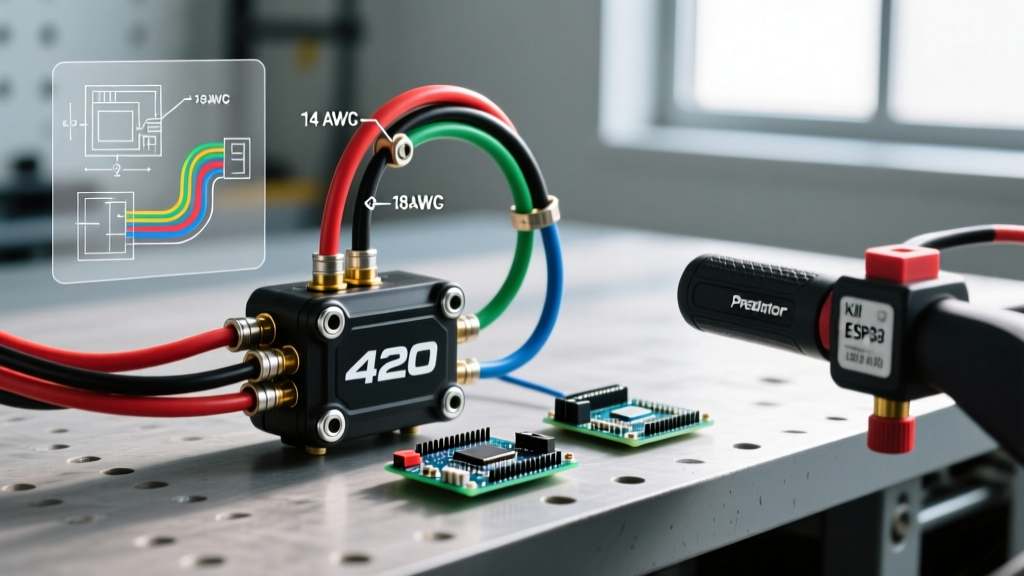
| Battery (+) to Solenoid | 6 AWG OFC | XLPE / Cross-linked | 150A ANL (at battery) | Handles 120A inrush without voltage drop; ANL prevents main harness fires. |
| Solenoid to Starter Motor | 6 AWG OFC | XLPE / Cross-linked | Unfused (Protected by ANL) | Short, heavy-gauge run minimizes resistance at the starter bendix. |
| Ignition / Key Switch | 14 AWG Stranded | PVC / Marine Grade | 15A Inline ATC | Low draw circuit; 15A protects against chafing shorts to the chassis. |
| Magneto Kill Wire | 16 AWG Stranded | Silicone / High-Temp | Unfused (Ground Circuit) | Must survive extreme head temperatures without melting into the exhaust. |
Vibration and Thermal Management Protocols
The Predator 420cc is a single-cylinder engine with significant harmonic vibration. Standard electrical tape and soldered joints are severe safety liabilities in this environment.
Why Soldering is a Safety Hazard Here
While soldering is standard in household electronics, it is strongly discouraged for engine-bay wiring. Solder wicks into stranded wire, creating a rigid, brittle point exactly where the wire enters the terminal. Under the constant vibration of a 420cc engine, this rigid point acts as a stress riser and will eventually snap, potentially dropping a live 12V starter cable onto the steel chassis or fuel lines.
The Safe Alternative: Use ratcheting hex-crimp tools with oxygen-free copper (OFC) terminals, sealed with 3:1 marine-grade adhesive-lined heat shrink. The adhesive melts and seals out moisture, while the mechanical crimp maintains flexibility and tensile strength. For comprehensive wire standards, refer to the National Electrical Code (NEC) principles regarding vibration-prone installations and flexible cord usage.
Exhaust Header Proximity
The cast-iron exhaust header on the Predator 420 routinely exceeds 800°F under continuous load. Standard PVC wire insulation begins to melt and off-gas toxic fumes at roughly 220°F. If the main 6 AWG starter cable rubs against the header, it will short to the engine block, bypassing the solenoid and potentially welding the starter motor into the engaged position. Always route main DC cables along the opposite side of the engine block, or use fiberglass fire sleeves rated to 1200°F if crossing near the exhaust is unavoidable.
The Magneto Kill-Switch: Preventing Runaway Engines
The most dangerous failure mode in small engine wiring is the inability to shut off the engine. The Predator 420 utilizes a flywheel magneto ignition system. The key switch does not "turn on" the ignition; rather, it removes a ground connection to allow the engine to run. When you turn the key to the OFF position, the switch grounds the primary winding of the ignition coil, killing the spark.
Testing the Kill Circuit Safely
- Visual Inspection: Trace the single kill wire from the ignition coil (located under the flywheel shroud) to the key switch. Ensure it is not pinched by the shroud screws.
- Multimeter Continuity Test: With the engine OFF and the spark plug removed, set your multimeter to continuity. Place one probe on the engine block (bare metal) and the other on the kill wire terminal at the switch.
- Expected Result: In the OFF position, you must have continuity (a closed circuit to ground). In the ON/RUN position, the circuit must be open (OL). If the OFF position shows an open circuit, the engine will not stop when the key is turned.
Battery Safety and Off-Gassing
Most Predator 420 electric start kits include a Sealed Lead Acid (SLA) battery. While labeled "sealed," these batteries feature pressure relief valves that vent hydrogen gas during heavy charging or deep discharge. Hydrogen is highly explosive. According to OSHA guidelines on battery safety, batteries must be charged and housed in well-ventilated areas away from ignition sources. Never mount the SLA battery directly above the engine's air intake or carburetor, where a venting event could draw explosive gas directly into the combustion chamber.
Troubleshooting Matrix: Electrical Failures
When the electric start system fails, haphazard troubleshooting can lead to bypassed safety features. Use this matrix to diagnose issues without compromising the harness.
| Symptom | Probable Cause | Safe Diagnostic & Repair Protocol |
|---|---|---|
| Starter clicks once, but engine does not crank. | Voltage drop across solenoid contacts or undersized battery cables. | Measure voltage drop across solenoid posts while cranking. If >0.5V, replace solenoid. Do not jump the posts with a screwdriver. |
| Starter spins, but engine flywheel does not engage. | Weak battery (low RPM prevents Bendix gear from throwing out) or dry Bendix shaft. | Load-test the 12V battery. Clean the starter Bendix shaft with brake cleaner; do not use WD-40 or heavy grease which attracts grit. |
| Engine runs, but will not shut off via key switch. | Severed kill wire or corroded chassis ground at the key switch. | Immediately cover the air intake to stall the engine. Repair the ground path using a star washer on bare metal. |
| Battery drains completely between uses. | Parasitic draw from improperly wired voltage regulator or missing master disconnect. | Install a marine-grade battery disconnect switch on the negative terminal to isolate the SLA battery during storage. |
Environmental and Operational Considerations
When wiring the Predator 420 for portable applications like generators or water pumps, the physical placement of the engine dictates electrical safety. The Consumer Product Safety Commission (CPSC) strictly warns against operating internal combustion engines in enclosed or semi-enclosed spaces due to carbon monoxide hazards. When routing remote-start wiring or extending the kill-switch harness to an exterior control panel, ensure the wiring does not require the engine to be placed near doors, windows, or HVAC intakes. Use UV-resistant conduit for any wiring that exits the engine shroud and is exposed to direct sunlight, as standard loom will degrade and expose live conductors within a single season of outdoor use.
Final Pre-Flight Checklist
- Verify 150A ANL fuse is installed within 6 inches of the battery positive terminal.
- Confirm all ring terminals are crimped with a ratcheting tool and sealed with adhesive heat shrink.
- Test magneto kill-switch continuity to the engine block in the OFF position.
- Ensure all wiring is secured with nylon zip-ties and routed at least 4 inches away from the exhaust header.
- Check that the battery hold-down strap prevents terminal contact with the metal chassis during heavy vibration.
By adhering to these rigorous standards for your predator 420 electric start wiring, you transform a potential fire hazard into a reliable, safe, and professional-grade starting system capable of withstanding the harshest job site conditions.