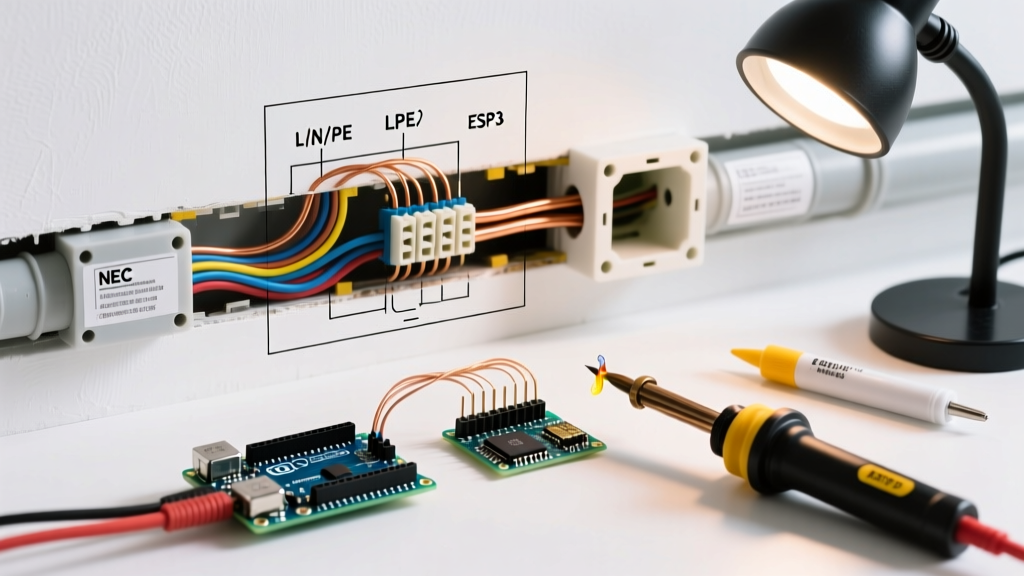

Why Apply Commercial Rigor to Residential Spaces?
When most contractors approach home renovation electrical wiring, they default to the bare minimum required by residential building codes: stapling NM-B (Romex) cable to studs, installing builder-grade receptacles, and sizing panels for basic appliance loads. However, the modern residential landscape has fundamentally shifted. As we navigate the electrical demands of 2026, homes are increasingly serving as micro-commercial facilities. Dual Level-2 EV chargers, CNC router woodshops, high-density server racks, and whole-home battery backups demand a paradigm shift.
Applying commercial wiring methodologies to a residential renovation isn't about over-engineering; it is about thermal management, voltage drop mitigation, and future-proofing. By borrowing techniques from commercial and industrial electrical guides, homeowners and master electricians can build systems that outlast the structures they inhabit.
Advanced Load Calculation: Beyond the Basic NEC 220
Standard residential load calculations often rely on NEC Article 220's 'Standard Method,' which applies generic watts-per-square-foot metrics. For a high-performance home renovation, commercial electricians utilize the Optional Calculation Method (NEC 220.82) combined with continuous load derating.
The 125% Continuous Load Rule
In commercial wiring, any load expected to run for three hours or more is classified as continuous and must be derated to 80% of the breaker's capacity. While residential codes are sometimes lax on enforcing this for home EV chargers or mini-split HVAC systems, applying the commercial 125% rule prevents thermal degradation at the breaker bus.
- EV Charger (48A continuous): Requires a 60A breaker and 4 AWG copper (or 3 AWG aluminum), not a 50A breaker.
- Server/Networking Rack (16A continuous): Requires a dedicated 20A circuit, not a shared 15A lighting circuit.
For heavy renovations, upgrading to a 400-Ampere service using twin 200A panels (such as the Square D QOM2200VH main breaker with dual subpanels) provides the necessary bus-bar surface area to handle harmonic distortion from modern variable-frequency drives (VFDs) and solar inverters.
Raceway Systems: EMT and THHN vs. NM-B Cable
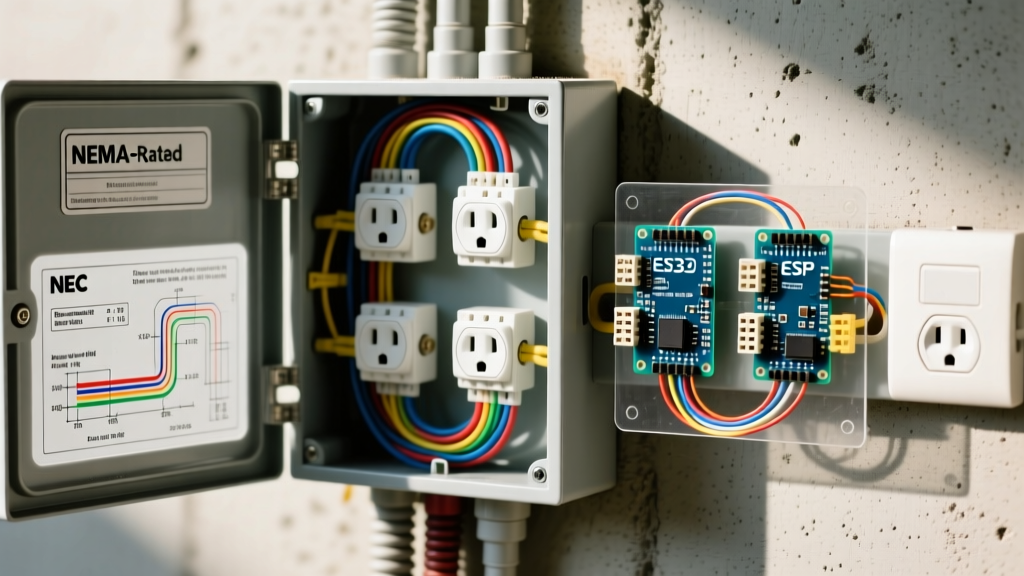
While NM-B cable is permissible in most residential dry-wall applications, commercial-grade renovations utilize Electrical Metallic Tubing (EMT) for all exposed runs in basements, garages, and utility rooms. EMT provides a superior physical barrier and acts as an equipment grounding conductor (EGC) when fitted with compression or set-screw fittings, per Copper Development Association guidelines on grounding pathways.
Pulling THHN/THWN-2 in Residential Conduit
Instead of pushing stiff Romex, pulling individual THHN/THWN-2 stranded conductors through 3/4-inch EMT offers massive advantages:
- Thermal Dissipation: Stranded wire in steel conduit dissipates heat far better than bundled NM-B inside insulated walls.
- Future Upgrades: If you need to upgrade a 20A circuit to a 30A circuit in 2030, you simply pull the old wires out and pull new ones through the existing conduit.
- Color Coding: Commercial standard dictates Black (Phase A), Red (Phase B), Blue (Phase C), White (Neutral), and Green (Ground). Even on single-phase 240V residential runs, maintaining this color discipline prevents catastrophic cross-wiring errors during future troubleshooting.
Pro-Tip for Exposed Ceilings: Use Unistrut P1000 series strut channels with P2997A EMT clamps suspended by 3/8-inch threaded rod. This creates a perfectly level, vibration-resistant raceway system that looks highly intentional in a finished modern-industrial basement.
Material Cost & Longevity: Builder-Grade vs. Commercial-Grade
The upfront cost of commercial-grade components is higher, but the failure rate drops exponentially. Below is a cost and lifecycle comparison for a standard 400-square-foot garage/shop renovation.
| Component | Builder-Grade (Residential Standard) | Commercial-Grade (Spec/Heavy Duty) | Cost Difference (Per Unit) |
|---|---|---|---|
| 15A/20A Receptacle | Standard Duplex (Aluminum contacts, ~$1.50) | Hubbell 5362-I Spec Grade (Brass contacts, ~$6.50) | +$5.00 |
| Circuit Breaker | Standard Thermal-Magnetic (~$8.00) | Square D QO (Visi-Trip, high AIC rating, ~$15.00) | +$7.00 |
| Wiring Method | 12/2 NM-B Romex (~$0.60/ft) | 3/4" EMT + 12 AWG THHN (~$2.80/ft installed) | +$2.20/ft |
| Wall Plates | Nylon Standard (~$0.50) | Stainless Steel / Polycarbonate (~$3.50) | +$3.00 |
Note: While the material cost for a 10-circuit shop renovation may increase by $800 to $1,200 using commercial parts, the elimination of nuisance tripping, melted receptacle contacts, and voltage drop provides an immediate ROI for heavy machinery users.
Spec-Grade Devices and Torque Verification
One of the most glaring differences between commercial and residential wiring practices is the adherence to NFPA 70 (NEC) Article 110.14(D), which mandates the use of calibrated torque tools for all electrical connections. Residential wiremen frequently 'feel' the tightness of a screw on a receptacle or breaker. In commercial work, this is a fire hazard.
During your home renovation electrical wiring project, invest in a calibrated torque screwdriver, such as the Wiha 320P or Klein Tools 70906. Setting the exact inch-pound torque specified on the lug of a Hubbell commercial receptacle or an Eaton BR breaker ensures the copper does not cold-flow or loosen over years of thermal expansion and contraction cycles.
Structured Cabling and Low-Voltage Separation
Commercial buildings treat low-voltage data as a life-safety and operational necessity. In a modern home renovation, running Cat5e alongside 120V AC lines is a critical error that induces electromagnetic interference (EMI).
The 12-Inch Rule
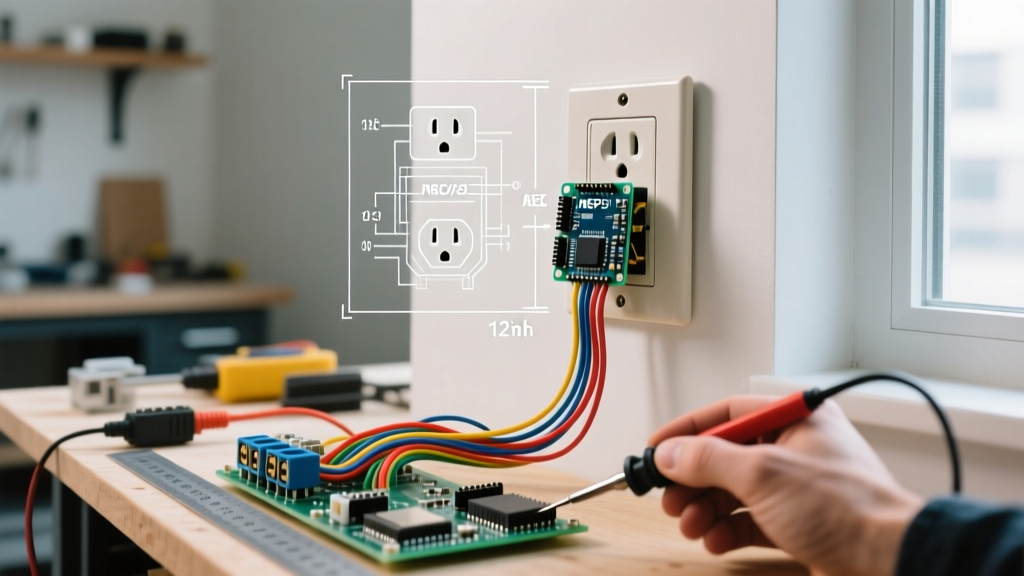
Maintain a strict 12-inch separation between AC power conduits and low-voltage data pathways. If crossing is unavoidable, do so at a strict 90-degree angle. For the data layer, utilize Belden 10GX Category 6A shielded twisted pair (STP) cabling, terminating into shielded keystone jacks bonded to a dedicated technical ground. This ensures your home network can handle 10-Gigabit throughput without packet loss from nearby variable-speed HVAC motors.
Grounding, Bonding, and Power Quality
According to OSHA electrical safety guidelines and NEC Article 250, a robust grounding electrode system is non-negotiable. While residential codes might allow a single ground rod if it achieves 25 ohms of resistance, commercial standards dictate a triangulated ground ring or multiple 5/8-inch by 8-foot copper-clad ground rods driven at least 6 feet apart, bonded together with bare 2 AWG copper wire.
Furthermore, install an Intermatic IG1200RC3 or similar commercial-grade Surge Protective Device (SPD) directly at the service entrance. In 2026, with homes saturated with microprocessor-driven appliances, whole-house transient voltage surge suppression is as vital as the main breaker itself.
Frequently Asked Questions
Is it legal to use commercial wiring methods in a residential home?
Yes. The NEC establishes the minimum safety standards. Exceeding those standards by using EMT conduit, THHN wire, and commercial-grade panels is entirely legal and often praised by local AHJs (Authority Having Jurisdiction), provided the installation meets all support and fill-capacity requirements.
Do I need a 3-phase power supply for a commercial-style home shop?
Not necessarily. While commercial shops use 3-phase power for large inductive motors, modern residential woodshops and metal shops can utilize Phase Converters (like those from Phase-A-Matic) or VFDs (Variable Frequency Drives) to convert single-phase 240V power into 3-phase power for heavy machinery, avoiding the massive utility cost of bringing a 3-phase drop to a residential address.
How does commercial wiring affect home resale value?
While you may not recoup 100% of the material cost difference in a standard appraisal, high-end buyers and home inspectors immediately recognize the value of a neatly wired, conduit-based panel with commercial spec-grade receptacles. It signals a 'zero-maintenance' electrical infrastructure, which is a powerful negotiating tool in premium real estate markets.