
Diagnosing Residential Circuits: A 2026 Perspective
As smart home ecosystems expand and electrical loads increase with EV chargers and heat pumps, understanding the distinct characteristics of various home electrical wiring types is no longer just for master electricians. For DIYers and homeowners, identifying the wiring behind your drywall is the critical first step in diagnosing flickering lights, tripped breakers, and dangerous arc faults. In 2026, with the widespread adoption of highly sensitive Combination Type AFCI (Arc-Fault Circuit Interrupter) breakers, legacy wiring faults that once went unnoticed are now causing nuisance trips that demand immediate troubleshooting.
This comprehensive guide breaks down the most common residential cable types, their specific failure modes, and actionable, code-compliant diagnostic steps to restore safety and reliability to your home's electrical system.
Quick Reference Matrix: Residential Wiring Types
Before pulling out a multimeter, you must identify the cable type. Use this diagnostic matrix to match your visual inspection with common failure points.
| Wiring Type | Era / Installation | Visual Identification | Primary Application | Most Common Failure Mode |
|---|---|---|---|---|
| NM-B (Romex) | 1960s - Present | Yellow (12 AWG), White (14 AWG), or Red (10 AWG) PVC jacket | Interior dry-wall branch circuits | Staple compression, nail punctures, shared neutral AFCI trips |
| UF-B | 1970s - Present | Solid gray PVC jacket with embedded conductors | Direct burial, outdoor feeds, sheds | Moisture wicking, UV degradation, shovel damage |
| Aluminum (AA-1350) | 1965 - 1973 | Silver-colored conductor, often with older rubber/cloth jacket | Whole-house branch wiring (legacy) | Oxidation, cold creep, thermal expansion fires |
| THHN/THWN | All Eras | Individual color-coded wires inside metal/PVC conduit | Exposed basements, garages, service panels | Conduit overfill, insulation melt from heat derating |
| Knob & Tube | 1880s - 1940s | Ceramic knobs, black rubberized cloth insulation, no ground | Historic homes (ungrounded) | Brittle insulation, rodent damage, overloaded splices |
Troubleshooting Non-Metallic Sheathed Cable (NM-B)
NM-B cable, universally known by the brand name Romex (specifically Southwire's SIMpull line), dominates modern residential construction. While highly reliable, its PVC jacket and paper wrapping are vulnerable to physical installation errors that manifest years later.
Symptom: Nuisance AFCI Tripping
If your 15A or 20A AFCI breaker trips immediately upon resetting, or randomly when a vacuum is turned on, you are likely dealing with a parallel or series arc fault. In NM-B circuits, this is frequently caused by staple compression. According to NEC Section 334.30, NM cable must be secured without damaging the jacket. Over-driven steel staples compress the PVC and paper separator, forcing the hot and neutral conductors together. Over time, thermal cycling degrades the insulation at the pinch point, creating micro-arcs.
Actionable Fix: Use an Amprobe AT-3500 cable tracer to map the route. Inspect attic and basement staple points. Remove over-driven staples and replace them with insulated cable stackers or use a hammer tacker with depth-adjusted staples. If the cable jacket is visibly indented or torn, you must cut out the damaged section and install a junction box with a new NM-B splice.
Symptom: Melted Wire Nuts at Receptacles
Finding melted or scorched wire nuts (wire connectors) when replacing an outlet is a hallmark of high-resistance connections. In 2026, with copper prices fluctuating, some contractors use lower-grade wire nuts that fail to maintain spring tension. Furthermore, failing to torque terminal screws to the manufacturer's specification (typically 14-16 in-lbs for standard 15A/20A receptacles) causes heat buildup that travels down the copper wire and melts the wire nut.
Actionable Fix: Strip back any heat-discolored copper (it will appear black or dark purple). Use IDEAL WingNut or 3M Performance Plus wire connectors, and always verify terminal torque using a calibrated torque screwdriver like the Klein Tools 62030.
Diagnosing Underground Feeder (UF-B) Circuit Faults
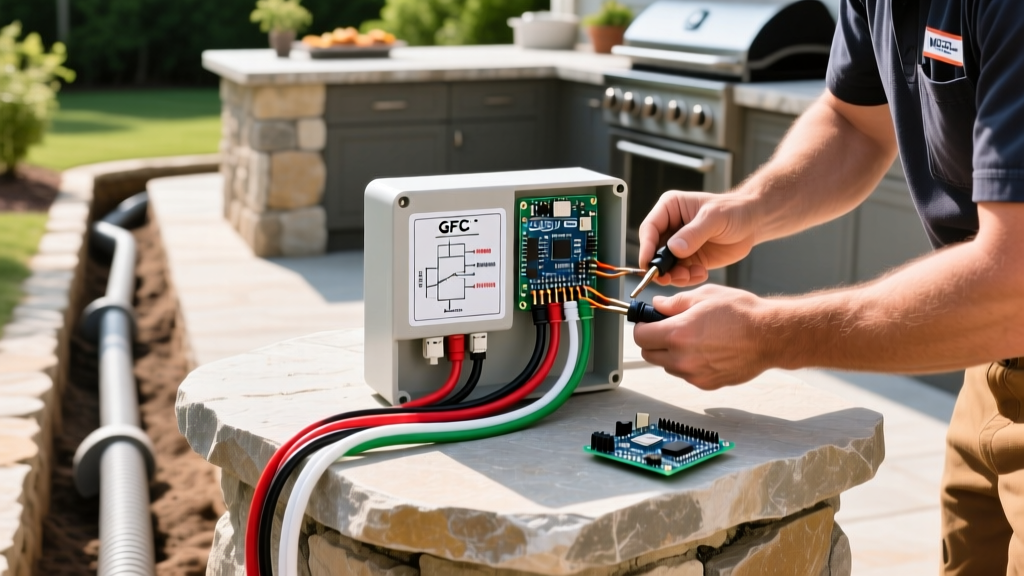
UF-B cable features conductors embedded in a solid, moisture-resistant gray PVC jacket. It is rated for direct burial without conduit (minimum 24 inches deep per NEC Table 300.5 for standard residential circuits). However, troubleshooting UF-B requires looking beyond the panel.
Moisture Wicking and Insulation Degradation
Unlike THWN wires in a conduit, if the outer jacket of a UF-B cable is nicked by a landscaping shovel or garden edger, groundwater can infiltrate the cable. Because the conductors are encased in solid PVC, water can 'wick' longitudinally along the wire for several feet, eventually reaching the junction box or panel and causing ground faults (GFCI trips).
Diagnostic Step: If an outdoor GFCI receptacle refuses to reset and the UF-B cable is buried, you must perform an insulation resistance test. While standard multimeters only output 1.5V to 9V, you need a Megohmmeter (Megger) like the Fluke 1587 FC (approx. $750 in 2026) to inject 500V DC into the de-energized circuit. A reading below 1 Megohm confirms moisture intrusion or jacket failure, requiring the cable to be pulled and replaced, ideally inside a Schedule 80 PVC conduit sleeve for future protection.
The Hidden Dangers of Legacy Aluminum Wiring
Homes built or remodeled between 1965 and 1973 often contain AA-1350 alloy aluminum branch wiring. The U.S. Consumer Product Safety Commission (CPSC) has long documented that unmodified aluminum wiring is 55 times more likely to create fire hazard conditions than copper.
Understanding 'Cold Creep' and Oxidation
Aluminum expands and contracts at a significantly higher rate than copper when heated by electrical current. Over years of thermal cycling, the wire 'creeps' away from the terminal screw, loosening the connection. This loose connection creates electrical arcing and intense heat. Additionally, aluminum oxidizes rapidly when exposed to air, forming aluminum oxide—a highly resistive insulator that exacerbates the heating problem.
Actionable Remediation: Never simply twist aluminum and copper together with a standard wire nut and anti-oxidant paste; this is a proven fire hazard. The only CPSC-recognized permanent DIY-friendly repair is pigtailing using King Innovation AlumiConn 3-Port lug connectors (approx. $4.50 each). These feature independent set-screws plated with a proprietary coating that prevents galvanic corrosion between the copper pigtail and the aluminum branch wire. For a whole-house remediation, budget roughly $15 to $25 per receptacle/switch point for labor and materials.
Testing THHN/THWN in Conduit Systems
In garages, basements, and commercial-style home workshops, individual THHN/THWN wires pulled through EMT (metal) or PVC conduit are standard. The primary troubleshooting issue here is heat derating due to conduit overfill.
Conduit Fill and Thermal Failure
If a circuit breaker feels warm to the touch, or the wires in the panel are too hot to safely grasp, check the conduit fill. NEC Chapter 9, Table 1 limits conduit fill to 40% for three or more conductors. When too many current-carrying conductors are bundled together, they cannot dissipate heat. A 12 AWG THHN wire rated for 90°C in free air must be derated if more than three current-carrying conductors share the same conduit run, potentially dropping its safe ampacity below the breaker's trip threshold.
Diagnostic Step: Count the current-carrying conductors (hot and neutral wires; grounds do not count). If you have 4 to 6 current-carrying wires, you must derate the ampacity to 80% of the 90°C column in NEC Table 310.16. If the math shows the wire is undersized for the breaker, you must either pull a new, larger gauge wire or split the circuits into separate conduits.
Essential Diagnostic Tools for 2026
Troubleshooting home electrical wiring types requires moving beyond the basic $15 voltage tester. Invest in these professional-grade tools to ensure accurate diagnostics:
- Fluke 117 True-RMS Multimeter ($220): Essential for detecting 'ghost voltages' and accurately measuring voltage drop across long NM-B runs. Its non-contact voltage (NCV) sensor is integrated directly into the tip for safe jacket testing.
- Klein Tools CL800 Clamp Meter ($130): Allows you to measure AC current draw on a circuit without stripping wire insulation, crucial for identifying overloaded 14 AWG circuits hiding behind 20A breakers.
- Gardner Bender GSP-520 Tone Generator ($35): Indispensable for tracing unmarked UF-B or NM-B cables through finished walls and attic insulation to locate hidden junction boxes.
When to Stop and Call a Professional
While understanding these home electrical wiring types empowers you to handle receptacle swaps, diagnostic tracing, and minor repairs, certain tasks legally and safely require a licensed electrician. According to the National Fire Protection Association (NFPA), which publishes the National Electrical Code (NEC), any work involving the main service panel bus bars, upgrading service amperage (e.g., 100A to 200A), or installing new 240V hardwired appliance circuits must be permitted and inspected. If your troubleshooting reveals widespread knob-and-tube wiring or whole-house aluminum branch circuits, hire a specialized electrical contractor to evaluate the system's integrity and insurance compliance.
Safety Override: Always de-energize the circuit at the main breaker panel and verify zero voltage with a True-RMS multimeter before opening any junction box or device yoke. Never rely solely on non-contact voltage testers, as they can yield false negatives on shielded or multi-wire branch circuits.