
Understanding Flexible Pipe for Electrical Wiring
When routing cables through tight joist bays, connecting vibrating machinery, or navigating complex commercial remodels, rigid EMT or PVC conduit simply will not work. This is where flexible pipe for electrical wiring—technically known as flexible conduit—becomes indispensable. Unlike rigid raceways, flexible conduit allows for tight bends, movement, and rapid installation in awkward geometries. However, selecting the wrong type or using improper cutting tools can lead to insulation damage, grounding failures, and severe National Electrical Code (NEC) violations.
In this comprehensive material and tool guide, we break down the exact specifications of flexible conduit types, the specialized tools required for clean cuts, and the critical NEC articles that govern their use in residential and commercial environments.
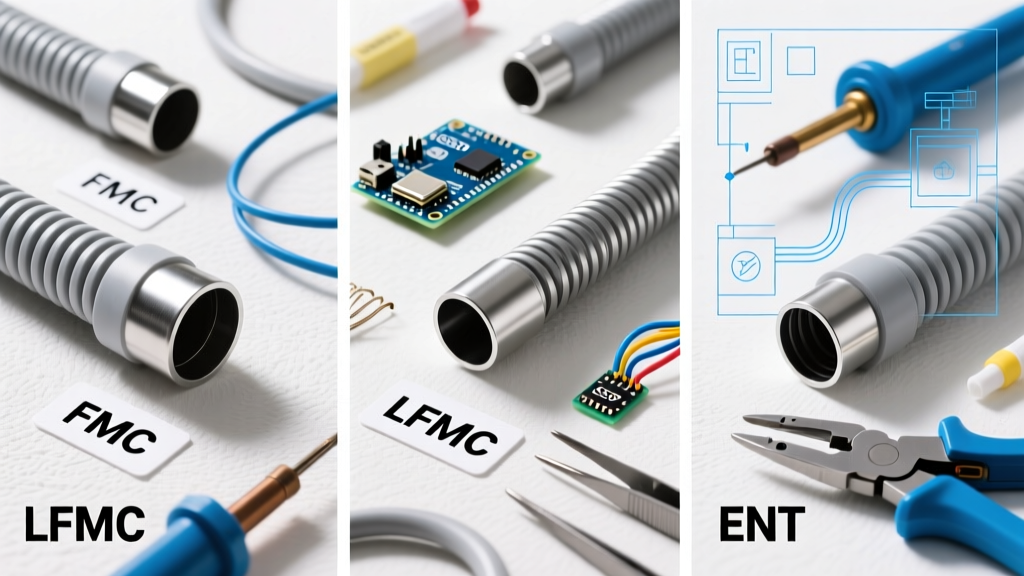
The Material Matrix: FMC vs. LFMC vs. LFNC vs. ENT
Electricians often use the term 'flex pipe' interchangeably, but the NEC strictly categorizes these materials based on their construction and environmental ratings. Below is a comparative breakdown of the four primary flexible raceways used in modern electrical installations.
| Conduit Type | Abbreviation | NEC Article | Wet/Dry Rating | Est. Cost (per 100ft, 1/2') | Primary Application |
|---|---|---|---|---|---|
| Flexible Metal Conduit | FMC (Greenfield) | Article 348 | Dry Locations Only | $65 - $85 | HVAC connections, drop ceilings, indoor motor whips |
| Liquidtight Flexible Metal | LFMC | Article 350 | Wet, Damp, & Dry | $95 - $125 | Outdoor AC disconnects, pool equipment, industrial machinery |
| Liquidtight Flexible Nonmetallic | LFNC | Article 356 | Wet, Damp, & Dry | $80 - $110 | Corrosive environments, solar PV combiner boxes |
| Electrical Nonmetallic Tubing | ENT (Smurf Tube) | Article 362 | Dry/Damp (Enclosed) | $35 - $50 | In-slab concrete pours, interior block walls, low-voltage |
Deep Dive: Material Nuances
- FMC (Galvanized Steel): Constructed from interlocked helical steel strips. It offers excellent crush resistance but zero moisture protection. The internal rough texture requires the use of wire pulling lubricant for runs longer than 5 feet.
- LFMC (Galvanized Steel with PVC Jacket): Features a seamless black or gray UV-resistant PVC jacket over the steel core. As of 2026, brands like Southwire and AFC Cable Systems dominate this space. The jacket prevents water ingress, making it mandatory for exterior HVAC disconnects.
- ENT (Corrugated PVC): Recognizable by its bright blue or orange color (though colors vary by region and voltage rating). ENT is highly flexible and can be bent by hand without a heat gun, but it crushes easily if left exposed on a concrete floor during active construction.
NEC Code Restrictions & Grounding Rules
Using flexible pipe for electrical wiring requires strict adherence to the National Electrical Code (NEC). The most common point of failure during inspections involves grounding and support spacing.
Inspector's Note: FMC and LFMC can serve as the equipment grounding conductor (EGC) only if the total length of the flexible conduit in the ground-fault return path does not exceed 6 feet, the circuit is protected at 20 amps or less, and you are using listed, tight-joint fittings. For runs over 6 feet, or circuits over 20A, you must pull a separate green or bare copper grounding wire inside the flex.
Support and Securing Requirements
According to NEC Article 350.30, LFMC must be securely fastened within 12 inches of every junction box, cabinet, or fitting. Furthermore, it must be supported at intervals not exceeding 3 feet. Using standard nylon zip-ties is a frequent code violation; you must use listed metal or UV-rated plastic conduit straps (e.g., Hubbell or O-Z/Gedney straps) with corrosion-resistant fasteners.
Essential Tools for Cutting and Prepping
The number one reason flexible conduit fails prematurely is improper cutting. Using a standard coarse-tooth hacksaw on FMC or LFMC leaves jagged, razor-sharp steel burrs on the inner edge. When you pull THHN wire through, these burrs slice the insulation, causing ground faults or arc flashes down the line.
The Pro Tool Kit
- Ratcheting Conduit Cutter (For ENT/LFNC): The Klein Tools 53722 or Greenlee 1731 ratcheting PVC cutter provides a perfectly square, burr-free cut on non-metallic flex pipe in seconds. ($45 - $65)
- Flex Conduit Cutter (For FMC/LFMC): For metallic flex, use a specialized rotary cutter or a fine-tooth (32 TPI) hacksaw blade. The Southwire FMC Cutter wraps around the pipe and scores it cleanly without deforming the helical profile. ($30 - $45)
- Internal Reamer: After cutting metallic flex, you must ream the inside. The Greenlee 845D Reamer fits on a standard screwdriver handle and shaves the internal steel burrs flush in three twists. ($25)
- Wire Pulling Lubricant: Never pull dry wire through FMC. Use a high-grade synthetic lubricant like 3M ScotchGard Yellow Pulling Lube or Ideal 45-001 to reduce friction and prevent insulation burn-through. ($12 per quart)
Step-by-Step Installation Flow
Follow this standardized workflow to ensure a clean, code-compliant installation when using flexible pipe for electrical wiring.
Step 1: Measure and Pre-Form
Uncoil the flex pipe and let it relax. Measure the required length, adding 6 inches for sweep bends. Avoid measuring while the conduit is under tension, as it will shrink back once released.
Step 2: Square Cut and Deburr
Cut the conduit square. If cutting LFMC, use a utility knife to carefully strip back 1.5 inches of the outer PVC jacket to expose the metal core for the fitting. Ream the inside edge thoroughly until smooth to the touch.
Step 3: Attach the Fitting
For LFMC, use a listed liquidtight connector (e.g., Appleton/ABB STB150). Slide the compression nut and ferrule over the pipe, insert the conduit into the fitting body until it bottoms out, and tighten the nut with channel-lock pliers until snug. Do not over-torque, which can crush the internal steel profile.
Step 4: Fish and Pull
If the run exceeds 4 feet, feed a fiberglass fish tape through the flex first. Coat your THHN/THWN wires with pulling lubricant, attach them to the fish tape using a smooth pulling head (wrap with electrical tape to avoid sharp wire ends catching), and pull steadily.
Common Failure Modes & Edge Cases
Even experienced electricians encounter edge cases when working with flexible raceways. According to OSHA wiring method standards and field failure reports, here are the most common issues to avoid:
- Vibration Fatigue on FMC: When connecting flex to heavy vibrating machinery (like commercial air compressors), standard FMC will eventually work-harden and snap at the fitting neck. Solution: Use a vibration-dampening loop and ensure the flex is not pulled taut. Leave a 2-inch droop to absorb kinetic energy.
- UV Degradation on LFNC: Standard gray LFNC will become brittle and crack after 18 months of direct sunlight exposure. Solution: If the flex is mounted on a sunny exterior wall, you must specify UV-rated black LFNC or use LFMC with a sun-resistant PVC jacket.
- Conduit Fill Violations: Because the interior of FMC is corrugated, the actual usable cross-sectional area is smaller than rigid pipe. Per NEC Chapter 9, Table 1, you are limited to 40% fill capacity for three or more conductors. Always use a conduit fill calculator based on the inside diameter of the specific flex brand you are using.
Frequently Asked Questions
Can I bury flexible pipe for electrical wiring underground?
Standard FMC and ENT cannot be direct-buried. However, specific types of LFMC and LFNC are rated for direct burial if listed for the application. Always check the manufacturer's spec sheet for a 'Direct Burial' rating, and it is highly recommended to bed the flex in 2 inches of sand to prevent sharp rocks from piercing the jacket over time.
Is 'Smurf Tube' (ENT) allowed in commercial plenums?
No. Standard ENT is not rated for plenum spaces (the area above drop ceilings used for HVAC return air) unless it is specifically marked as 'Plenum Rated' and meets the stringent flame and smoke requirements of NFPA 90A. In most commercial plenums, flexible metal conduit (FMC) is the required standard.
How do I transition from flexible conduit to rigid EMT?
Use a combination coupling or a threaded hub. Terminate the flexible conduit with a threaded flex connector, and screw it into an EMT coupling or a threaded box hub. Ensure a bonding bushing is used if the flex is serving as the grounding path and the connection relies on concentric knockouts that may have been removed.