
Mastering Commercial Electrical Wiring Examples for Modern Facilities
Designing and installing electrical systems in commercial environments requires a fundamental shift from residential practices. While residential wiring typically relies on 120V/240V single-phase split systems, commercial infrastructure demands higher capacity, enhanced safety protocols, and complex load management. For electrical contractors, facility managers, and engineering students, studying practical electrical wiring examples is the most effective way to bridge the gap between theoretical codebooks and real-world job sites.
In 2026, the commercial electrical landscape is heavily influenced by the latest National Electrical Code (NEC) revisions, fluctuating copper prices, and the rapid adoption of smart-building technologies. According to the NFPA 70 National Electrical Code, commercial installations must rigorously address harmonic distortion, arc flash mitigation, and energy efficiency. Below, we dissect three highly specific commercial electrical wiring examples, complete with conductor sizing, overcurrent protection calculations, and physical infrastructure requirements.
Example 1: 480V 3-Phase Motor Circuit for an HVAC Rooftop Unit
One of the most common commercial electrical wiring examples involves feeding large 3-phase induction motors, such as those found in commercial HVAC rooftop units (RTUs). Unlike standard branch circuits, motor circuits are governed by NEC Article 430, which requires distinct calculations for conductor ampacity and overcurrent protection devices (OCPD).
Scenario: 50 HP, 480V, 3-Phase Compressor Motor
Assume we are wiring a 50 HP, 480V, 3-phase compressor with a nameplate Full Load Amps (FLA) rating of 65A. The motor is located 150 feet from the main distribution panel.
- Conductor Sizing (NEC 430.22): Conductors must be sized at 125% of the motor FLA. 65A x 1.25 = 81.25A. Referring to NEC Table 310.16 (75°C column), a 3 AWG THHN/THWN-2 copper conductor (rated 100A) is required.
- OCPD Sizing (NEC 430.52): Motor branch circuit short-circuit and ground-fault protection is calculated separately from the overload protection. For an inverse-time breaker, the maximum rating is 250% of the FLA. 65A x 2.50 = 162.5A. The next standard breaker size is 175A.
- Motor Overload Protection (NEC 430.32): Overloads are typically built into the motor starter or variable frequency drive (VFD) and are set between 115% and 125% of the nameplate FLA.
| Component | Specification | NEC Reference |
|---|---|---|
| Conductors (3-Phase + Ground) | 3 AWG Copper THHN/THWN-2 | 430.22 / 310.16 |
| Equipment Grounding Conductor | 8 AWG Copper (per Table 250.122 for 175A OCPD) | 250.122 |
| Branch Circuit Breaker | 175A 3-Pole Inverse Time (e.g., Square D PowerPact) | 430.52 |
| Disconnect Switch | 100A Fused Disconnect (Horsepower rated) | 430.109 |
| Conduit | 1.25-inch EMT (Electrical Metallic Tubing) | Chapter 9, Table 1 |
Expert Insight: When terminating 3 AWG wire in commercial lugs, NEC 110.14(D) strictly requires the use of a calibrated torque screwdriver or wrench. In 2026, inspectors routinely check for torque marks on lugs to prevent loose connections that lead to thermal failure and arc flash incidents.
Example 2: 277V Commercial LED Lighting and DALI Controls
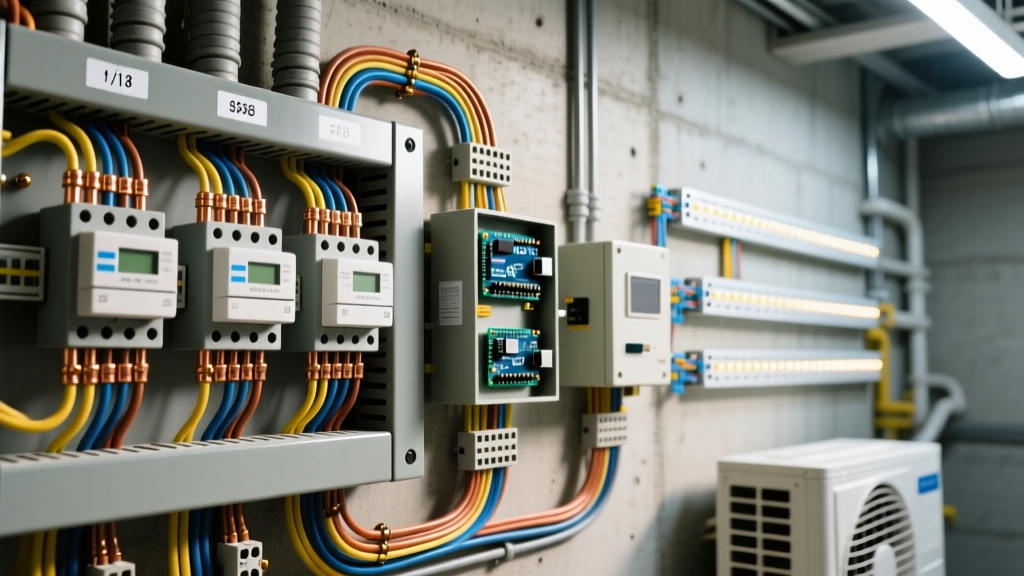
Lighting in large commercial spaces (warehouses, big-box retail, open-plan offices) is almost exclusively powered by 277V single-phase circuits derived from a 480Y/277V 3-phase wye transformer. A modern commercial wiring example must also account for advanced lighting control networks, such as DALI (Digital Addressable Lighting Interface).
Scenario: High-Bay Warehouse LED Lighting Layout
We are wiring a continuous run of 40 high-bay LED fixtures, each drawing 1.2A at 277V. The total continuous load is 48A. Because lighting is considered a continuous load (operating for 3 hours or more), the circuit must be derated to 80%.
- Circuit Split: We cannot put 48A on a single standard breaker. We will split the load across three 20A, 277V single-pole breakers (14 fixtures per circuit, drawing 16.8A each, well within the 16A continuous limit for a 20A breaker).
- Wire Selection: 12 AWG THHN copper is standard for 20A commercial lighting circuits.
- Neutral Conductor Sizing: In commercial environments with heavy non-linear loads (like LED drivers), harmonic currents can accumulate on the neutral. While a standard 12 AWG neutral is often code-compliant for linear loads, best practice and many local 2026 amendments require oversized neutrals or dedicated neutrals per phase to prevent overheating.
DALI vs. 0-10V Dimming Wiring
When integrating dimming controls, the wiring topology changes drastically:
- 0-10V Dimming: Requires a 2-conductor, 18 AWG or 16 AWG shielded control wire run alongside the line voltage. It is a simple analog signal, but voltage drop over long warehouse runs can cause uneven dimming at the far end of the circuit.
- DALI (Digital Addressable Lighting Interface): Uses a 2-wire digital bus (typically 18 AWG unshielded twisted pair). DALI is polarity-free and can share the same conduit as the 277V power conductors, provided the wire insulation is rated for the maximum voltage present (600V rated THHN is standard). DALI allows individual fixture addressing and bidirectional data reporting, making it the premier choice for 2026 smart-building integrations.
Example 3: 120V/208V Office Receptacles and AFCI/GFCI Mandates
Office spaces utilize 120V single-phase power derived from the 208Y/120V wye system. A staple among commercial electrical wiring examples is the Multi-Wire Branch Circuit (MWBC), which shares a neutral between two 120V circuits on different phases (e.g., Phase A and Phase B, yielding 208V between them). This saves conduit fill and copper costs.
However, the 2026 NEC has expanded Ground-Fault Circuit Interrupter (GFCI) and Arc-Fault Circuit Interrupter (AFCI) requirements. Under NEC 210.8(B), GFCI protection is now mandatory for all 125V through 250V receptacles rated 50A or less in commercial kitchens, rooftops, and specific maintenance areas. Furthermore, NEC 210.12 requires AFCI protection in commercial dormitories and specific office break-rooms.
Isolated Ground (IG) Receptacles for IT Infrastructure
For commercial server rooms or sensitive medical equipment, standard grounding is insufficient due to electromagnetic interference (EMI) traveling along the equipment grounding conductor. An Isolated Ground (IG) receptacle (identified by an orange triangle) features a grounding terminal that is insulated from the metal yoke. The IG wire (typically green with a yellow stripe) is run completely insulated back to the panel's isolated ground bus, bypassing the conduit and junction boxes to eliminate ground loops.
Physical Infrastructure: Conduit Selection Matrix
Unlike residential wiring, which heavily utilizes Non-Metallic (NM) Romex cable, commercial wiring demands physical protection. The OSHA Electrical Safety Standards and NEC Article 300 dictate rigorous mechanical protection for commercial conductors.
| Conduit Type | Material | Best Commercial Application | Relative Cost (2026) |
|---|---|---|---|
| EMT (Electrical Metallic Tubing) | Galvanized Steel | Exposed indoor ceilings, office walls, standard commercial runs. | $$ |
| RMC (Rigid Metal Conduit) | Heavy Steel | Hazardous locations, physical damage zones, underground vaults. | $$$$ |
| PVC (Schedule 40/80) | Polyvinyl Chloride | Underground concrete encased duct banks, highly corrosive environments. | $ |
| MC (Metal Clad Cable) | Aluminum Interlocked Armor | Retrofit projects, dropped ceilings where pulling wire in EMT is impractical. | $$$ |
Commercial Wiring Cost Estimates (2026 Outlook)
Understanding the financial scope of commercial electrical wiring examples is crucial for project bidding. In 2026, material costs (specifically copper and steel conduit) remain volatile, while labor rates for licensed commercial electricians average between $75 and $135 per hour depending on the metropolitan area.
- Basic Office Fit-Out: $8.50 to $12.00 per square foot (includes standard lighting, 120V receptacles, and basic data conduit).
- Retail/Restaurant Space: $15.00 to $22.00 per square foot (requires heavy 3-phase HVAC, commercial kitchen GFCI compliance, and architectural lighting).
- Industrial/Warehouse: $5.00 to $9.00 per square foot (high-bay lighting, 480V bus duct distribution, minimal finished wall wiring).
Frequently Asked Questions
Can I use residential NM-B (Romex) cable in a commercial drop ceiling?
No. NEC Article 334 restricts the use of NM cable in commercial buildings, particularly above suspended drop ceilings which are considered plenums or concealed spaces in commercial construction. You must use EMT conduit with THHN wires, or plenum-rated MC (Metal Clad) cable.
Why do commercial buildings use 480Y/277V instead of 208Y/120V?
Higher voltage reduces the current required to deliver the same amount of power (Power = Voltage x Current). By utilizing 480V for heavy machinery and 277V for lighting, commercial facilities can use smaller gauge wire, smaller conduit, and lower amperage breakers, resulting in massive savings on copper and infrastructure costs over large square footages.
What is the 2026 NEC requirement for torque markings?
NEC 110.14(D) mandates that all electrical connections must be tightened using a torque-indicating tool to the manufacturer's specified values. Inspectors now look for physical evidence of torque verification, such as paint pens or torque-seal marks on breaker lugs and disconnect switches, to ensure connection integrity and prevent thermal fires.