
The Standard US Electrical Wiring Color Code Chart
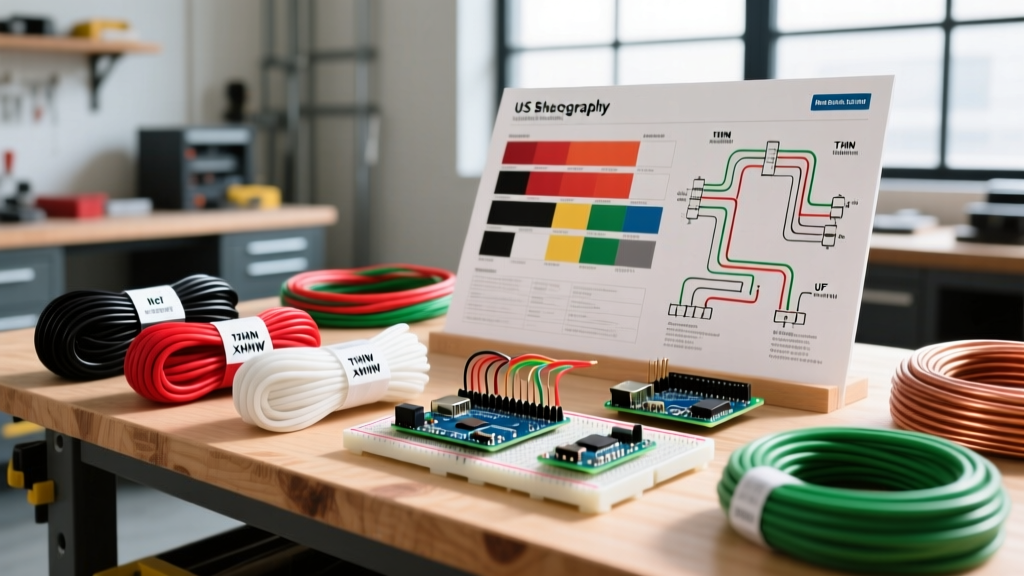
Understanding the electrical wiring color code chart is the foundational baseline for any residential or commercial installation. Governed primarily by the National Electrical Code (NEC / NFPA 70), these color standards prevent catastrophic faults, arc flashes, and lethal shocks. However, a color code is only as effective as the physical insulation material protecting the conductor. As copper pricing and conduit fill capacities remain critical factors for electricians in 2026, selecting the right wire material alongside the correct color is mandatory for code compliance and longevity.
CRITICAL SAFETY WARNING: Never trust wire color alone, especially in older homes or undocumented remodels. Always verify dead circuits using a True-RMS multimeter or non-contact voltage tester before making physical contact with any conductor. Refer to OSHA 1910.304 Wiring Design and Protection for mandatory workplace verification protocols.
Residential & Light Commercial AC Color Matrix (120V/240V)
| Wire Color | Function | Typical Application | Common AWG Sizes | NEC Reference |
|---|---|---|---|---|
| Black | Hot (Line 1) | Standard 120V branch circuits, appliance feeds | 14, 12, 10, 8 | NEC 200, 210 |
| Red | Hot (Line 2 / Switch Leg) | 240V appliances, 3-way switch travelers, smoke detector interconnects | 14, 12, 10 | NEC 210.4 |
| Blue / Yellow | Hot (Line 3 / Travelers) | Conduit pulls for 3-way/4-way switches, dedicated 20A circuits | 12, 10 | NEC 210 |
| White / Gray | Neutral (Grounded) | Return path for 120V/240V circuits | 14 to 2 | NEC 200.2, 200.6 |
| Green / Bare Copper | Equipment Ground | Fault current path back to the panel | 14 to 4 | NEC 250.119 |
Commercial 3-Phase Color Codes (208V & 480V)
When transitioning from residential to commercial environments, the electrical wiring color code chart shifts to accommodate 3-phase power. Miswiring a 480V system using 208V color conventions will instantly destroy equipment and pose severe arc flash hazards.
- 208Y/120V Systems: Phase A (Black), Phase B (Red), Phase C (Blue), Neutral (White), Ground (Green/Bare).
- 480Y/277V Systems: Phase A (Brown), Phase B (Orange), Phase C (Yellow), Neutral (Gray), Ground (Green/Bare).
Pro-Tip for Commercial Panels: The 'Orange' wire in a 480V system is traditionally the 'High Leg' (or Wild Leg) in a 240V Delta configuration, which carries ~208V to ground. However, in a modern 480Y/277V Wye system, Orange is simply Phase B. Always label panel directories explicitly to match the NFPA National Electrical Code (NEC) requirements for 408.3(E) Phase Identification.
Decoding Wire Insulation Materials: THHN vs. XHHW-2 vs. NM-B
While the color dictates the circuit's logical function, the insulation material dictates its physical survivability and ampacity. In 2026, supply chain shifts and updated conduit-fill calculations have made material selection more critical than ever.
1. THHN / THWN-2 (Thermoplastic High Heat-Resistant Nylon)
The undisputed king of conduit pulls. THHN features a PVC inner insulation and a slick nylon outer jacket, making it highly resistant to oil, gas, and abrasion.
- Temperature Rating: 90°C in dry locations, 75°C in wet locations.
- Best Use Case: Commercial conduit runs, panel pigtails, and underground PVC conduit (when rated THWN-2).
- Drawback: The nylon jacket can be brittle in extreme cold and takes up more physical space in conduit due to thicker insulation walls compared to cross-linked alternatives.
2. XHHW-2 (Cross-Linked Polyethylene High Heat-Resistant Water-Resistant)
As copper costs remain high, electricians are increasingly specifying XHHW-2. Because XLPE (cross-linked polyethylene) insulation has a higher dielectric strength than PVC, the insulation layer can be manufactured thinner.
- Temperature Rating: 90°C in both dry and wet locations.
- Best Use Case: Crowded conduit pulls where conduit fill capacity (NEC Chapter 9, Table 1) is a limiting factor. You can often fit more XHHW-2 wires in a 3/4-inch EMT conduit than THHN.
- Cost: Generally 5-10% more expensive per foot than THHN, but saves money on conduit upsizing and labor during difficult pulls.
3. NM-B (Non-Metallic Sheathed Cable / Romex)
Standard for residential framing. The outer jacket color indicates the internal wire gauge, not the phase.
- White Jacket: 14 AWG (15 Amp circuits).
- Yellow Jacket: 12 AWG (20 Amp circuits).
- Orange Jacket: 10 AWG (30 Amp circuits, e.g., water heaters).
- Black Jacket: 6 AWG or 8 AWG (Heavy appliances, subpanels).
Crucial NEC Limitation: Although the internal THHN wires inside NM-B are rated for 90°C, NEC 334.80 strictly limits the ampacity of NM-B cable to the 60°C column of Table 310.16. You cannot use the 90°C column to derate NM-B.
Essential Tools for Wire Identification and Stripping
Working with color-coded wires requires precision tools that prevent nicking the copper conductor—a common failure point that leads to localized heating and eventual breaker trips.
Verification & Testing Tools
- Fluke 117 True-RMS Multimeter (~$190): Features VoltAlert non-contact voltage detection built into the tip. Essential for verifying that a white wire hasn't been improperly re-identified as a hot switch leg.
- Milwaukee 2202-20 Voltage Detector (~$25): A reliable, standalone NCV tester with a built-in LED flashlight. Perfect for quick panel scans before terminating breakers.
- Ideal Industries 34-082 Suretrace Circuit Identifier (~$160): When working in unmarked commercial panels where color codes have been ignored by previous contractors, this tone generator traces specific breakers to outlets without tripping the circuit.
Stripping & Termination Tools
- Klein Tools 11063 Wire Stripper (~$30): Handles 8-22 AWG stranded and solid wire. The precision-machined stripping holes prevent scoring the copper on 12 AWG THHN, which is critical for maintaining the wire's tensile strength.
- Knipex TwinStrip (~$85): Automatically adjusts to the insulation thickness of THHN and XHHW-2 from 10-24 AWG. A massive time-saver for commercial electricians terminating hundreds of receptacles.
Edge Cases: Re-identifying White Wires as Hot
One of the most common code violations involves using a white neutral wire as a 'hot' traveler or switch leg without proper re-identification. According to NEC 200.7(C)(1), if a white wire is used as an ungrounded (hot) conductor, it must be permanently re-identified.
- The Right Way: Wrap the exposed white insulation at every accessible termination point with high-quality 33+ rated electrical tape (e.g., 3M Super 33+) or use a black heat-shrink sleeve before terminating.
- The Wrong Way: Leaving the white wire bare at the switch and assuming the next electrician will figure it out. This is a primary cause of severe shock hazards during future remodels.
Frequently Asked Questions (FAQ)
Can I use green tape to re-identify a colored wire as a ground?
No. NEC 250.119 strictly mandates that equipment grounding conductors must be bare, covered with green insulation, or covered with green insulation with one or more yellow stripes. You cannot take a black or white wire and wrap it in green tape to serve as a ground. The ground must be a dedicated green or bare copper wire from the panel to the device.
Why do some older homes have white wires connected to black wires?
In pre-1970s wiring (often cloth-covered or early rubber-insulated), color codes were not strictly standardized or enforced as they are today. You may also find 'switch loops' where a 2-wire cable (black and white) was run to a ceiling fixture, and the white wire was used to carry the hot feed down to the switch. Modern code requires a dedicated neutral at every switch box (NEC 404.2(C)), necessitating 3-wire cables in new construction.
Does the color code apply to low-voltage DC wiring?
The standard AC electrical wiring color code chart does not apply to DC circuits. In DC systems (like solar arrays or telecom racks), Red is typically Positive (+) and Black is Negative (-). However, always consult the specific manufacturer schematics, as telecom often uses Blue/White-Blue pairs, and automotive DC wiring utilizes entirely different color matrices.