
Mastering the Different Types of Electrical Wiring for Home Projects
Whether you are upgrading a 1970s kitchen, finishing a basement, or installing a dedicated Level 2 EV charger circuit, selecting the correct cable is non-negotiable. Misunderstanding the different types of electrical wiring is the leading cause of failed inspections, voltage drops, and residential electrical fires. As of 2026, with copper prices stabilizing but remaining historically high, and local jurisdictions widely adopting the latest National Electrical Code (NEC) standards, precision in your material selection is more critical than ever.
This home project guide breaks down the exact wiring types you will encounter, their specific applications, current market costs, and the NEC code requirements you must follow to ensure your project is safe and compliant.
💡 Expert Insight: Before purchasing any wire, always check your local municipal building department's code amendments. While the NEC is the national baseline, local inspectors in areas like Chicago or New York City often mandate metallic conduit (EMT) instead of standard non-metallic cable for all residential branch circuits.1. Non-Metallic Sheathed Cable (NM-B / Romex)
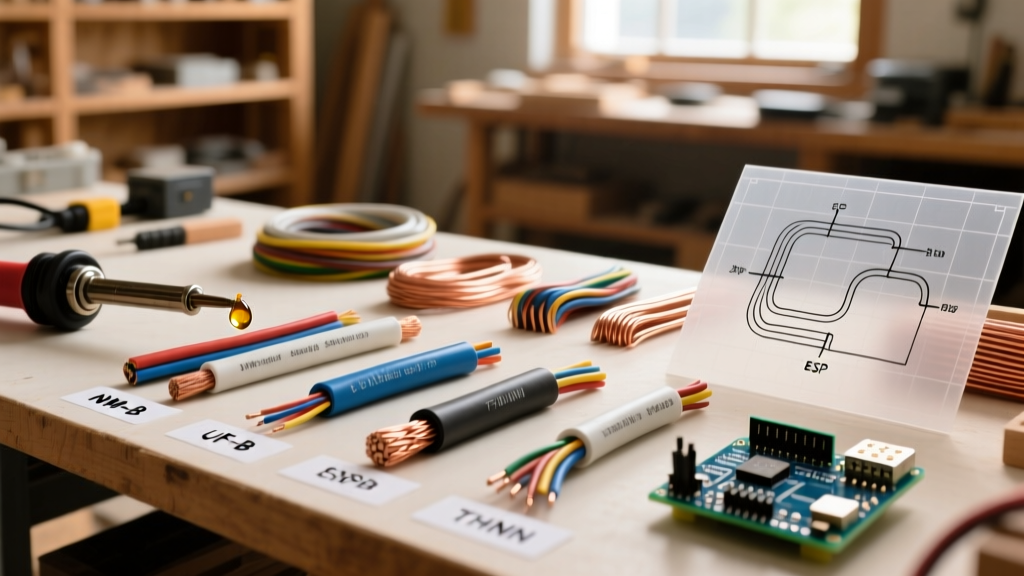
NM-B cable, universally known by the legacy brand name Romex, is the undisputed standard for indoor, dry-location residential wiring. It consists of two or more insulated conductors wrapped in a protective PVC jacket, alongside a bare copper ground wire.
Anatomy and Color Coding
Modern NM-B cable uses a strict color-coded jacket system to help inspectors and electricians instantly identify the wire gauge and ampacity:
- White Jacket (14 AWG): Rated for 15 Amps. Used primarily for basic lighting circuits. Pro Tip: Many 2026 custom home builders are phasing out 14 AWG entirely, opting for 12 AWG universally to reduce voltage drop and allow for future circuit upgrades.
- Yellow Jacket (12 AWG): Rated for 20 Amps. The standard for kitchen, bathroom, and general-purpose receptacle circuits.
- Orange Jacket (10 AWG): Rated for 30 Amps. Used for heavy appliances like electric dryers and standard water heaters.
- Black Jacket (8 AWG or 6 AWG): Rated for 40 to 55 Amps. Reserved for large ranges, HVAC condenser units, and sub-panels.
2026 Pricing and Installation Specifics
As of early 2026, a 250-foot coil of Southwire SIMpull 12/2 NM-B wire costs between $115 and $135. The SIMpull technology features a specialized lubricant embedded in the jacket, reducing pulling friction by up to 50% when fishing wires through tight stud bays. When securing NM-B, NEC 334.30 requires stapling within 8 inches of every single-gang box and every 4.5 feet along the run. Furthermore, per NEC 300.4(D), if the wire runs through a wood stud and is less than 1.25 inches from the face of the framing member, you must install a steel nail plate to prevent drywall screws from piercing the cable.
2. Underground Feeder Cable (UF-B)
When your home project extends outdoors—such as wiring a detached shed, a landscape lighting transformer, or an outdoor receptacle—NM-B is strictly prohibited due to its vulnerability to moisture. Instead, you must use UF-B cable.
Unlike NM-B, UF-B features a solid gray PVC jacket that encases the individual conductors completely, eliminating the paper wrapping found in indoor cables. This makes it impervious to rot, UV degradation, and soil acidity.
Direct Burial Depth Requirements
According to NFPA NEC Table 300.5, the burial depth for UF-B cable is strictly regulated:
- 24 Inches Deep: Required for standard residential branch circuits (up to 120V, 20A) without GFCI protection.
- 12 Inches Deep: Permitted if the circuit is protected by a GFCI breaker at the source and the cable is protected by rigid metal conduit (RMC) or PVC schedule 80 where it emerges from the ground to the termination point.
3. THHN / THWN-2 Conductors in Conduit
For exposed wiring in unfinished basements, garages, or surface-mounted runs, individual conductors pulled through conduit are required. The industry standard is THHN/THWN-2. The dual rating means it is suitable for both dry locations (THHN - 90°C) and wet locations (THWN-2 - 75°C).
In 2026, stranded THHN is heavily preferred by professionals over solid core for conduit pulls, as it navigates 90-degree sweeping bends in EMT (Electrical Metallic Tubing) or PVC conduit without kinking. A 500-foot spool of 12 AWG stranded THHN typically costs around $75 to $90.
Comparison Matrix: Choosing the Right Wire
| Wire Type | Jacket / Format | Approved Locations | Common Ampacity | 2026 Est. Cost (per ft) |
|---|---|---|---|---|
| NM-B (12/2) | Yellow PVC Sheath | Indoor, Dry, Concealed | 20 Amps | $0.45 - $0.55 |
| UF-B (12/2) | Gray Solid PVC | Outdoor, Direct Burial, Damp | 20 Amps | $0.75 - $0.90 |
| THHN/THWN-2 | Individual Nylon/THW | Inside Conduit (EMT/PVC) | Depends on Gauge | $0.15 - $0.25 |
| MC Cable (12/2) | Interlocking Aluminum Armor | Commercial, Exposed Residential | 20 Amps | $1.10 - $1.30 |
Critical NEC Code Requirements for Home Wiring
Understanding wire types is only half the battle; knowing how to protect and terminate them is what separates a DIYer from a master electrician. The U.S. Consumer Product Safety Commission (CPSC) heavily emphasizes the following modern code requirements to prevent arc faults and shocks.
AFCI and GFCI Mandates
Under current NEC guidelines (widely enforced in 2026), Arc-Fault Circuit Interrupter (AFCI) protection is required on virtually all 15A and 20A branch circuits supplying living areas, including bedrooms, living rooms, hallways, and closets. This prevents fires caused by loose connections or damaged wires arcing inside walls.
Simultaneously, Ground-Fault Circuit Interrupter (GFCI) protection is mandated for all 125V, 15A, and 20A receptacles in damp or wet locations. This includes kitchens, bathrooms, garages, crawlspaces, and outdoor patios. You can achieve this via a GFCI receptacle at the first point of the circuit or a GFCI breaker in the main panel.
Box Fill Calculations (NEC 314.16)
Overcrowding wires inside a junction or receptacle box generates excess heat, degrading the wire insulation over time. To calculate box fill, you must know the cubic inch allowance per wire gauge:
- 14 AWG: 2.0 cubic inches per conductor
- 12 AWG: 2.25 cubic inches per conductor
- 10 AWG: 3.0 cubic inches per conductor
Example: A standard single-gang plastic nail-on box holds 18 cubic inches. If you are using 12 AWG wire, you divide 18 by 2.25, giving you a maximum of 8 'wire counts'. Note that all ground wires combined count as one wire count, and internal cable clamps count as one wire count. Exceeding this limit requires upgrading to a deep 22.5 cubic inch box.
Common Home Project Wiring Mistakes to Avoid
- Stripping Too Much Insulation: When terminating wires on a receptacle or using wire nuts, strip exactly 3/4 inch of insulation. Leaving bare copper exposed outside the wire nut or past the terminal screw creates a severe shock and short-circuit hazard.
- Mixing Wire Gauges on a Breaker: Never connect a 14 AWG wire to a circuit protected by a 20 Amp breaker, even if the rest of the circuit uses 12 AWG wire. The breaker will not trip before the 14 AWG wire melts and catches fire inside the wall.
- Using Indoor Tape for Outdoor Splices: Standard vinyl electrical tape degrades rapidly under UV light and moisture. For outdoor or underground splice enclosures, always use heat-shrink tubing with adhesive-lined marine-grade seals or encapsulated resin kits.
Conclusion
Navigating the different types of electrical wiring requires a blend of material knowledge and strict adherence to safety codes. By matching the correct cable—whether it is NM-B for interior walls, UF-B for direct burial, or THHN in conduit—to your specific home project environment, you ensure a system that is not only functional but inherently safe for decades to come.