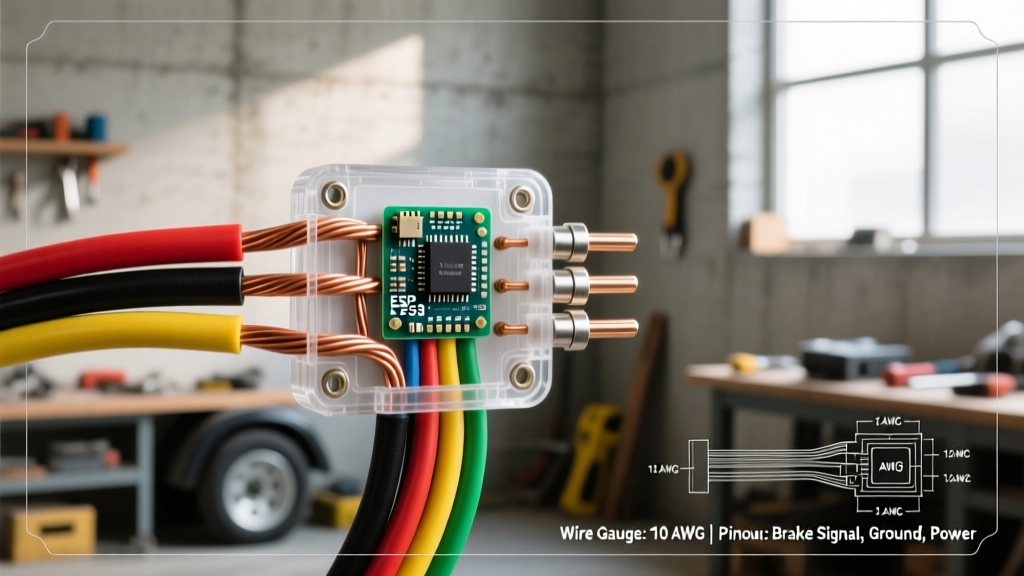

The Critical Intersection of Trailer Wiring and Federal Compliance
When it comes to towing heavy loads, inspecting trailer wiring with electric brakes is not just a matter of mechanical safety; it is a strict legal requirement governed by the Department of Transportation (DOT) and the Federal Motor Carrier Safety Administration (FMCSA). As we move through 2026, Commercial Vehicle Safety Alliance (CVSA) enforcement blitzes have increasingly targeted defective brake wiring and non-compliant breakaway systems on commercial and heavy-duty recreational trailers.
A failure in the electric brake circuit doesn't just mean a longer stopping distance. Under federal regulations, operating a trailer with a compromised brake circuit can result in immediate out-of-service (OOS) orders, severe fines, and catastrophic liability in the event of a collision. This comprehensive inspection guide details the exact electrical specifications, testing protocols, and compliance standards required to keep your trailer wiring road-legal and safe.
FMCSA Regulatory Framework for Electric Brakes
The foundation of trailer brake compliance in the United States is outlined in 49 CFR Part 393, Subpart C. According to the FMCSA braking regulations, any commercial motor vehicle or trailer with a Gross Vehicle Weight Rating (GVWR) exceeding 3,000 lbs must be equipped with an operative braking system on all wheels. Furthermore, the electrical circuit supplying these brakes must be entirely independent of the tail light and running light circuits to prevent voltage drop from compromising braking force.
2026 Compliance Note: DOT inspectors are now utilizing advanced multimeters and thermal imaging to check for high-resistance connections at the 7-way plug. A voltage drop exceeding 0.5V on the 12V brake supply wire under load is now frequently cited as a critical deficiency during Level I inspections.
Wire Gauge, Routing, and Material Standards
One of the most common compliance failures stems from using undersized or inappropriate wire types. Standard PVC-jacketed automotive wire is highly susceptible to heat degradation, vibration fatigue, and moisture ingress. For DOT-compliant trailer wiring, you must use cross-linked polyethylene (XLPE) insulated wire, specifically meeting the SAE J1128 GXL or TXL standard.
Minimum Wire Gauge Requirements by Trailer Length
The National Electrical Code (NEC) does not directly govern mobile vehicular DC systems, but the Society of Automotive Engineers (SAE) and FMCSA guidelines dictate strict voltage drop limits. Below is the required minimum wire gauge for the primary electric brake feed (Pin 2 on a 7-way connector) based on the total circuit length (from the tow vehicle battery to the furthest brake magnet).
| Total Circuit Length (One Way) | 2-Axle Trailer (4 Brakes / ~15A Peak) | 3-Axle Trailer (6 Brakes / ~22A Peak) | Recommended Wire Type |
|---|---|---|---|
| Under 20 Feet | 10 AWG | 8 AWG | SAE J1128 GXL |
| 20 to 35 Feet | 8 AWG | 6 AWG | SAE J1128 GXL |
| 35 to 50 Feet | 6 AWG | 4 AWG | SAE J1128 GXL / TXL |
| Over 50 Feet | 4 AWG | 2 AWG | SAE J1128 GXL / Welding Cable |
The 7-Way RV Blade Connector: Pinout & Inspection Checklist
The SAE J286 standard dictates the pinout for the 7-way RV blade connector. During an inspection, verify the following pins with a digital multimeter (such as a Fluke 87V) while the brake controller is manually activated:
- Pin 1 (Ground / White): Must show less than 0.1 ohms of resistance to the trailer chassis. Critical Edge Case: Never rely solely on the hitch ball for grounding. A dedicated 10 AWG white ground wire must be bonded directly to the trailer frame using a star washer and dielectric grease.
- Pin 2 (Electric Brakes / Blue): Should read 12V-14V when the manual override on the brake controller is engaged. Inspect the wire routing inside the axle tubes; it must be secured with rubber-lined P-clamps every 18 inches to prevent chafing against the steel axle.
- Pin 6 (12V Auxiliary / Black): Supplies constant 12V power to charge the breakaway battery and power interior trailer accessories. Must be fused at 30A or 40A within 18 inches of the tow vehicle's battery.
Breakaway System Compliance & Battery Testing
Federal law under 49 CFR § 393.43 mandates that every trailer equipped with electric brakes must have an automated emergency breakaway system. If the trailer separates from the hitch, a physical lanyard pulls a switch, routing battery power directly to the brake magnets to lock the wheels.
The 15-Minute Load Test Protocol
Inspectors don't just check if the breakaway switch clicks; they test the battery's sustained capacity. To pass a rigorous DOT inspection, your breakaway battery must be able to apply the brakes at full lock for a minimum of 15 minutes. Here is the step-by-step testing procedure:
- Disconnect the 7-way plug from the tow vehicle to isolate the trailer's electrical system.
- Pull the breakaway lanyard pin.
- Using a clamp meter around the blue brake feed wire, verify an immediate current draw (typically 12-18 amps for a dual-axle setup).
- Leave the pin pulled for exactly 15 minutes.
- Re-measure the voltage at the brake magnets. If the voltage drops below 10.5V before the 15-minute mark, the battery fails compliance and must be replaced.
2026 Technology Shift: While sealed lead-acid (SLA) batteries have been the standard for decades, the industry is rapidly shifting toward Lithium Iron Phosphate (LiFePO4) breakaway batteries, such as the RELiON RB1250. These units provide a stable 13.2V output throughout the entire discharge cycle, ensuring maximum braking force even at minute 14 of a breakaway event, and they eliminate the sulfation failures common in SLA batteries left uncharged over winter.
Brake Controller Calibration and Synchronization
The wiring is only half the equation; the brake controller in the tow vehicle must be properly calibrated to the trailer's electrical load. Time-delayed controllers are largely considered obsolete for heavy commercial towing due to their inconsistent panic-stop performance. Proportional controllers, like the Tekonsha Prodigy P3 (Model 90195) or the Curt Spectrum (Model 51175), use internal accelerometers to match the trailer's braking force to the tow vehicle's deceleration rate.
During inspection, verify the controller's 'Boost' setting. For trailers weighing over 80% of the tow vehicle's weight, a Boost level of 2 or 3 is required to initiate trailer braking slightly ahead of the tow vehicle, preventing dangerous jackknife push-through scenarios. Ensure the controller's diagnostic screen shows a solid connection indicator; a flashing red or green light indicates a high-resistance ground or a shorted brake magnet coil.
Troubleshooting Matrix: Common Brake Wiring Failures
| Symptom | Probable Cause | Diagnostic Action & Fix |
|---|---|---|
| Brakes lock up when turning or hitting bumps | Short circuit in the blue brake wire; insulation chafed against the steel chassis. | Inspect wire routing near the suspension. Repair with adhesive-lined heat shrink (3M MDT). |
| Weak braking; controller shows low output | High resistance on the white ground wire; corrosion at the tongue or hitch ball. | Clean frame contact point to bare metal. Install a dedicated 10 AWG ground wire to the 7-way plug. |
| Brake controller displays 'S.H.' or 'O.L.' error | Shorted brake magnet or blown inline fuse. | Test each brake magnet individually with a multimeter. Resistance should be between 3.0 and 4.5 ohms. |
| Breakaway system fails to engage brakes | Corroded breakaway switch contacts or dead SLA battery. | Bypass switch with a jumper wire to test battery. Replace switch if voltage doesn't pass through. |
Frequently Asked Questions (FAQ)
Can I use standard household Romex wire for trailer brake wiring?
No. Household NM-B (Romex) wire is strictly prohibited for mobile applications. The solid copper core will rapidly fatigue and snap due to the constant vibration and torsional flexing of a trailer frame. Furthermore, the PVC jacket degrades quickly when exposed to UV light, road salt, and automotive fluids. You must use stranded, SAE-rated GXL or TXL wire.
How often should the breakaway battery be replaced to maintain DOT compliance?
For traditional 12V 5Ah Sealed Lead-Acid (SLA) batteries, replacement every 12 to 18 months is recommended, regardless of usage, due to internal sulfation. If you upgrade to a LiFePO4 battery, the service life extends to 5+ years, provided the built-in Battery Management System (BMS) is protected from extreme under-hood heat.
Are electric over hydraulic (EOH) brake systems subject to the same wiring rules?
Yes, but with higher amperage requirements. EOH systems use an electric motor to drive a hydraulic pump, which can draw 20 to 30 amps continuously. If your trailer uses an EOH actuator (like the HydraStar HBA-16), you must upgrade the blue brake feed wire to a minimum of 6 AWG and ensure your brake controller is explicitly programmed for EH/EOH mode, not standard electric magnet mode.
For more detailed federal guidelines on commercial vehicle safety standards, refer to the FMCSA regulations on operative brakes. Ensuring your trailer wiring with electric brakes meets these rigorous standards guarantees not only legal compliance but the safety of everyone on the road.