
The Critical Importance of Wire Color Standards
When working on any residential, commercial, or industrial project, understanding the standard colour coding for electrical wiring is not merely a matter of organization—it is a fundamental life-safety requirement. Misidentifying a current-carrying conductor can lead to catastrophic arc flashes, equipment destruction, or fatal electrocution. While the concept of color-coding seems straightforward, the reality is that standards vary drastically depending on your geographic location, the voltage of the system, and whether you are dealing with Alternating Current (AC) or Direct Current (DC).
In North America, the National Electrical Code (NEC), published by the National Fire Protection Association (NFPA), dictates strict identification rules. Conversely, Europe, the UK, and many other regions follow the International Electrotechnical Commission (IEC 60446) standards. This comprehensive guide breaks down the exact colour coding for electrical wiring across different global standards, voltage levels, and edge cases you will encounter in the field.
NEC Color Codes for AC Power Circuits (US & Canada)
The NEC does not explicitly mandate the color of the hot (ungrounded) conductors for standard residential wiring, but it strictly mandates the colors for neutral (grounded) and ground (equipment grounding) conductors. However, decades of industry practice and specific NEC articles (such as 210.5 for branch circuits) have established rigid de facto standards that inspectors enforce.
Standard Residential & Light Commercial (120V / 240V)
For standard split-phase systems found in most North American homes using NM-B (Romex) cable or THHN wire in conduit:
- Black: Hot (Line 1) - 120V or 240V.
- Red: Hot (Line 2) - Used for 240V appliances, switch loops, or multi-wire branch circuits (MWBC).
- White (or Gray): Neutral (Grounded Conductor). NEC Article 200.2 strictly requires grounded conductors to be white or gray.
- Bare Copper or Green: Equipment Grounding Conductor (EGC).
Commercial 3-Phase Systems (208V & 480V)
Commercial environments introduce 3-phase power, requiring a more complex colour coding for electrical wiring to prevent cross-phase shorts and ensure proper motor rotation.
| System Voltage | Phase A (L1) | Phase B (L2) | Phase C (L3) | Neutral | Ground |
|---|---|---|---|---|---|
| 208Y/120V | Black | Red | Blue | White | Green / Bare |
| 480Y/277V | Brown | Orange | Yellow | Gray | Green / Bare |
⚠️ CRITICAL CODE UPDATE: Prior to the 2008 NEC cycle, white was used for neutrals across all voltage levels. Today, Gray is strictly required for the neutral on 277V/480V systems. Mixing up a 120V white neutral with a 277V gray neutral on a shared neutral bar can result in 277V being pushed into 120V circuits, instantly destroying appliances and causing fires.
IEC & International Colour Coding Standards
If you are working in the UK, EU, Australia, or regions adhering to IEC standards, the colour coding for electrical wiring is entirely different. The UK harmonized its colors with the IEC in 2004 (fully enforced by 2006 via BS 7671), moving away from the old red/black system to the modern brown/blue system.
| IEC System Type | Phase / Live | Neutral | Earth (Ground) |
|---|---|---|---|
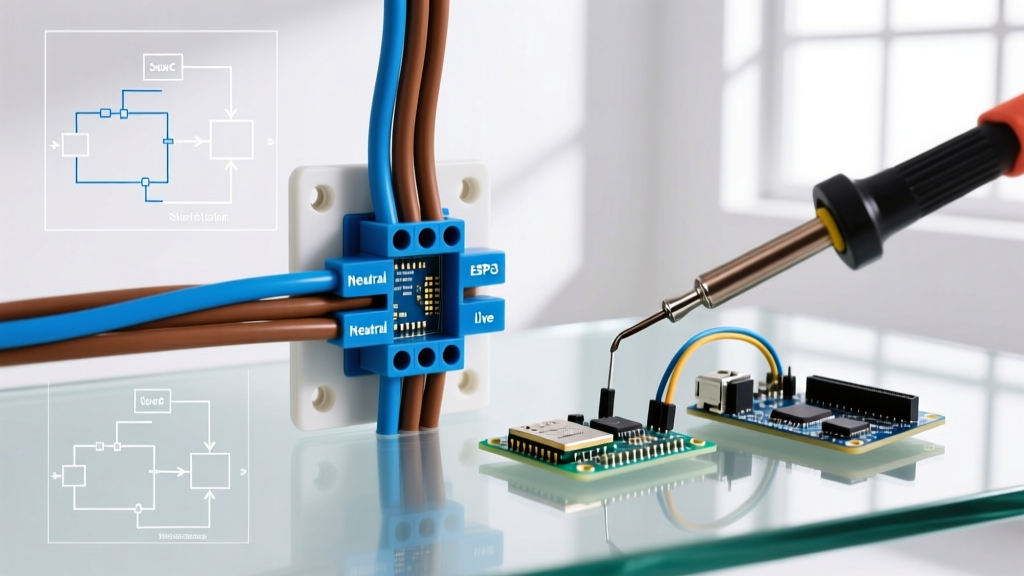
| Single-Phase (230V) | Brown | Blue | Green / Yellow Stripe |
| 3-Phase (400V) | Brown (L1), Black (L2), Gray (L3) | Blue | Green / Yellow Stripe |
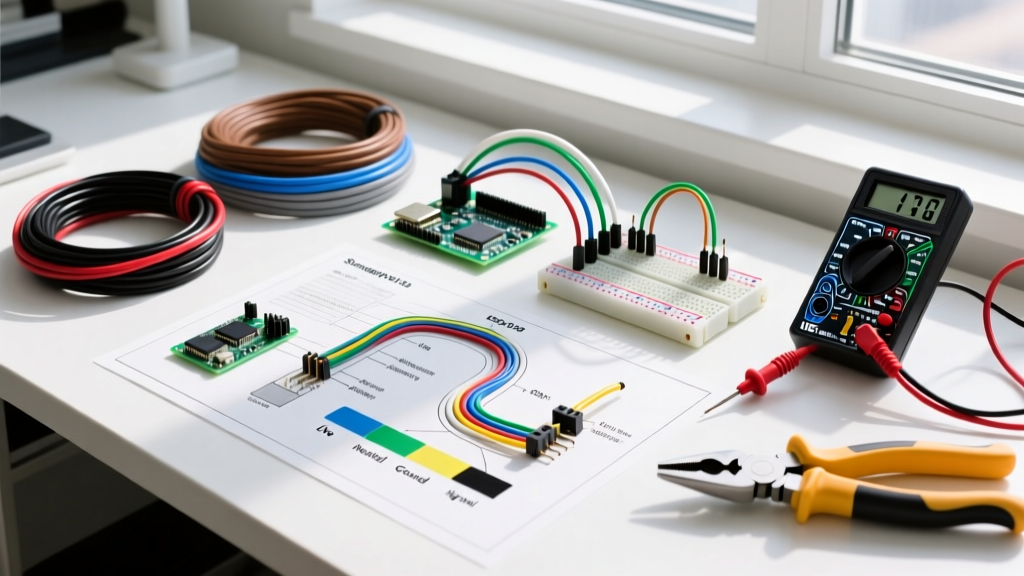
Important Note for Travelers: When working on older UK installations (pre-2004), you will encounter Red (Live) and Black (Neutral). Always test with a multimeter before assuming the wiring has been updated to the modern Brown/Blue IEC standard.
DC Power Circuit Wiring Colors
Direct Current (DC) wiring—common in solar PV arrays, telecommunications, automotive, and off-grid battery banks—follows a different set of rules. The NEC Article 690 (Solar Photovoltaic Systems) and general DC practices dictate the following:
- Red: Positive (+) Ungrounded Conductor.
- Black: Negative (-) Ungrounded Conductor.
- White or Gray: Grounded Conductor (if the DC system is grounded).
- Green or Bare: Equipment Grounding Conductor.
When pulling wire for a 48V telecom battery bank or a 12V marine panel, using standard 10 AWG THHN in Red and Black is the industry standard. Never use white or green for DC hot legs, as this violates OSHA electrical safety identification norms and creates severe shock hazards for technicians assuming the wire is a neutral or ground.
Edge Cases & Special NEC Requirements
True expertise in electrical wiring is demonstrated by knowing how to handle the edge cases that don't fit neatly into standard residential wiring diagrams.
1. The High-Leg Delta (Orange Wire)
In older commercial buildings and certain industrial setups, you may encounter a 240V 3-Phase Delta system with a center-tapped neutral. This creates three different voltages to ground: 120V, 120V, and 208V. The 208V phase is known as the "High Leg" or "Wild Leg." NEC 110.15 strictly requires the high-leg conductor to be identified by an outer finish that is Orange. If you are pulling wire in a high-leg delta panel, Phase B (the high leg) must be Orange THHN. Failing to do so can result in an inspector immediately red-tagging the panel, or worse, an electrician accidentally wiring a 120V receptacle to the 208V high leg.
2. Switch Loops and Re-Identification
In standard residential wiring, a 2-wire NM-B cable (Black, White, Bare) is often used to run power from a ceiling fixture down to a wall switch. In this "switch loop" scenario, the White wire is actually being used as a hot feed to the switch. According to NEC 200.7(C)(2), this white wire must be permanently re-identified at both ends to indicate it is a hot conductor.
Best Practice: Use high-quality phase tape, such as 3M Super 33+ Vinyl Electrical Tape (approx. $4.50 per roll), in Black or Red to wrap the ends of the white wire. Do not rely on cheap, off-brand tape that will dry out, crack, and fall off inside the junction box after five years.
3. Multi-Wire Branch Circuits (MWBC)
An MWBC shares a single neutral (White) between two hot legs (Black and Red) on opposite phases to cancel out the neutral current. The NEC requires these breakers to be tied together with a handle tie so both phases disconnect simultaneously. The colour coding here is vital: if an electrician mistakenly uses Black and Black (from the same phase) instead of Black and Red, the neutral wire will carry the sum of the loads instead of the difference, leading to a melted neutral and a potential fire.
Best Practices for Field Identification
Relying solely on the factory jacket color of NM-B cable or THHN insulation is often insufficient in large commercial pull-boxes or complex smart-home panels. Implement these professional habits:
- Phase Tape Everything: In 3-phase commercial panels, buy bulk rolls of 3M Temflex 1700 or Super 33+ in Black, Red, Blue, Brown, Orange, and Yellow. Tape the last 6 inches of every wire before terminating it on the busbar or breaker.
- Labeling Smart Home Wires: When pulling Cat6 or 18/2 thermostat wire alongside line-voltage, use distinct colors (e.g., Blue for data, Red for fire alarm, White for HVAC) and label both ends with a Brady BMP21-PLUS wire wrap labeler.
- Never Trust the Color Blindly: Always treat every wire as live until tested. In older homes, previous DIYers may have used white wires for hot legs without re-identifying them. A non-contact voltage tester (like the Klein Tools NCVT-3) and a CAT III multimeter are mandatory before touching any conductor.
Summary
Mastering the colour coding for electrical wiring is a baseline requirement for any electrician or advanced DIYer. Whether you are navigating the Black/Red/Blue paradigm of North American 208V systems, the Brown/Black/Gray IEC 3-phase standard, or the critical Orange high-leg delta, strict adherence to code prevents catastrophic failures. Always verify your local jurisdiction's adopted code cycle, use premium re-identification materials, and test before you touch.