
The High Stakes of Residential Electrical Wiring Code
The democratization of home improvement tutorials has empowered countless homeowners to tackle DIY electrical projects. However, there is a vast chasm between watching a five-minute video and understanding the rigorous, life-saving standards of the residential electrical wiring code. The National Electrical Code (NEC), published by the National Fire Protection Association (NFPA), is not merely a suggestion; it is a complex, legally enforceable framework designed to prevent electrical fires and electrocution.
When analyzing DIY versus professional execution, the divergence in code comprehension becomes immediately apparent. Licensed electricians spend years mastering NEC Articles, local amendments, and practical edge cases. DIYers often focus on 'making it work' rather than 'making it compliant.' This article provides a deep-dive analysis into where DIY residential wiring typically fails code inspections, the true cost of non-compliance, and the professional standards that ensure long-term safety.
The Core Framework: NEC 2023 and Beyond
The National Electrical Code (NEC) is updated every three years. As jurisdictions adopt the 2023 NEC (and prepare for the 2026 cycle), requirements for Arc-Fault Circuit Interrupters (AFCI), Ground-Fault Circuit Interrupters (GFCI), and grounding electrode systems have become stricter. A professional electrician's first step is always verifying the local Authority Having Jurisdiction (AHJ) adoption cycle, whereas a DIYer often relies on outdated forum advice.
Expert Insight: 'Making a circuit function is easy. Making a circuit function safely under fault conditions, while dissipating heat and resisting environmental degradation over 40 years, requires strict adherence to the residential electrical wiring code.' — Master Electrician Field Notes.
DIY vs Professional: A Cost and Risk Matrix
While DIY electrical work appears to save money upfront, the hidden costs of code violations—ranging from failed inspections to voided home insurance policies—often outweigh the initial savings. Below is a comparative matrix analyzing a standard 20-amp kitchen small-appliance branch circuit installation.
| Metric | DIY Execution | Professional Execution |
|---|---|---|
| Material Sourcing | Big-box store generic components; mismatched wire gauges. | Wholesale supply houses; specific UL-listed components (e.g., Leviton 20A TR receptacles). |
| Code Knowledge | Relies on outdated YouTube tutorials; misses local AHJ amendments. | Continuous education on NEC 2023/2026 updates and local municipal codes. |
| Permit & Inspection | Often skipped (unpermitted work); risks $500-$2,000 in municipal fines. | Pulled and managed by contractor; inspection passes on the first attempt. |
| Liability & Insurance | Homeowner assumes 100% liability; insurance may deny fire claims. | Covered by contractor's general liability and worker's comp insurance. |
| Testing Protocol | Visual check and flipping the breaker; basic $15 plug-in testers. | Validated with Fluke T6-1000 FieldSense and Megger insulation resistance testers. |
Where DIYers Fail: Top 3 Code Violations
When electrical inspectors evaluate unpermitted or DIY-permitted work, they consistently find the same three categories of residential electrical wiring code violations. Understanding these highlights the technical depth required for professional-grade work.
1. Box Fill Violations (NEC Article 314.16)
The NEC mandates strict cubic-inch volume calculations for junction and device boxes to prevent wire insulation damage and heat buildup. DIYers frequently stuff four or five 12 AWG wires into a standard 18-cubic-inch single-gang 'old work' box.
- The Math: Under NEC Table 314.16(B), each 12 AWG conductor requires 2.25 cubic inches. Each 14 AWG requires 2.0 cubic inches. Internal clamps count as one conductor volume, and the device (switch/receptacle) counts as two conductor volumes.
- The Professional Fix: Pros calculate exact box fill before cutting drywall. For a standard 3-way switch with multiple 12 AWG feeds, a professional will upgrade to a deep 47-cubic-inch masonry box or use a 4-inch square box with a mud ring, ensuring zero stress on wire terminations.
2. AFCI and GFCI Misapplication (NEC 210.12 & 210.8)
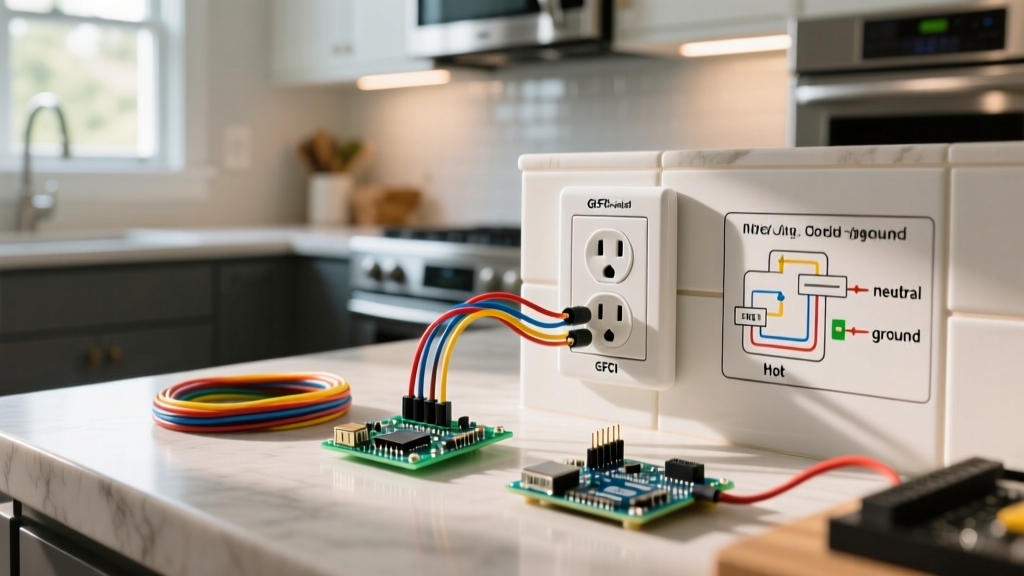
The 2023 NEC expanded GFCI protection requirements and maintained strict AFCI mandates for living spaces. DIYers often confuse the two or fail to apply them correctly.
- GFCI (Ground Fault): Protects against shock. Required in kitchens, bathrooms, garages, outdoors, and within 6 feet of sinks. DIYers often use cheap, non-TR (Tamper Resistant) receptacles that fail inspection.
- AFCI (Arc Fault): Protects against fire by detecting dangerous arcing. Required in bedrooms, living rooms, and closets.
- The Professional Fix: Instead of daisy-chaining receptacles, professionals often install Dual Function (CAFCI/GFCI) circuit breakers at the panel, such as the Eaton BRCAF115 or Siemens Q115DF. While these breakers cost roughly $45 to $60 each (compared to $8 for a standard breaker), they provide comprehensive protection and eliminate the nuisance tripping associated with downstream receptacle wiring errors.
3. Neutral and Ground Bonding in Subpanels (NEC 250.24)
This is arguably the most dangerous and common DIY subpanel mistake. When installing a subpanel (e.g., for a detached garage or basement finish), the NEC strictly requires the separation of the grounded conductor (neutral) and the equipment grounding conductor (ground).
- The DIY Error: DIYers often leave the green bonding screw installed in the subpanel, bonding the neutral bus to the panel enclosure. This creates a parallel neutral path, causing normal return current to flow through the grounding system, which can electrify metal appliance chassis and plumbing.
- The Professional Fix: A licensed electrician will remove the bonding screw or strap in the subpanel. They will install an isolated ground bar (e.g., Square D PK4GTA) and run a dedicated 4-wire feeder (two hots, one neutral, one ground) from the main panel, strictly adhering to NEC 250.32.
The Professional Advantage: Diagnostic Tools and Testing
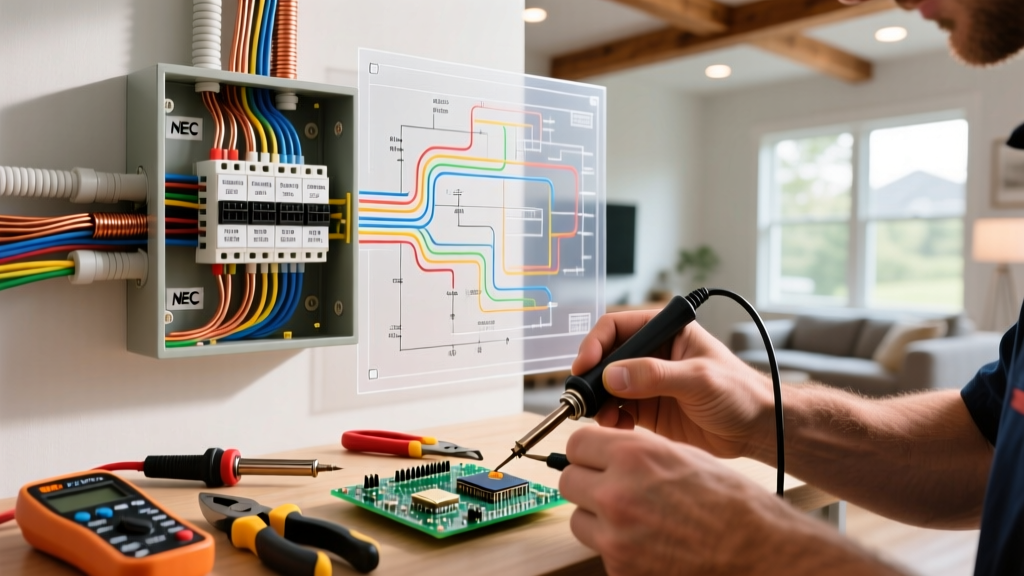
Adhering to the residential electrical wiring code is only half the battle; verifying the installation is the other. According to the Consumer Product Safety Commission (CPSC), faulty wiring is a leading cause of residential fires. Professionals mitigate this risk with specialized diagnostic equipment that goes far beyond a standard multimeter.
- Fluke T6-1000 Electrical Tester: Utilizes FieldSense technology to measure AC voltage and current simultaneously through the jaw, without requiring metal-to-metal contact. This allows pros to verify live circuits safely without exposing bare wire.
- Klein Tools CL800 Clamp Meter: Essential for measuring actual amp draw on a circuit to ensure the continuous load does not exceed 80% of the breaker rating (e.g., 16 Amps on a 20 Amp breaker), a critical NEC 210.20 requirement.
- Megger MIT230 Insulation Tester: Used on long wire runs to test the integrity of the wire insulation by applying a high-voltage DC charge, ensuring no micro-tears occurred during the wire pulling process.
Decision Framework: When to DIY and When to Call a Pro
Not all electrical work requires a master electrician. However, understanding your limits is crucial for maintaining code compliance and personal safety. The Occupational Safety and Health Administration (OSHA) emphasizes that electrical work carries inherent fatal risks if lockout/tagout and verification procedures are not followed.
Safe for Competent DIYers (Permit Usually Not Required)
- Swapping like-for-like receptacles, switches, and light fixtures.
- Replacing a broken GFCI or AFCI receptacle with an identical UL-listed model.
- Installing low-voltage wiring (thermostats, doorbells, network cables).
Strictly Professional Territory (Permit and Inspection Mandatory)
- Upgrading the main electrical service (e.g., 100A to 200A).
- Installing new branch circuits or extending existing ones into new rooms.
- Wiring subpanels, detached garages, or outdoor workshops.
- Any work involving the main service disconnect or meter base.
Frequently Asked Questions
How much does an electrical permit and inspection cost?
Permit costs vary wildly by municipality, typically ranging from $50 for a simple circuit addition to $300+ for a service upgrade. However, if a DIYer is caught doing unpermitted work, the AHJ can issue a 'Stop Work' order and levy fines ranging from $500 to $2,000, requiring the walls to be opened for inspection.
Can I use 14 AWG wire on a 20-amp breaker?
Absolutely not. NEC 240.4(D) strictly limits 14 AWG copper to 15-amp overcurrent protection. Using 14 AWG on a 20-amp breaker is a severe fire hazard, as the wire will overheat and melt before the breaker trips. Professionals exclusively use 12 AWG THHN/THWN for 20-amp circuits to ensure a robust safety margin.
Will my home insurance cover an electrical fire if the work was DIY?
If the fire is traced back to unpermitted, non-compliant DIY electrical work that violates the residential electrical wiring code, your insurance provider has grounds to deny the claim. Professional work, backed by municipal inspection sign-offs, provides a legal paper trail that protects your coverage.