
The True Cost of Electrical Wiring of a Building in 2026
Estimating the cost of the electrical wiring of a building requires moving beyond simplistic 'per square foot' averages. In 2026, fluctuating copper markets, updated National Electrical Code (NEC) mandates, and regional labor shortages have created a highly variable pricing landscape. Whether you are a general contractor budgeting for a new commercial plaza or a homeowner planning a custom build, understanding the granular costs of materials, labor phases, and code compliance is critical to avoiding mid-project budget overruns.
2026 Quick Cost Summary:- Residential New Construction: $4.50 to $8.50 per square foot
- Commercial Office/Retail: $7.00 to $14.00 per square foot
- Industrial/Heavy Manufacturing: $15.00 to $25.00+ per square foot
Material Costs: Wire, Conduit, and Distribution
Material costs typically account for 30% to 40% of the total electrical budget. In 2026, copper prices have stabilized compared to the peaks of the early 2020s, but aluminum feeder cables remain highly sensitive to global smelting outputs. Below is a breakdown of core material costs based on current wholesale-to-contractor pricing.
| Material Specification | 2026 Unit Cost Range | Primary Application |
|---|---|---|
| 12 AWG THHN Copper (Stranded) | $0.18 - $0.26 / linear ft | Standard 20A branch circuits |
| 4/0 AWG XHHW-2 Aluminum | $2.40 - $3.15 / linear ft | Service entrance feeders (200A) |
| 3/4" EMT Conduit (Galvanized) | $0.45 - $0.65 / linear ft | Commercial exposed wall/ceiling runs |
| Schedule 40 PVC Conduit (1") | $0.30 - $0.45 / linear ft | Underground service laterals |
| 200A Main Breaker Panel (Square D) | $180 - $280 | Residential main service distribution |
| 400A Panelboard (Eaton/Siemens) | $1,400 - $2,400 | Commercial sub-distribution |
| 480V to 120/208V Step-Down Transformer | $2,800 - $4,500 | Commercial 3-phase power conditioning |
Labor Rates and Electrician Hourly Costs
Labor represents the largest single expense in any wiring project, often consuming 50% to 60% of the total budget. According to the U.S. Bureau of Labor Statistics, the median wage for electricians hovers around $31.50 per hour. However, the burdened contractor billing rate—which includes insurance, overhead, vehicle costs, and profit margins—is significantly higher.
2026 Burdened Billing Rates by Tier
- Apprentice Electrician: $55 - $75 per hour (Limited to supervised rough-in and material handling)
- Journeyman Electrician: $85 - $120 per hour (Branch circuit pulling, device termination, troubleshooting)
- Master Electrician / Foreman: $130 - $175 per hour (System design, panel balancing, code inspections, 3-phase switchgear)
Pro-Tip for General Contractors: In high-cost-of-living metros (e.g., San Francisco, New York, Boston), expect journeyman billing rates to push past $145 per hour. In the Midwest and Southeast, rates remain closer to the $85 baseline.
Phase-by-Phase Installation Cost Breakdown
The electrical wiring of a building is not executed in a single sweep. It is divided into distinct phases, each with its own cost profile and labor intensity.
- Phase 1: Underground and Service Entrance (10% of Budget)
This involves trenching, laying Schedule 40 or 80 PVC, pulling heavy-gauge service entrance cables, and setting the utility meter base. Costs here are heavily dictated by soil conditions and the distance from the utility transformer to the building's main disconnect. - Phase 2: Rough-In (35% of Budget)
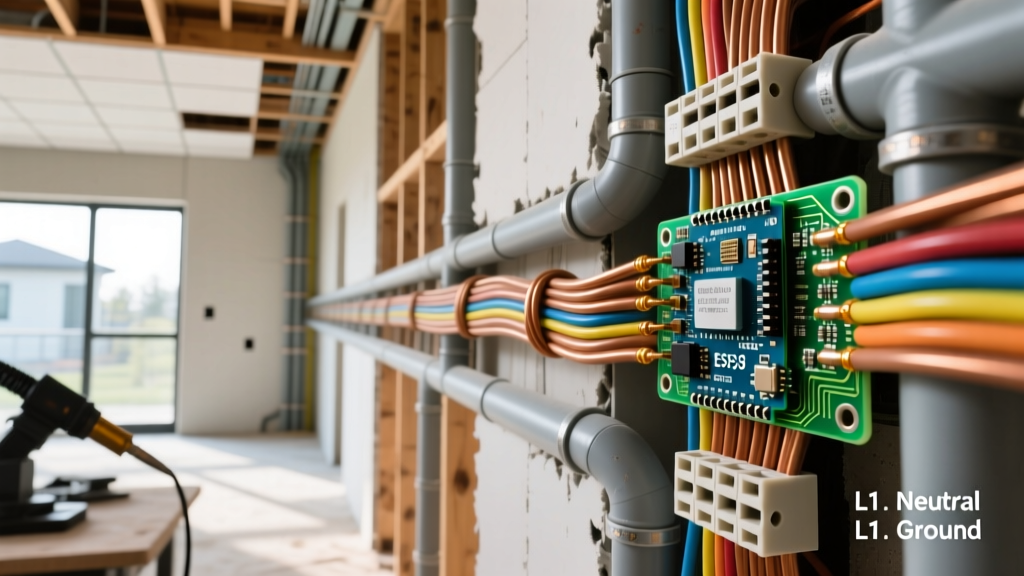
Executed while wall cavities are open. Electricians drill framing studs, mount junction boxes, and pull miles of Romex (NM-B) or THHN through EMT conduit. This phase is highly labor-intensive and requires precise coordination with HVAC and plumbing trades to avoid spatial conflicts. - Phase 3: Top-Out / Ceiling Grid (15% of Budget)
Specific to commercial buildings, this phase involves installing lighting fixtures, HVAC disconnects, and fire alarm strobes into suspended ceiling grids before the drop tiles are laid. - Phase 4: Trim-Out and Termination (30% of Budget)
The most meticulous phase. Electricians terminate wires at receptacles, switches, and panelboards. Errors here cause breakers to trip or devices to fail. This phase also includes programming smart lighting control systems and labeling all circuit directories to NEC standards. - Phase 5: Testing and Commissioning (10% of Budget)
Megger testing, ground fault loop impedance testing, and thermal imaging of loaded panelboards to ensure no loose connections are generating excess heat.
Commercial vs. Residential Wiring Variables
The complexity of the electrical wiring of a building scales exponentially when moving from residential to commercial applications. Residential builds typically rely on single-phase 120/240V split-phase systems. Commercial buildings, however, require three-phase power to run heavy HVAC chillers, elevators, and industrial machinery.
The Cost Impact of Three-Phase Power
Upgrading a building to a 480V/277V 3-phase wye system requires specialized switchgear, larger conduit bends, and step-down transformers for standard 120V receptacle loads. Furthermore, commercial spaces must comply with strict energy codes. According to the U.S. Department of Energy, modern commercial buildings must integrate advanced lighting controls, occupancy sensors, and automated daylight harvesting systems, which can add $1.50 to $3.00 per square foot to the electrical budget.
Code Compliance Alert: The transition to the 2023 and upcoming 2026 editions of the National Electrical Code (NFPA 70) has drastically expanded the requirements for Arc-Fault Circuit Interrupters (AFCI) and Ground-Fault Circuit Interrupters (GFCI). Budget an additional $15 to $25 per circuit breaker to accommodate these code-mandated safety devices in both residential and commercial spaces.
Hidden Costs: Permits, Inspections, and Engineering
First-time developers often overlook the soft costs associated with electrical installations. These 'hidden' fees can add 5% to 12% to your total electrical budget.
- Electrical Engineering / Drafting: $1,500 - $5,000. Required for commercial buildings to produce stamped load calculation sheets, voltage drop calculations, and short-circuit current availability (SCCA) studies.
- Municipal Permitting: $500 - $3,500. Based on the total valuation of the electrical contract. Some jurisdictions charge a flat fee per square foot, while others charge per circuit or panelboard.
- Utility Tap Fees: $2,000 - $15,000+. If the local utility must install a new pad-mounted transformer or upgrade the overhead distribution lines to serve your building's load, these fees are passed directly to the property owner.
- Temporary Power Poles: $800 - $1,500. Required during the 6-12 month construction phase before the permanent service is energized.
Frequently Asked Questions (FAQ)
Can I save money by using aluminum wire instead of copper?
Yes, but only in specific applications. Aluminum (specifically XHHW-2 or THHN-2 AA-8000 series alloy) is highly cost-effective for large feeder cables (e.g., 2 AWG and larger) and service entrance conductors. However, it is rarely used for branch circuits (15A and 20A receptacles) in modern construction due to termination complexities and the need for specialized CO/ALR rated devices or anti-oxidant pastes.
How long does the electrical wiring of a building take?
For a standard 2,500 sq. ft. residential home, the electrical rough-in and trim-out will take a two-man crew approximately 3 to 5 weeks of active work, spread across the broader construction timeline. A 10,000 sq. ft. commercial office space typically requires 8 to 14 weeks of electrical labor, heavily dependent on the complexity of the lighting control systems and HVAC integration.
Does adding EV charging infrastructure significantly increase wiring costs?
Integrating Electric Vehicle (EV) charging during new construction is vastly cheaper than retrofitting. Running an empty 1.5" PVC conduit from the main panel to the garage or parking lot costs roughly $150 to $300 per run. Pulling the wire and installing a Level 2 (40A-80A) hardwired charger later will cost $800 to $1,500 per stall. If you plan for it during the initial build, you future-proof the building with minimal upfront capital.