
The Reality of Series Electrical Wiring in Residential DIY
When homeowners begin exploring electrical DIY projects, one of the most common points of confusion is the concept of series electrical wiring. In popular culture and basic grade-school science experiments, wiring components in a series loop is the standard way to light up a bulb. However, in modern residential construction, series wiring is strictly prohibited for standard 120V and 240V branch circuits. If you wire your living room receptacles in series and one wire nut fails or a single device shorts, every single outlet downstream loses power.
Yet, series electrical wiring still holds critical, code-compliant applications in the modern home. From switch control legs to low-voltage landscape lighting and smart-home sensor loops, understanding how to safely deploy series circuits is a hallmark of an advanced DIYer. This guide breaks down the physics, the practical applications, and the strict National Electrical Code (NEC) boundaries you must respect in 2026.
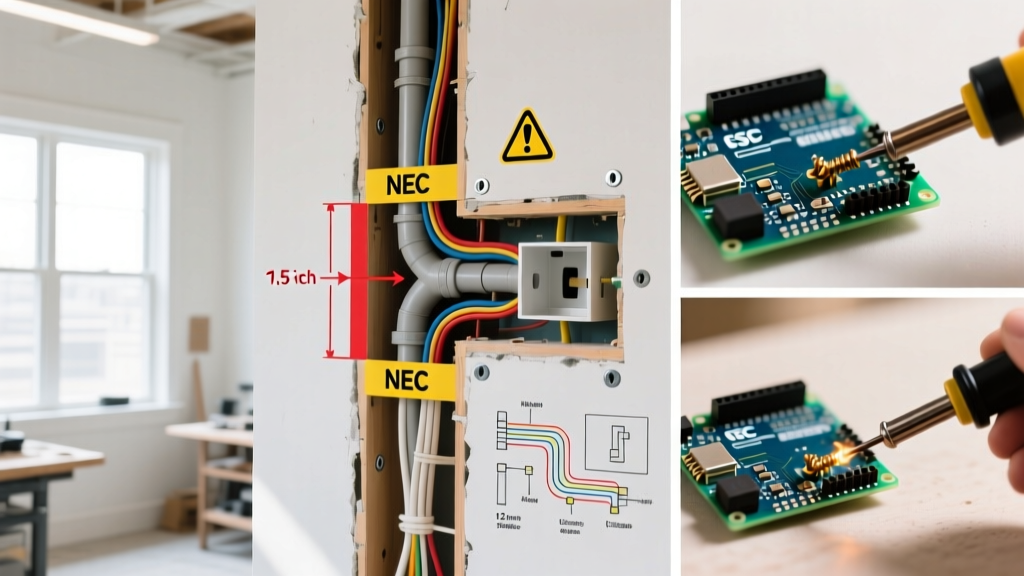
Safety Warning: Never wire 120V/240V receptacles, hardwired appliances, or standard lighting fixtures in series. The NEC mandates parallel wiring for branch circuits to ensure independent operation and proper overcurrent protection. Always consult the NFPA 70 National Electrical Code before altering your home's high-voltage infrastructure.
The Physics: How Series Circuits Behave
Before picking up your wire strippers, you must understand the electrical behavior of a series circuit. According to fundamental circuit theory documented by Georgia State University's HyperPhysics, a series circuit provides only a single path for current to flow. This results in three immutable rules:
- Current is Constant: The amperage (I) is exactly the same at every point in the circuit ($I_{total} = I_1 = I_2$).
- Voltage Divides: The total voltage is divided among the components based on their resistance ($V_{total} = V_1 + V_2 + ...$).
- Resistance Adds Up: The total resistance is the sum of all individual resistances ($R_{total} = R_1 + R_2 + ...$).
Because voltage drops across each component, wiring multiple 120V incandescent bulbs in series on a standard 120V residential breaker will result in dim, underpowered lights. Furthermore, if the continuity of the wire is broken at any single point, the entire circuit dies instantly. This "single point of failure" is exactly why series wiring is banned for general home power distribution.
Valid Home Applications for Series Wiring
Despite the restrictions on branch circuits, series electrical wiring is the backbone of several essential home systems.
1. Switch Loops and Control Legs
Every standard single-pole light switch in your home is wired in series with the lighting load. The switch acts as a deliberate, controllable point of resistance (an open or closed gap) on the hot leg. When you flip the switch off, you break the series path, halting current flow. In 3-way and 4-way switch configurations (used for stairwells and hallways), the traveler wires create a complex series-logic loop that allows multiple physical switches to control a single load by alternating the series path.
2. 12V/24V Low-Voltage Landscape Lighting
The most common place DIYers encounter series wiring is in outdoor landscape lighting. While technically a "daisy-chained" parallel-series hybrid, the main trunk line from the transformer to the final fixture operates as a continuous series run. Because modern LED fixtures draw very little current (often just 2 to 5 watts each), the voltage drop across the series wire run is manageable, provided you calculate the wire gauge correctly. The U.S. Department of Energy notes that proper low-voltage wiring requires careful attention to distance and wire thickness to prevent premature LED driver failure.
3. Holiday and Decorative Lighting
Traditional C7 and C9 incandescent holiday light strings are wired in series. This is why when one bulb burns out and the internal shunt fails, the entire strand goes dark. While modern commercial LED holiday lights use parallel-wired sub-sections to prevent total failure, vintage and specialty decorative series loops are still prevalent in home seasonal setups.
Series vs. Parallel: Quick Comparison Matrix
| Feature | Series Electrical Wiring | Parallel Wiring (Standard Home) |
|---|---|---|
| Current Flow | Single path; constant amperage | Multiple paths; amperage divides |
| Voltage | Drops across each component | Constant across all components |
| Failure Mode | One break kills the whole circuit | One break affects only that branch |
| Wire Gauge Sizing | Based on total run length & drop | Based on total max amperage load |
| Primary Home Use | Switch legs, 12V landscape, sensors | 120V/240V receptacles, hardwired lights |
Step-by-Step: Wiring a 12V Series Landscape Run
Let's apply series electrical wiring to a practical 2026 home project: installing a 12V LED landscape path lighting system using a 300W VOLT Lighting Pro transformer.
- Calculate the Load and Voltage Drop: Suppose you are running 8 LED path lights, each drawing 3W (24W total). At 12V, the current is 2 Amps. Using the voltage drop formula $VD = \frac{2 \times K \times I \times L}{CM}$ (where K=12.9 for copper, I=2A, L=100ft one-way, and CM is circular mils), 14 AWG wire will yield a drop of roughly 0.77V. This is well within the acceptable 10% limit for LED drivers.
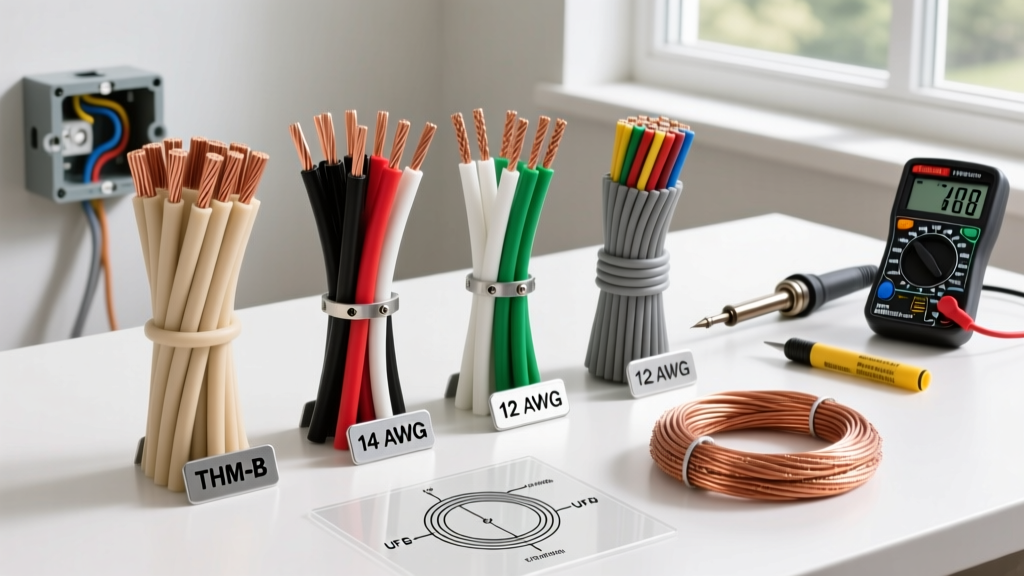
- Trench and Lay the Wire: Dig a shallow 3-inch trench. Lay a continuous run of 14 AWG or 12 AWG direct-burial low-voltage wire from the transformer to the final fixture location. Do not cut the wire at each fixture.
- Create the Series Tap Connections: At each fixture location, strip a 1-inch window of insulation from the main trunk wire without cutting the copper conductors. This maintains the series continuity of the main loop.
- Connect the Fixtures: Use silicone-filled, moisture-sealed wire connectors (such as King Innovation DryConn or VOLT Lighting Twist-on Connectors). Connect the fixture's positive lead to the uncut positive trunk, and the negative to the negative.
- Terminate at the Transformer: Connect the start of the series run to the 12V or 14V taps on the multi-tap transformer. If your voltage drop calculation at the furthest fixture is slightly high, use the 14V tap to compensate.
Troubleshooting Open Circuits with a Multimeter
The primary drawback of series electrical wiring is the "dead string" effect. If your landscape lights or switch loop fails entirely, you have an open circuit. Here is how to isolate the fault using a digital multimeter like the Fluke 117:
- Step 1: Verify Source Voltage. Set your multimeter to AC Voltage (for switch legs) or DC/AC Voltage (depending on your landscape transformer). Test the source terminals to ensure power is leaving the panel or transformer.
- Step 2: The Halving Method. If a 100-foot series landscape run is dead, go to the physical midpoint (fixture #4 out of 8). Disconnect the wire nut and test for voltage. If you have 12V at the midpoint, the break is in the second half of the run. If you have 0V, the break is in the first half.
- Step 3: Continuity Testing. Turn off the power completely. Switch your Fluke 117 to the Continuity setting (the diode/sound wave icon). Test the disconnected wire segments. A continuous beep indicates a healthy wire; silence indicates a severed conductor, often caused by shovel damage or rodent chewing.
NEC Code Restrictions and Safety Boundaries
As a home DIYer, your enthusiasm for series electrical wiring must always be tempered by the National Electrical Code. Under NEC Article 210 (Branch Circuits) and Article 240 (Overcurrent Protection), all standard household receptacles and lighting outlets must be wired in parallel. This ensures that a 15A or 20A breaker accurately senses the cumulative current draw of all devices on the circuit.
If you were to wire five 1000W space heaters in series on a 120V circuit, the resistance would skyrocket, current would plummet, and the heaters would barely generate heat—while the wiring itself might overheat due to improper load balancing. Conversely, if you wire them in parallel, they draw roughly 41A combined, which will instantly and safely trip a 20A breaker, preventing a house fire.
Respect the boundaries: keep series wiring confined to low-voltage control circuits, switch legs, and specialized landscape applications. When in doubt, pull a permit and consult a licensed master electrician to ensure your home project is both functional and legally compliant.