
The Hidden Hazards Behind the Drywall
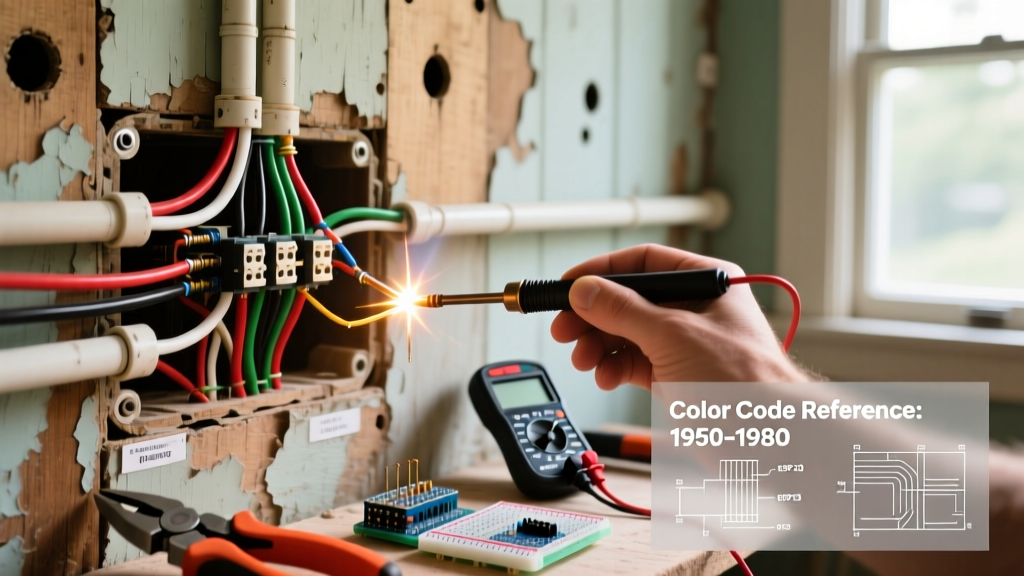
Planning a renovation on a mid-century or older home? Peeling back plaster and drywall often reveals a tangled, undocumented history of electrical work. For modern DIYers and contractors, understanding old house electrical wiring colors is not just a matter of code compliance; it is a critical, life-saving safety step. Today, electricians rely on a strict paradigm: black for hot, white for neutral, and green or bare copper for ground. However, historical wiring frequently breaks these modern rules, creating severe shock and fire hazards for the unprepared renovator.
Before you swing a hammer or drill into a stud cavity in 2026, you must understand how wire insulation colors, materials, and applications have evolved over the last century. Misidentifying a conductor in a 1950s switch loop or a 1970s aluminum branch circuit can lead to catastrophic failure modes, including arc faults and electrical fires.
The Evolution of Wire Insulation Colors (1920–1980)
The color of the wire insulation in older homes was often dictated by the manufacturing capabilities of the era rather than a universal safety code. Below is a breakdown of what you will encounter when opening up walls in pre-1980 construction.
| Era | Wire Type | Typical Colors | Primary Hazards & Renovation Notes |
|---|---|---|---|
| 1920–1940 | Knob-and-Tube (K&T) | Black, White (often faded to grey/brown) | Brittle rubber insulation, no equipment ground, splices hidden in walls. |
| 1940–1960 | Cloth-Covered NM | Black, White, Grey outer braid | Asbestos in outer braid, inner rubber cracks when bent, no ground wire. |
| 1960–1970 | Early PVC NM-B | Black, White, Bare Copper | Introduction of ground, but early PVC degrades under high heat. |
| 1965–1973 | Aluminum NM | Black, White, Grey (marked 'AL') | High thermal expansion, oxidation at copper terminals causes arcing. |
Decoding Specific Historical Wiring Systems
Knob-and-Tube: When Black and White Look Identical
Knob-and-tube (K&T) wiring was the standard from the 1880s through the 1930s. Originally, K&T utilized rubber insulation covered by a cotton or loom braid. The hot wire was typically black, and the neutral was white. However, after 80+ years of exposure to heat, dust, and nicotine from indoor smoking, both wires often fade to an identical, crusty grey or brown.
Renovation Action: Never assume polarity in a K&T system based on visual color. You must use a digital multimeter to verify the hot conductor. Furthermore, K&T lacks an equipment grounding conductor. According to the National Electrical Code (NEC), you cannot simply add a three-prong receptacle to an ungrounded K&T circuit without installing a GFCI (Ground Fault Circuit Interrupter) and labeling it 'No Equipment Ground'.
The Cloth-Covered Era and Asbestos Risks
In the 1940s and 1950s, non-metallic (NM) sheathed cable featured a braided cotton outer jacket. While the inner wires were still colored black and white, the outer jacket was often white, grey, or black. When renovating, the primary concern here is not just the electrical color code, but the material composition. Many manufacturers used asbestos fibers in the outer braid to increase heat resistance. Disturbing this wiring during demolition requires proper PPE and, in some jurisdictions, professional abatement.
The Aluminum Wiring Anomaly (1965–1973)
During the copper shortage of the mid-1960s, builders switched to aluminum branch circuit wiring. The insulation colors remained standard (black, white, bare), making it visually indistinguishable from copper NM cable at a glance. You must strip back a small section of insulation or check the cable jacket for the stamped letters 'AL' or 'ALUM'.
Industry Data: According to the Consumer Product Safety Commission (CPSC), homes wired with pre-1972 aluminum wire are 55 times more likely to have one or more connections reach fire hazard conditions compared to homes wired with copper. Aluminum expands and contracts significantly more than copper, causing screw-terminal connections at receptacles to loosen, arc, and ignite surrounding wood framing.
The 'Switch Loop' Trap: When White Isn't Neutral
The most dangerous color-code misconception in old house renovations involves the 'switch loop.' Prior to the 2011 NEC update (NEC 404.2(A)(1)), electricians were allowed to use a standard 2-wire cable (black and white) to run power from a ceiling fixture down to a wall switch.
In this configuration, the white wire was used as the always-hot feed down to the switch, and the black wire returned the switched power up to the light. The NEC required the white wire to be re-identified with black tape or paint, but in practice, this was almost never done.
The 2026 Smart Home Failure Mode: Renovators installing modern smart switches (which require a dedicated neutral wire) often open the switch box, see the white wire, and connect it to the smart switch's neutral pigtail. Because that white wire is actually carrying 120V of live current, this creates an immediate dead short, destroying the switch, tripping the breaker, and potentially causing an arc flash.
Essential Diagnostic Tools for 2026 Renovations
To safely navigate unpredictable historical wiring colors, you must move beyond basic neon circuit testers. Equip your renovation toolkit with these professional-grade diagnostics:
- Fluke 117 True-RMS Digital Multimeter (~$215): Essential for verifying neutral vs. ground and identifying ghost voltages. Its 'LoZ' (Low Impedance) mode prevents false readings caused by capacitive coupling in old, unshielded cloth cables.
- Klein Tools NCVT-3 Non-Contact Voltage Tester (~$32): Features dual-range detection (12V to 1000V). Crucial for scanning walls for live K&T wires before cutting into plaster.
- Knipex 1101150 Standard Cutter (~$45): When stripping 60-year-old rubber insulation, standard wire strippers will tear the brittle jacket and score the copper. Precision flush cutters allow you to score the insulation longitudinally and peel it back without damaging the conductor.
Action Plan: Budgeting and Remediation
When planning your renovation budget, you must account for the inevitable electrical upgrades required when dealing with outdated color codes and ungrounded systems. Here is a realistic cost breakdown for 2026:
Option A: Targeted Pigtail Remediation (Aluminum Wiring)
If your home has aluminum wiring with standard black/white colors, a full rewire may not be immediately feasible. The accepted remediation is pigtail remediation using COPALUM crimps or AlumiConn lug connectors.
- Material Cost: Ideal Industries AlumiConn 2-Port connectors cost approximately $3.50 each.
- Labor Cost: Expect to pay $15 to $25 per connection point (receptacle, switch, or junction box) for a licensed electrician to perform the pigtailing.
- Total for 2,000 sq. ft. home: $2,500 – $4,500.
Option B: Full Home Rewire
If your home features a chaotic mix of K&T, cloth-covered NM, and early PVC with misidentified colors, the Electrical Safety Foundation International (ESFI) strongly recommends a complete rewire to bring the home up to modern safety standards.
- Cost per Square Foot: $8.00 to $12.00.
- Total for 2,000 sq. ft. home: $16,000 – $24,000.
- Timeline: 7 to 14 days of active labor, requiring extensive drywall patching and painting afterward.
Frequently Asked Questions
Can I just paint the white wire black if I use it as a hot?
Under current NEC guidelines, re-identifying a white wire as a hot conductor is permitted in specific scenarios (like switch loops or conduit runs) using permanent markers, tape, or paint. However, in old cloth-covered wiring, the porous surface absorbs paint and tape adhesives fail over time. It is always safer to pull a new, code-compliant NM-B cable with the correct factory color coding.
Why do some old houses have red wires?
Red wires in older homes typically indicate a 240-volt circuit (like an electric range or baseboard heater) or a three-way switch configuration. In mid-century multi-wire branch circuits (MWBC), a red wire and a black wire share a single neutral white wire, drawing from opposite phases of the electrical panel. Always turn off both breakers (or use a handle tie) before working on MWBCs.
Is it safe to mix old and new wiring?
You can transition from old wiring to new NM-B cable, but the junction must occur inside an accessible, code-approved junction box. You cannot simply twist old cloth-covered wires together with new THHN copper inside a wall cavity and wrap it in electrical tape. Use wire connectors rated for the specific gauge and material, and ensure the old insulation is not so brittle that it crumbles when pushed back into the box.