
The Critical Role of Electrical Wiring Terminals in Commercial Infrastructure
In commercial and industrial electrical systems, the termination point is statistically the most vulnerable link in the power distribution chain. According to the National Fire Protection Association (NFPA), loose or degraded connections at electrical wiring terminals are a leading cause of electrical fires in commercial buildings. When managing 480V/277V 3-phase systems, motor control centers (MCCs), and high-capacity panelboards, the selection, preparation, and torquing of lugs and terminals dictate the long-term reliability of the entire installation.
This guide provides commercial electricians, project managers, and maintenance engineers with a deep-dive into heavy-duty electrical wiring terminals. We will cover material science, exact torque mandates, failure mode analysis, and field-proven termination protocols for high-amperage commercial environments.
Anatomy of Commercial Terminal Types
Unlike residential wiring, which relies heavily on simple screw-terminal receptacles and wire nuts, commercial infrastructure requires heavy-duty lugs capable of handling 600V and currents ranging from 100A to 3000A+.
1. Mechanical Set-Screw Lugs
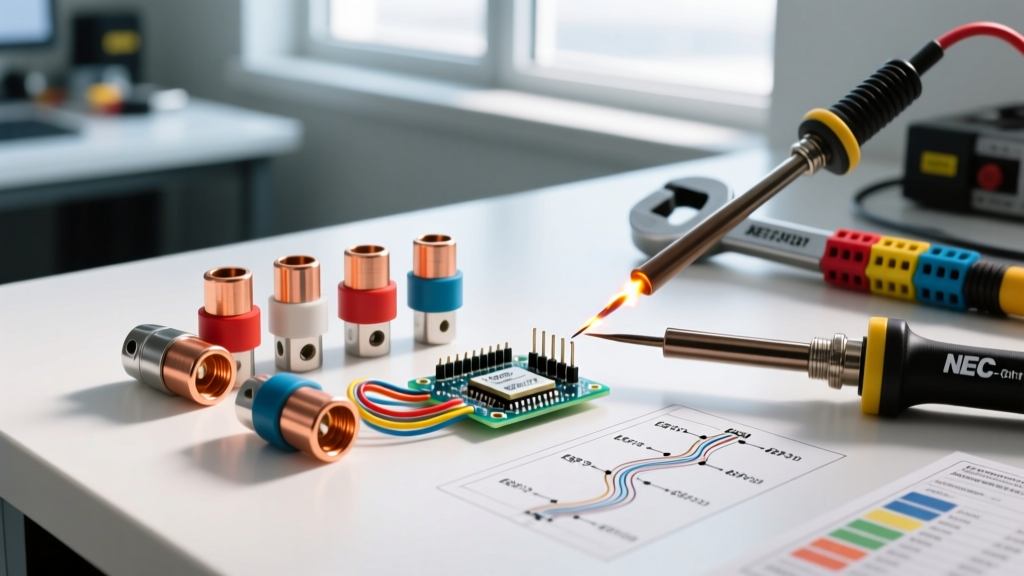
The workhorse of commercial panelboards. These feature a threaded barrel with one or two set-screws that bite into the conductor. Modern dual-rated mechanical lugs are machined from 6061-T6 aluminum alloy and are tin-plated to accept both copper and aluminum conductors. They are highly reusable and allow for visual inspection of wire insertion depth.
2. Compression Terminals
Compression lugs require a specialized hydraulic or manual crimping tool with matched dies. Once crimped, the terminal forms a cold-weld, gas-tight seal around the conductor. These are mandatory for high-vibration environments (e.g., heavy manufacturing floors, generator sets) and underground vaults where moisture ingress is a concern. They cannot be reused once crimped.
3. Shear-Bolt Connectors
A newer innovation gaining massive traction in commercial retrofits. Shear-bolt lugs feature hex-head bolts with engineered breakaway necks. The installer tightens the bolt with a standard socket wrench until the head shears off at a precise, factory-calibrated torque value. This eliminates human error in torque application and removes the need for expensive calibrated torque wrenches in cramped panel spaces.
Material Science: Aluminum vs. Copper and Galvanic Risks
The vast majority of commercial electrical wiring terminals and panelboard busbars are manufactured from aluminum due to its superior weight-to-cost ratio. However, mixing aluminum lugs with copper conductors introduces severe electrochemical risks.
Expert Warning: Never rely solely on the tin-plating of a dual-rated lug to prevent galvanic corrosion in damp commercial environments (e.g., wastewater treatment plants, food processing facilities). Always apply a high-grade antioxidant joint compound.
When moisture acts as an electrolyte between copper and aluminum, rapid galvanic corrosion occurs, creating aluminum oxide. Aluminum oxide is a highly resistive insulator. As resistance increases, the terminal heats up, accelerating the corrosion in a catastrophic thermal runaway loop.
NEC Torque Mandates and Specification Matrix
The National Electrical Code (NEC) Section 110.14(D) strictly mandates that all electrical wiring terminals must be tightened to the torque values specified by the manufacturer using calibrated tools. The Occupational Safety and Health Administration (OSHA) frequently cites contractors who cannot produce calibration certificates for their torque tools during site inspections.
Below is a reference matrix for standard dual-rated aluminum mechanical lugs terminating copper conductors. Always verify with the specific manufacturer's data sheet, as thread pitch and screw head designs vary.
| Conductor Size (AWG/kcmil) | Typical Torque (in-lbs) | Typical Torque (N-m) | Recommended Tool Type |
|---|---|---|---|
| #4 - #2 AWG | 45 - 50 in-lbs | 5.1 - 5.6 N-m | 1/4" Drive Dial/Digital Torque Wrench |
| #1 - 2/0 AWG | 100 - 150 in-lbs | 11.3 - 16.9 N-m | 3/8" Drive Click or Digital Torque Wrench |
| 3/0 - 4/0 AWG | 200 - 250 in-lbs | 22.6 - 28.2 N-m | 1/2" Drive Calibrated Torque Wrench |
| 250 - 500 kcmil | 375 - 500 in-lbs | 42.4 - 56.5 N-m | 1/2" Drive Heavy-Duty Torque Wrench |
| 600 - 750 kcmil | 600 - 900 in-lbs | 67.8 - 101.7 N-m | 3/4" Drive Industrial Torque Wrench / Multiplier |
Common Failure Modes in Commercial Terminations
Understanding how electrical wiring terminals fail allows commercial electricians to implement preventative measures during the rough-in and termination phases.
1. Cold Flow (Thermal Cycling Creep)
Aluminum conductors exhibit "cold flow" or creep. Under the constant pressure of a set-screw, aluminum slowly deforms and extrudes outward over time. When the commercial building's HVAC systems cycle on and off, the massive inrush currents cause the wire to heat and expand, then cool and contract. This thermal cycling accelerates cold flow, resulting in a loose connection and subsequent arcing within 2 to 5 years if not re-torqued.
2. Harmonic Neutral Overloading
Modern commercial buildings are saturated with non-linear loads: LED lighting drivers, variable frequency drives (VFDs), and server UPS systems. These loads generate triplen harmonics (3rd, 9th, 15th) that do not cancel out in the neutral busbar but instead stack arithmetically. It is common to see neutral currents exceeding 120% of the phase currents. If the neutral electrical wiring terminals are not sized and torqued identically to the phase lugs, the neutral bus will overheat and melt.
3. Stranding Damage During Preparation
Using a standard ring-style wire stripper on large-stranded commercial wire (e.g., 3/0 AWG THHN) often nicks the outer copper strands. A nicked strand creates a localized stress point. Under high fault currents, the conductor will snap at the termination point, causing a phase-to-ground arc flash.
Step-by-Step Commercial Termination Protocol
To ensure compliance with NETA (InterNational Electrical Testing Association) acceptance testing specifications, follow this rigorous termination protocol for mechanical lugs:
- Precision Stripping: Use a calibrated, adjustable insulation stripping tool. Strip the insulation exactly to the depth gauge of the specific lug barrel. Do not score the outer strands.
- Wire Brushing (For Aluminum Conductors): If terminating aluminum wire, use a stainless-steel wire brush to remove the microscopic layer of aluminum oxide immediately before termination. Note: Do not wire brush copper; it is unnecessary and removes the protective tin-plating on the strands.
- Antioxidant Application: Apply a generous coat of NOALOX or equivalent zinc-dust antioxidant compound to the stripped conductor and inside the lug barrel. This compound excludes oxygen and prevents oxide reformation.
- Seating the Conductor: Insert the wire fully into the barrel. Ensure no bare strands are splaying outside the lug (which reduces the effective contact area and creates shock hazards).
- Calibrated Torquing: Using a recently calibrated torque wrench (calibration must be within the last 12 months or 5,000 cycles), tighten the set-screw to the manufacturer's exact specification. Apply steady, continuous force; do not "jerk" the wrench.
- Torque Seal Application: Apply a brightly colored, UV-resistant torque seal (inspection lacquer) across the set-screw and the lug body. This provides a visual indicator for future maintenance teams to instantly identify if the screw has backed out due to vibration or thermal cycling.
2026 Product Spotlight and Pricing Guide
Procurement for commercial projects requires balancing upfront material costs with long-term reliability. Below is a snapshot of heavy-duty electrical wiring terminals frequently specified in commercial bids:
- Ilsco TA Series (Dual-Rated Mechanical): The industry standard for panelboards. A TA-4/0-1/0 lug typically costs between $9.50 and $13.00 per unit in bulk contractor packs. Excellent for general distribution panels.
- Burndy YAV Series (Compression): Features a narrow tongue design ideal for tight MCC busbar spacing. A YAV28L (for 4/0 AWG) retails around $18.00 to $24.00. Requires expensive matched-die hydraulic crimpers, but offers superior vibration resistance.
- Panduit LCA Series (Shear-Bolt): Premium pricing at $45.00 to $65.00 per lug for large sizes (350 kcmil+), but saves up to 40% in labor time by eliminating the need for torque wrenches and reducing installer fatigue in overhead commercial cable tray terminations.
Conclusion: The Value of Preventative Thermography
Even with perfect installation techniques, commercial electrical wiring terminals are subject to environmental stressors, building settlement, and grid fluctuations. Best practice dictates that all newly installed commercial switchgear and panelboards undergo a baseline infrared thermographic scan 30 days after initial energization, and annually thereafter. By combining rigorous termination protocols with modern diagnostic imaging, facilities can virtually eliminate terminal-related electrical fires and unplanned downtime.