
Beyond Cable Management: The Critical Role of Raceway Safety
When planning a commercial retrofit or new construction project, an electrical wiring raceway is often viewed merely as a physical shield or an aesthetic cable management solution. However, from a safety and engineering perspective, a raceway is a complex thermal and electrical system. As of 2026, the proliferation of high-wattage PoE++ (Type 4) lighting, Level 2 EV charging circuits, and high-density data centers has drastically increased the thermal load inside modern conduits. Ignoring the physics of raceway fill and grounding doesn't just violate code—it creates severe fire and shock hazards.
This guide dives deep into the National Electrical Code (NEC) requirements, thermal derating mathematics, and physical installation best practices to ensure your raceway systems are safe, compliant, and built to last.
The Hidden Danger: Raceway Fill Capacity & Heat Dissipation
The most common safety failure in raceway installation is overfilling. When conductors are packed too tightly, they cannot dissipate the heat generated by electrical resistance. This trapped heat degrades the thermoplastic insulation (like THHN/THWN-2), eventually leading to short circuits or electrical fires.
NEC Chapter 9, Table 1 Rule: For three or more conductors in a single raceway, the maximum allowable fill is 40% of the raceway's internal cross-sectional area. For two conductors, it is 31%, and for a single conductor, it is 53%.
Thermal Derating: The Multiplier Effect
Staying under the 40% physical fill limit is only half the battle. You must also apply the ampacity derating factors outlined in NEC 310.15(C)(1). When multiple current-carrying conductors (CCCs) share a single electrical wiring raceway, their ability to shed heat is compromised, requiring you to reduce their maximum allowable ampacity.
- 4 to 6 CCCs: Derate to 80% of the base ampacity.
- 7 to 9 CCCs: Derate to 70%.
- 10 to 20 CCCs: Derate to 50%.
Real-World Edge Case: Imagine you are running four 12 AWG THHN circuits (8 CCCs) through a 3/4-inch EMT conduit. The base ampacity of 12 AWG THHN is 30A. Applying the 70% derating factor (for 7-9 CCCs) drops the allowable ampacity to 21A. While this still technically supports a 20A breaker, you have zero margin for error. If you add just one more circuit (10 CCCs), the derating drops to 50% (15A), forcing you to upsize the wire to 10 AWG or install a second parallel raceway.
Material Selection Matrix: PVC vs. EMT vs. Rigid Metal
Choosing the correct raceway material is a safety decision dictated by the environment. Below is a 2026 comparison matrix of the three most common raceway types, factoring in current material costs and safety profiles.
| Raceway Type | 2026 Avg. Cost (per 10ft) | Impact Resistance | Grounding Path | Best Application & Safety Notes |
|---|---|---|---|---|
| PVC (Schedule 40) | $12.00 - $18.00 | Moderate (Brittle in extreme cold) | None (Requires internal EGC wire) | Underground, wet locations, and embedded in concrete. Must use expansion fittings for runs over 25 feet to prevent buckling. |
| EMT (Electrical Metallic Tubing) | $8.00 - $14.00 | Low (Dents easily) | Yes (If properly bonded) | Interior commercial, dry locations. Lightweight and offers excellent EMI shielding. Must use compression fittings for reliable grounding. |
| RMC (Rigid Metal Conduit) | $45.00 - $65.00 | Extremely High | Yes (Superior fault-current path) | Industrial plants, hazardous locations, and physical damage zones. Provides the highest level of mechanical and thermal protection. |
Grounding and Bonding Best Practices for Metal Raceways
When using metal conduits like EMT or RMC, the raceway itself is designed to serve as the Equipment Grounding Conductor (EGC). However, a metal tube only provides a safe ground-fault current path if every joint is tightly bonded. According to the OSHA standard 1910.305 and NEC Article 250, improper bonding is a leading cause of fatal shock hazards in commercial facilities.
Compression vs. Set-Screw Fittings
While set-screw (indent) fittings are cheaper and faster to install, they rely on a single point of contact that can vibrate loose over time, especially near heavy machinery. Compression fittings use a threaded nut to squeeze a ferrule around the conduit, providing a 360-degree, gas-tight electrical bond. For any circuit over 100A, or in high-vibration environments, compression fittings are a non-negotiable safety best practice.
Bonding Bushings and Knockouts
If you must remove the concentric or eccentric knockouts from a panelboard to accommodate a large conduit, you destroy the factory-grounded path. NEC 250.96 mandates the use of a bonding bushing (such as the Appleton BP series) with a copper jumper wire connected directly to the panel's ground bus to restore the fault-current path.
Step-by-Step: Safely Pulling Wire Through a Raceway
Physical damage to wire insulation during the pulling process is a silent safety hazard. If the insulation is scraped or stretched, it can fail months after the installation is energized.
- Calculate the Jam Ratio: The jam ratio is the raceway's inside diameter divided by the cable's outside diameter. If the ratio falls between 2.8 and 3.2, the cable can wedge against the conduit wall and jam. If your calculation lands in this zone, you must upsize the raceway.
- Monitor Pulling Tension: The maximum safe pulling tension for copper conductors is 0.008 pounds per circular mil. For a standard 12 AWG wire (6,530 circular mils), the max tension is roughly 52 lbs. Use a fish tape with a tension gauge for long runs.
- Apply the Correct Lubricant: Never use dish soap or petroleum-based greases; these will chemically degrade THHN/THWN insulation over time. Use a UL-listed, synthetic pulling compound like Polywater J or Polywater Clear, which are specifically formulated to be compatible with modern thermoplastic insulations.
Common Failure Modes & Edge Cases
Even experienced electricians fall victim to environmental edge cases. Here are three specific failure modes to avoid:
- PVC Sagging and Thermal Expansion: PVC expands significantly with temperature changes. If installed outdoors without expansion fittings (like the Carlon E943 series), a 50-foot run of PVC can expand by over 2 inches on a hot summer day, causing the conduit to buckle and pull apart at the joints. Furthermore, NEC 300.19 requires 1/2-inch to 1-inch PVC to be supported every 3 feet to prevent sagging.
- Galvanic Corrosion: When connecting aluminum conduit fittings to steel conduit, or running dissimilar metals in a damp environment, galvanic corrosion will eat through the metal, destroying the grounding path. Always use dielectric unions or isolation tape when mixing metals.
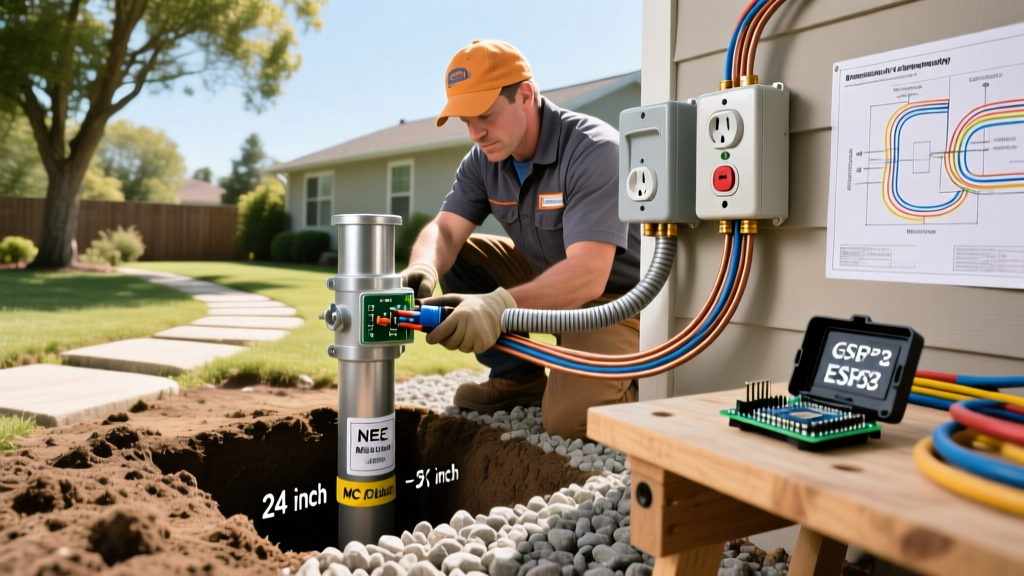
- Water Ingress in Vertical Runs: When running an electrical wiring raceway from an underground trench up into a building, condensation and groundwater will travel up the conduit via capillary action. Always install a sealing fitting or duct seal compound at the base of the vertical riser to prevent water from entering the electrical panel.
Frequently Asked Questions (FAQ)
Can I mix low-voltage data cables and 120V power in the same raceway?
No. Unless the low-voltage cables are specifically rated for the higher voltage (e.g., 600V) and the power conductors are present for functional association (like a PoE injector's power feed), NEC Article 725 and Article 800 strictly prohibit mixing Class 1/Power circuits with Class 2/3 or communications circuits in the same raceway without a physical, listed barrier.
Do I need to count a neutral wire as a current-carrying conductor for derating?
It depends on the circuit. On a standard single-phase, 120V/240V residential circuit, the neutral only carries the unbalanced load and is not counted. However, on a 3-phase, 4-wire wye circuit where the major load is non-linear (like LED drivers or VFDs), the neutral carries harmonic currents and must be counted as a CCC for thermal derating purposes.
Where can I find the exact fill capacity charts for specific conduit brands?
Manufacturers like Atkore and Southwire publish conduit fill calculators based on NEMA standards and NEC Chapter 9, Table 4. Always verify the internal diameter of the specific brand you are using, as Schedule 80 PVC has a significantly smaller internal diameter than Schedule 40 PVC of the same nominal trade size.
Final Thoughts on Raceway Engineering
Treating an electrical wiring raceway as a mere 'pipe for wires' is a relic of the past. Modern electrical loads demand rigorous attention to thermal dynamics, physical pulling limits, and grounding continuity. By strictly adhering to NEC fill limits, applying proper derating math, and selecting the right materials for the environment, you ensure a system that is not only code-compliant but inherently safe for decades to come.