
The Commercial Stakes of Above-Ground Pool Installations
While above-ground pools are frequently categorized as residential DIY projects, the commercial sector—ranging from HOA community amenities and boutique hotel plunge pools to luxury glamping resorts—relies heavily on them for cost-effective, low-impact aquatic amenities. However, when executing above ground swimming pool electrical wiring in a commercial, multi-family, or public-access environment, the liability profile shifts dramatically. Commercial electrical contractors cannot rely on the leniency often afforded to residential retrofits. A single wiring fault or improper bond in a public-facing above-ground pool can result in catastrophic electrocution hazards, massive litigation, and immediate facility shutdowns.
In 2026, commercial electrical inspectors are enforcing NEC Article 680 with zero tolerance for ambiguity. This guide provides commercial electrical contractors with the exact specifications, material requirements, and edge-case troubleshooting protocols required to wire above-ground pools for high-liability commercial applications.
NEC Article 680: Core Mandates for Commercial Above-Ground Pools
"The primary objective of Article 680 is to ensure that all conductive surfaces in and around the pool area are at the same electrical potential, eliminating the risk of stray voltage gradients that can cause fatal shock." — NEC Handbook Commentary, Article 680
1. Equipotential Bonding vs. Equipment Grounding
The most common failure point in commercial above-ground pool inspections is the conflation of equipment grounding with equipotential bonding. They are entirely distinct systems that must work in tandem.
- Equipment Grounding: This is the insulated green or bare wire run inside the conduit with the circuit conductors. It provides a low-impedance fault current path back to the panel to trip the breaker. For a commercial 20A pool pump circuit, a 12 AWG insulated copper ground is mandatory.
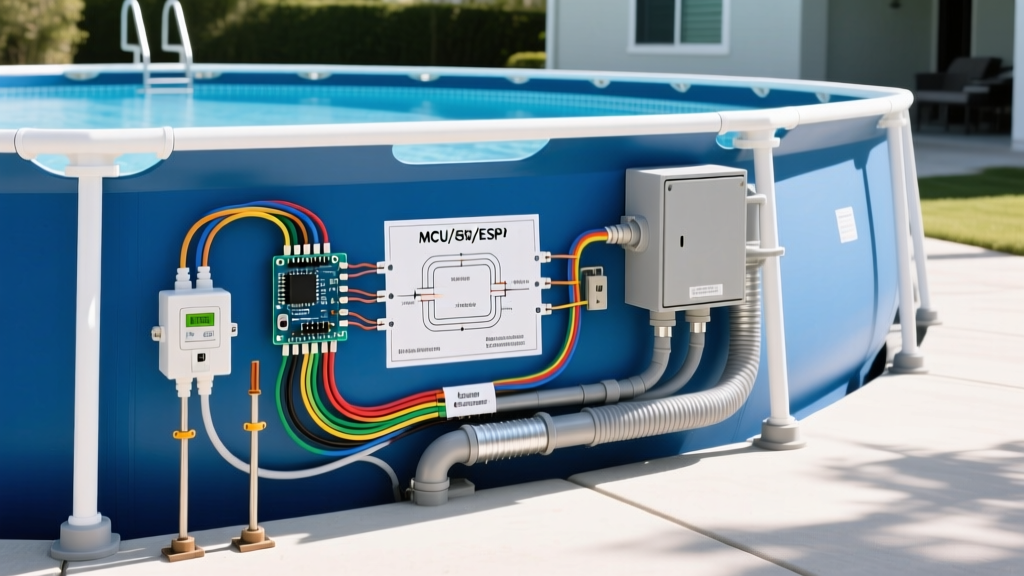
- Equipotential Bonding: This system ties all metallic components together to eliminate voltage gradients. Per NEC 680.26, you must use a minimum 8 AWG bare solid copper wire. This wire must connect the pump motor housing, metal ladders, pool light niches, and any metallic pool walls within 5 feet of the pool.
2. The Above-Ground Bonding Grid Misconception
A pervasive myth in the industry is that above-ground pools do not require an equipotential bonding grid because they sit on the surface rather than in the earth. This is false for commercial installations. If the above-ground pool features structural metal components, they must be bonded. Furthermore, if the pool utilizes non-conductive resin walls, the water itself must be bonded using a listed water bonding device (such as the Superior Pool Products Water Bonding Fitting) integrated into the plumbing line, tied into the 8 AWG bonding loop.
VFD Pump Integration and GFCI Nuisance Tripping
Commercial facilities are rapidly upgrading to Variable Frequency Drive (VFD) pool pumps, such as the Pentair IntelliFlo VSF, to meet stringent commercial energy codes. According to the U.S. Department of Energy, VFD pool pumps can reduce commercial pool energy consumption by up to 70%. However, integrating VFD pumps into above ground swimming pool electrical wiring introduces a specific challenge: high-frequency leakage current.
Standard residential GFCI breakers often interpret the high-frequency harmonic leakage from a VFD motor as a ground fault, resulting in nuisance tripping. For commercial installations, contractors must specify GFCI breakers engineered for VFD compatibility. The Siemens QPF220A (20A) or Eaton BR220GFI with updated trip-curve firmware are the current 2026 standards for mitigating VFD nuisance trips while maintaining the strict 5mA Class A GFCI trip threshold required by NEC 680.21.
2026 Commercial Material & Labor Cost Matrix
When bidding on HOA or commercial resort above-ground pool installations, accurate material forecasting is critical. Below is the current commercial pricing matrix for Q2 2026.
| Material / Component | Specification / Model | Estimated Unit Cost |
|---|---|---|
| Bonding Wire | 8 AWG Bare Solid Copper (per ft) | $3.15 / ft |
| Conduit (Commercial Grade) | Schedule 80 PVC, 1/2 inch (per ft) | $1.65 / ft |
| Circuit Conductors | 12 AWG THHN (3-wire + ground) | $1.90 / ft |
| GFCI Breaker | Siemens QPF220A 20A 2-Pole | $64.00 |
| Bonding Ground Box | Hubbell Quazite PS241410 | $88.50 |
| Direct Burial Lug | King Innovation 81102 Bronze | $14.25 |
| Water Bonding Fitting | Superior Pool Products (Inline) | $52.00 |
| Commercial Labor Rate | Licensed Electrician (Avg US) | $145 - $195 / hr |
Common Edge Cases & Troubleshooting in HOA/Hotel Installs
Commercial environments present unique environmental and structural challenges that residential wiring rarely encounters. Anticipating these edge cases separates standard electricians from true commercial specialists.
Edge Case 1: Stray Voltage from Adjacent Commercial Infrastructure
In multi-use commercial properties (e.g., an above-ground pool located behind a hotel's main kitchen or near a commercial HVAC chiller), heavy 3-phase equipment can induce stray voltage into the earth or nearby metallic structures. If the pool's equipotential bonding grid is not completely isolated from the building's structural steel, voltage gradients can transfer into the pool water. Solution: Always verify that the pool bonding grid is tied to the pool equipment ground, but verify via a multimeter that no neutral-to-earth voltage exceeding 1.5V is present on the bonding loop when adjacent heavy machinery cycles on.
Edge Case 2: Vinyl Liner Static and Capacitance Buildup
Large commercial above-ground pools utilizing heavy-duty vinyl liners can generate significant static electricity through water circulation and wind friction. Because vinyl is a dielectric, the water can hold a capacitive charge. If a swimmer touches a bonded metal ladder while in the water, they may experience a micro-shock. Solution: Ensure the inline water bonding device is installed within 3 feet of the pool return jet, and verify continuity from the water bond to the main pump motor housing using a calibrated low-resistance ohmmeter (reading must be less than 0.5 ohms).
Edge Case 3: Conduit Degradation in Commercial Landscaping Zones
Residential codes often permit Schedule 40 PVC conduit for pool wiring. In commercial HOA settings, where commercial landscaping crews use heavy aerators and edgers, Schedule 40 is a massive liability. Solution: Mandate Schedule 80 PVC or Liquidtight Flexible Nonmetallic Conduit (LFNC) for all runs subject to physical damage. Use cast aluminum or heavy-duty polymer conduit bodies (like the Appleton Form 7) rather than standard PVC bodies to prevent UV degradation and physical crushing.
FAQ: Commercial Inspector Red Flags
Do commercial above-ground pools require a dedicated permit and inspection?
Yes. Unlike small residential inflatable pools, any commercial, HOA, or multi-family above-ground pool exceeding 42 inches in depth requires a full electrical permit, a rough-in inspection (to verify the bonding grid before concrete or decking is poured over it), and a final inspection. Inspectors will specifically check for the 8 AWG bonding wire and proper GFCI protection on all 120V and 240V circuits within 10 feet of the pool.
Can I use flexible cord for a commercial pool pump?
No. While NEC allows a flexible cord for a residential pool pump up to 3 feet in length, commercial installations generally require hardwired connections using rigid or Schedule 80 PVC conduit directly into the motor's junction box. This prevents landscaping damage and UV degradation associated with exposed cords in high-traffic commercial amenity areas.
What is the required clearance for overhead service drops near the pool?
NEC Table 680.8 dictates strict clearances for communication and utility wires over commercial pools. Utility service drops must maintain a minimum vertical clearance of 22.5 feet above the water surface and the diving platform, and a minimum horizontal clearance of 10 feet from the pool edge. If an HOA's above-ground pool is sited near a utility pole, the contractor must coordinate with the local utility provider to reroute the drop before the pool installation begins.