
Decoding the NEC Electrical Wiring Color Code Standards
When an Authority Having Jurisdiction (AHJ) steps onto a commercial or residential job site in 2026, the first thing they inspect isn't just the torque on your lugs—it is the electrical wiring color code. Proper wire identification is not merely an organizational preference; it is a critical safety mandate enforced under the National Electrical Code (NEC). Misidentified conductors lead to catastrophic arc flashes, severe shock hazards, and immediate inspection failures. According to the NFPA 70 (NEC), standardized color coding ensures that electricians, maintenance personnel, and first responders can instantly recognize voltage levels and conductor functions, mitigating the risk of fatal errors during troubleshooting or emergency shutoffs.
This comprehensive compliance guide breaks down the exact color code requirements for single-phase, three-phase, and DC systems, highlighting the most common violations that trigger AHJ rejections and how to properly re-identify conductors to meet code.
Single-Phase AC: The Core NEC Color Code Matrix
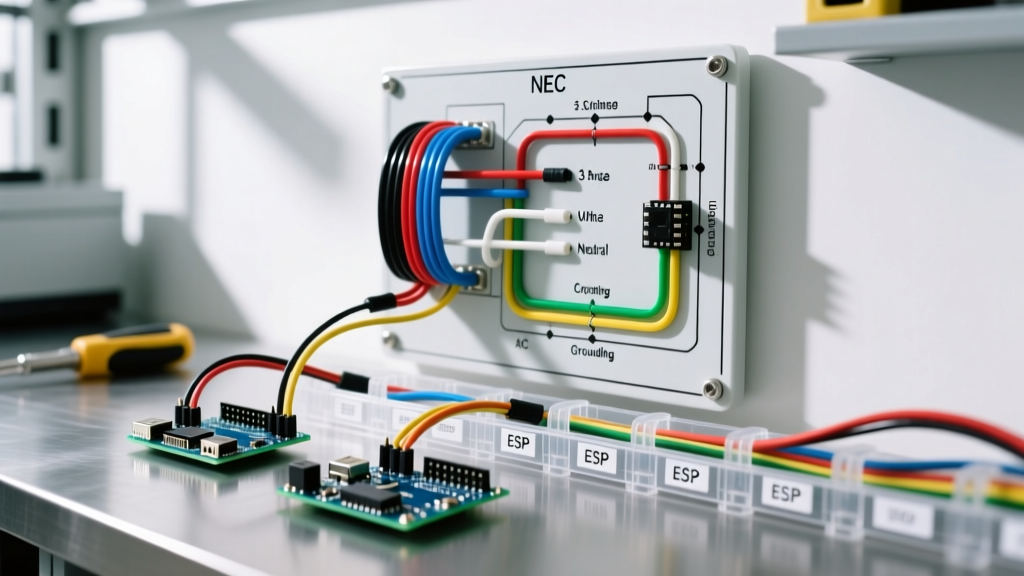
For standard 120V/240V single-phase systems (the backbone of US residential and light commercial wiring), the NEC strictly defines the roles of grounded, ungrounded, and grounding conductors. The most common cable types, such as Southwire SIMpull THHN or standard NM-B (Romex), come pre-colored to meet these specifications.
| Conductor Function | NEC Required Color | NEC Article Reference | Common Wire Types |
|---|---|---|---|
| Hot (Line 1 / 120V) | Black | 210.4(D), 310.12(A) | THHN, NM-B, XHHW |
| Hot (Line 2 / 240V) | Red | 210.4(D), 310.12(A) | THHN, NM-B, XHHW |
| Neutral (Grounded) | White or Gray | 200.2(A), 200.6 | THHN, NM-B, XHHW |
| Ground (Equipment) | Bare, Green, or Green/Yellow | 250.119 | Bare Copper, THHN |
Inspector's Note: Under NEC Article 200.6, the grounded (neutral) conductor must be white or gray. However, for larger conductors (4 AWG and larger) where standard colored insulation is not readily available, the NEC permits re-identification using white tape, paint, or sleeves at every point where the conductor is accessible. Failure to mark both ends of a re-identified neutral is an automatic red-tag during rough-in inspections.
Three-Phase and High-Voltage Compliance Matrix
Commercial and industrial facilities rely on three-phase power, and the OSHA electrical safety standards alongside the NEC require distinct color coding to differentiate between 208Y/120V and 480Y/277V systems. Mixing up these voltage classes can destroy 277V lighting ballasts or cause explosive failures in 480V motor drives.
208Y/120V vs. 480Y/277V Phase Identification
| Phase | 208Y/120V System Colors | 480Y/277V System Colors |
|---|---|---|
| Phase A (Line 1) | Black | Brown |
| Phase B (Line 2) | Red | Orange |
| Phase C (Line 3) | Blue | Yellow |
| Neutral (Grounded) | White | Gray |
| Ground (Equipment) | Green / Bare | Green / Bare |
The High-Leg Delta Exception: In older 240V Delta systems with a center-tapped neutral (High-Leg Delta), the "B" phase (the high leg) measures 208V to ground. NEC Article 215.8 and 230.56 mandate that this specific high-leg conductor must be identified with an Orange outer finish. Inspectors actively look for orange tape or insulation on the B-phase in legacy panels; failing to identify the high leg is a severe code violation that poses a massive shock hazard to anyone assuming standard 120V to ground.
Top 5 Color Code Violations That Trigger AHJ Rejections
Based on field inspection data and industry audits, the following five color code violations are the most frequent culprits for failed electrical inspections in 2026:
- The "Switched Leg" White Wire Oversight (NEC 200.7(C)(1)): When using standard 2-wire NM cable for a switch loop, the white wire is often used as the "hot" feed to the switch. The NEC requires this white wire to be permanently re-identified (typically with black tape) at both the panel and the switch box. Leaving it white tricks future electricians into thinking it is a neutral, leading to dead shorts or electrocution.
- Using Green/Yellow IEC Grounds as Current-Carrying Conductors: With the rise of imported European CNC machinery and HVAC equipment, electricians frequently encounter IEC-standard green/yellow striped wires. Under US NEC rules, green and green/yellow are strictly reserved for equipment grounding conductors (EGC). Repurposing an IEC ground wire as a neutral or hot wire inside a US panel is an immediate fail.
- Improper Re-Identification Tape: Using masking tape, duct tape, or cheap, non-UL-listed friction tape to re-identify a neutral or hot wire violates NEC 110.12 (Mechanical Execution of Work). Inspectors require UL-listed vinyl electrical tape (like 3M Scotch Super 33+) or heat shrink tubing.
- Missing Grounding Electrode Conductor (GEC) Identification: While the GEC doesn't have a strict insulation color requirement like the EGC, if it is run in a raceway or bundled with other wires, it must be clearly identifiable. Many electricians fail to label the GEC at the grounding busbar, confusing it with standard equipment grounds.
- DC Control Circuit Confusion (NFPA 79 vs. NEC 725): In industrial control panels, mixing up DC positive (typically Red) and DC negative (typically Black or Blue) with AC hot/neutral colors leads to disastrous cross-wiring. Class 1 and Class 2 remote-control circuits must be visually separated and color-coded distinctly from line-voltage power.
Proper Wire Re-Identification: Materials and Methods
When working with large gauge conductors (e.g., 2/0 AWG THHN in a commercial feeder) or correcting switch loops, the materials you use for re-identification matter just as much as the color itself. The AHJ will reject non-durable markings.
Approved Re-Identification Materials (2026 Market Standards):
- 3M Scotch Super 33+ Vinyl Electrical Tape: The industry gold standard. Costs approximately $8 to $12 per 66-foot roll. It resists UV, moisture, and temperatures up to 221°F (105°C).
- 3M FP-301 Heat Shrink Tubing: Ideal for panel interiors where tape might peel over time due to heat. A 4-foot stick of 1-inch black or white heat shrink costs around $6 to $9.
- Panduit Wire Markers / Sleeves: For complex control panels, pre-printed slip-on markers ($15 to $25 per pack) provide a cleaner, more professional finish than tape and are highly favored by strict commercial inspectors.
Pro-Tip for Electricians: When re-identifying a white wire as a hot conductor, wrap the tape completely around the wire's insulation at least twice, covering a minimum of 1 inch of the wire. Do not just place a single strip of tape on one side of the wire; the inspector must be able to see the re-identification from any angle when looking into the junction box.
Navigating Imported Machinery: IEC vs. NEC Harmonization
One of the most complex compliance hurdles in modern industrial wiring is dealing with imported machinery built to International Electrotechnical Commission (IEC) standards, specifically IEC 60204-1. The IEC electrical wiring color code differs drastically from the NEC:
- IEC Phases: Brown (L1), Black (L2), Gray (L3).
- IEC Neutral: Blue.
- IEC Ground: Green/Yellow stripe.
If you are wiring a 480V US facility and connect a machine with Brown/Black/Gray phase wires, you must ensure the facility's phase rotation and color mapping are documented on the panel schedule. The NEC does not require you to rip out the internal wiring of a UL/CE-listed machine, but the supply wiring from the US disconnect to the machine's terminal block must follow NEC color codes (Brown/Orange/Yellow for 480V). Always install a prominent warning label on the machine's main disconnect stating: "WARNING: Internal wiring conforms to IEC 60204-1. Blue is Neutral, Green/Yellow is Ground." This simple $5 label can save you from a failed inspection and protect future maintenance technicians from lethal assumptions.
Final Inspector's Checklist for Color Code Compliance
Before calling for your final rough-in or trim-out inspection, walk the site with this mental checklist:
- Are all white/gray wires strictly neutral, or properly taped at both ends if used as a hot switched leg?
- Is the high-leg (208V to ground) in any Delta system clearly marked with orange tape or insulation?
- Are all equipment grounding conductors bare, green, or green/yellow, with no current-carrying conductors sharing these colors?
- Is the 480V system properly utilizing Brown/Orange/Yellow, distinct from the 208V Black/Red/Blue system?
- Are all re-identification tapes UL-listed and wrapped fully around the conductor?
Mastering the electrical wiring color code is about more than passing a one-time inspection; it is about establishing a baseline of safety that protects the facility and its occupants for decades. When in doubt, consult the latest edition of the Mike Holt Enterprises NEC guides or your local AHJ for region-specific amendments to the national code.