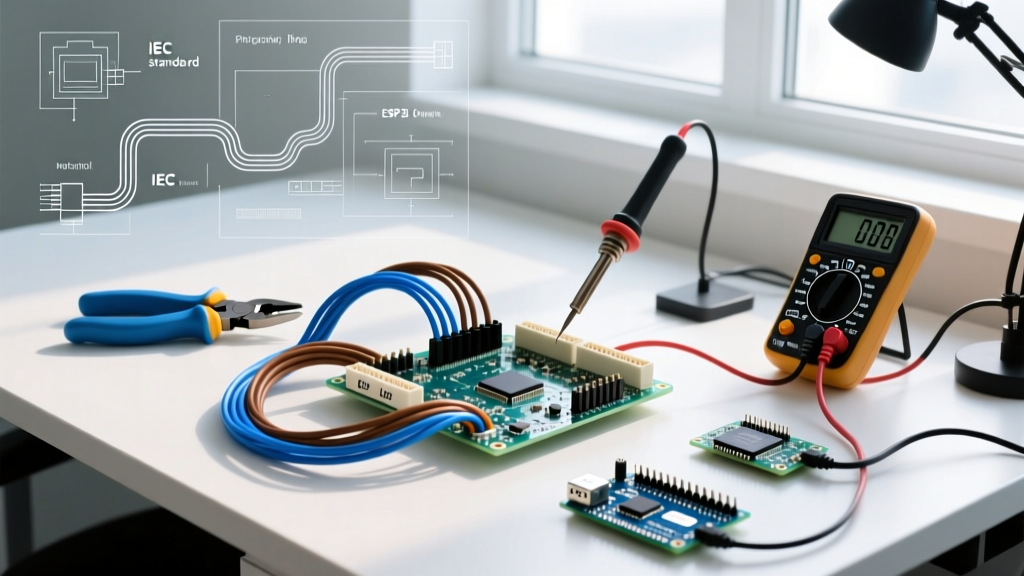

The Global Standard: Decoding Blue and Brown Electrical Wiring
When you open an imported appliance, a European control panel, or an international piece of industrial machinery, the internal wiring often defies North American expectations. Instead of the familiar black, white, and green, you are greeted by electrical wiring blue and brown. This color scheme is not arbitrary; it is the strict mandate of the International Electrotechnical Commission (IEC). For electricians, DIYers, and facility managers operating in 2026, understanding the divergence between IEC and North American NEC (National Electrical Code) standards is a critical safety and compliance requirement.
The use of electrical wiring blue and brown is governed primarily by IEC 60445 (Basic and safety principles for man-machine interface, marking and identification). This standard harmonizes color codes across most of the globe, including the European Union, the United Kingdom, Australia, and parts of Asia. Misinterpreting these colors in a North American context can lead to catastrophic short circuits, equipment destruction, or lethal electric shock.
Phase, Neutral, and Earth Assignments
- Brown (L / Line): The active or 'hot' phase conductor. In a standard 230V AC single-phase system, this wire carries the alternating current from the source to the load.
- Blue (N / Neutral): The return path conductor. It completes the circuit and is typically at or near zero volts relative to earth, though it must always be treated as a live current-carrying conductor.
- Green/Yellow (PE / Protective Earth): The safety grounding conductor. This bi-color stripe is universally reserved for earth and must never be used for phase or neutral.
Safety Warning: Never assume wire colors are correct on imported or used machinery. Always perform a dead-circuit continuity test and a live-circuit voltage verification using a CAT III or CAT IV multimeter before making physical contact with any terminal.
IEC vs. NEC: A Cross-Border Wiring Comparison Matrix
North America relies on the National Fire Protection Association (NFPA) and the NEC (NFPA 70) for wiring color codes. Mixing up IEC and NEC standards is a leading cause of electrical fires in facilities utilizing imported machinery. Below is a direct comparison of single-phase and three-phase color assignments.
| Function | IEC (Global/EU/UK) | NEC (North America 120/240V) | Common Cable Type |
|---|---|---|---|
| Line / Hot (Phase 1) | Brown | Black | H05VV-F (IEC) / SJT (NEC) |
| Neutral | Blue | White (or Grey) | H05VV-F (IEC) / SJT (NEC) |
| Protective Earth | Green/Yellow | Green, Green/Yellow, or Bare | H05VV-F (IEC) / SJT (NEC) |
| Line / Hot (Phase 2 - 240V) | Black | Red | Multi-core flex |
| Line / Hot (Phase 3 - 3-Phase) | Grey | Blue | SY / YY Armored |
Code Compliance for Imported Appliances and Machinery
In 2026, global supply chains mean that encountering electrical wiring blue and brown in North American facilities is commonplace. However, OSHA Standard 1910.304 strictly enforces NEC wiring methods for permanent installations in the US. You cannot legally leave IEC-colored wiring exposed in a standard US junction box or panel board without proper identification sleeves.
The Danger of 'Adapter' Wiring and Code Violations
A frequent and dangerous shortcut is splicing a North American NEMA 5-15P plug onto a European H05VV-F flexible cord using standard wire nuts. This violates NEC Article 400 (Flexible Cords and Cables) and creates severe failure modes. The H05VV-F cord features fine-stranded copper designed for IEC terminal blocks. When clamped under the screw terminals of a standard North American plug, these fine strands easily crush and splay, leading to high-resistance connections, arcing, and localized melting. Always replace the entire cord assembly with a UL-listed SJT or SOOW cord when adapting equipment for North American use.
DC vs. AC: When Blue and Brown Mean Something Else
Expert electricians must be aware of a critical edge case outlined by the International Electrotechnical Commission (IEC): the color codes shift when transitioning from Alternating Current (AC) to Direct Current (DC). While brown and blue are strictly AC mains colors, DC systems utilize a different matrix to prevent fatal cross-connections.
- AC Mains: Brown = Line, Blue = Neutral.
- DC Power (2-wire): Brown = Positive (L+), Grey = Negative (L-).
- DC Power (3-wire with center tap): Brown = Positive, Grey = Negative, Blue = Mid-wire.
Misidentifying a DC grey wire for an AC neutral blue wire can result in immediate equipment destruction if the chassis is bonded to the wrong potential. In solar PV installations and telecom battery banks, always verify whether the system is AC or DC before trusting the brown/blue color scheme.
Step-by-Step: Rewiring an IEC Appliance for North American Use
If you must integrate a 230V IEC-wired appliance into a North American 240V split-phase system (like a residential dryer, welder, or industrial lathe), follow this compliant procedure to ensure safety and pass local inspections:
- Verify Voltage Tolerance: Check the appliance nameplate. A 230V European motor will typically run safely on 240V US split-phase, but control boards with 230V-to-12V transformers may overheat. Verify the Hz rating (50Hz vs 60Hz); a 50Hz motor on a 60Hz supply will run 20% faster and may overheat without a VFD.
- Remove the H05VV-F Cord: Cut off the European Schuko or BS 1363 plug and strip the H05VV-F jacket back 4 inches from the strain relief.
- Select NEC-Compliant Cord: Replace it with an SJT or SOOW cord rated for 600V. For a 15A load, use 14 AWG; for 20A, use 12 AWG. Ensure the cord features a UL/CSA mark.
- Map the Conductors: Connect the SJT Black wire to the appliance's Brown (Line) terminal. Connect the SJT White wire to the Blue (Neutral) terminal. If the appliance requires 240V only (no neutral), cap the white wire and use the SJT Red wire for the second hot leg.
- Bond the Ground: Connect the SJT Green wire to the appliance's Green/Yellow terminal and ensure the metal chassis is bonded to the ground bus.
- Torque Terminals: Use a calibrated torque screwdriver. Standard 10A IEC terminal blocks require exactly 0.5 Nm to 0.8 Nm. Under-torquing causes thermal runaway; over-torquing shears the fine IEC strands.
Frequently Asked Questions (FAQ)
Can I use blue wire as a hot leg in the US?
Under NEC 2026 guidelines, blue is typically reserved for Phase 3 in a 3-phase 120/208V system or as a switched leg for lighting. Using blue as a standard 120V hot leg in a residential single-phase setting is a code violation and will fail municipal inspection. Stick to black or red for single-phase hot legs.
Is brown wire always live?
In AC systems adhering to IEC 60445, yes, brown is the live/line conductor. However, always verify with a non-contact voltage tester or a multimeter before touching any conductor. Previous technicians may have wired equipment incorrectly, or the equipment may have been repaired using non-standard wire colors due to supply chain shortages.
What happens if I swap blue and brown?
Swapping Line (Brown) and Neutral (Blue) in an AC circuit will often allow the appliance to function because AC alternates direction. However, this creates a severe shock hazard. The appliance's internal switch will break the neutral path while leaving the internal components energized at full line voltage, posing a lethal risk during maintenance or bulb replacement.