
Decoding the Materials Inside Your Walls
When planning a whole-home renovation or a major addition, understanding exactly what electrical wiring is made of is not just an academic exercise—it is a critical factor in budgeting, code compliance, and long-term safety. At its core, modern electrical wiring consists of three primary components: the conductor (the metal that carries the current), the insulation (the polymer that contains the current), and the jacket (the outer protective layer). For renovators, the specific metallurgical and chemical makeup of these layers dictates everything from how easily a wire can be fished through an existing wall cavity to how it must be terminated at the breaker panel.
In 2026, material costs and supply chain dynamics continue to influence whether contractors reach for copper or aluminum, while updates to the National Electrical Code (NEC) dictate stricter rules on insulation temperature ratings. Let us break down the exact materials used in modern wiring and how to select the right ones for your renovation project.
The Core Conductors: Copper vs. Aluminum
The conductor is the highway for electrical current. In residential and light commercial renovations, you will encounter two primary metals, each with distinct physical properties, failure modes, and installation requirements.
Copper: The Renovation Standard
Over 90% of residential branch circuits in North America utilize copper conductors. Specifically, wiring uses Electrolytic Tough Pitch (ETP) copper, which is 99.9% pure. Copper is favored for its high tensile strength, exceptional thermal conductivity, and resistance to galvanic corrosion.
- Solid vs. Stranded: For standard 14 AWG, 12 AWG, and 10 AWG branch circuits (lighting and receptacles), solid copper wire is used because it terminates easily under standard breaker screws and push-in connectors. For larger feeders (like a 200-amp main service) or wires routed through tight, convoluted conduit bends, stranded copper is utilized for flexibility.
- The Drawback: Copper is heavy and expensive. A 250-foot coil of 12/2 NM-B (Romex) copper wire typically costs between $115 and $135 in early 2026, heavily dependent on global commodities markets.
Aluminum: The Feeder Alternative
Many renovators hear "aluminum wiring" and immediately think of the fire hazards associated with 1970s solid aluminum branch circuits. However, modern aluminum wiring is fundamentally different. Today’s aluminum wire is made from AA-8000 series aluminum alloy, which includes trace amounts of iron and copper to reduce "creep" (the tendency of the metal to slowly deform under mechanical pressure and heat).
While rarely used for standard 15-amp or 20-amp receptacle circuits today due to termination complexities, AA-8000 aluminum is the standard for large feeder cables (e.g., 2/0 or 4/0 AWG) running from the utility drop to the main panel, or supplying sub-panels. It is significantly lighter and roughly 40% cheaper than equivalent copper feeders.
Renovation Warning: If you are renovating a home built between 1965 and 1973, you may encounter legacy solid aluminum branch wiring. The U.S. Consumer Product Safety Commission (CPSC) strongly recommends mitigating these circuits. Do not simply swap receptacles; you must use COPALUM crimping or AlumiConn lug connectors to safely pigtail the aluminum to copper.
Insulation and Jacketing: The Polymers That Protect
If the metal carries the power, the polymers keep it from burning your house down. The materials used for insulation have evolved significantly, moving away from brittle rubber to advanced thermoplastics and thermosets.
THHN and THWN-2: The Conduit Staples
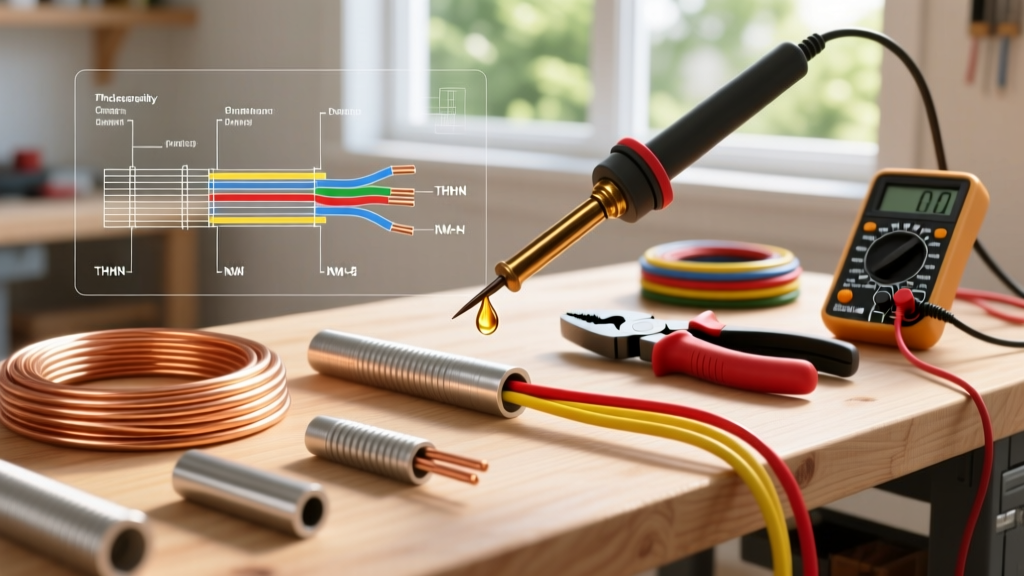
When pulling individual wires through EMT (metal) or PVC conduit, you will use THHN/THWN-2 wire. What is it made of? The primary insulation is a 15-to-20-mil thick layer of Polyvinyl Chloride (PVC). Over the PVC, manufacturers extrude a 4-mil thick jacket of Nylon. The nylon serves a highly specific mechanical purpose: it makes the wire incredibly slick, reducing friction when pulling multiple conductors through long conduit runs. It also provides exceptional resistance to chemical spills and abrasion. However, in a renovation scenario, if you pull THHN through a conduit with sharp, un-reamed metal burrs, the thin nylon jacket can strip off, compromising the wire's chemical resistance.
XHHW-2: The Renovator's Secret Weapon
Cross-Linked Polyethylene (XLPE) is the material used in XHHW-2 wire. Unlike PVC, XLPE is a thermoset polymer, meaning it will not melt if exposed to a soldering iron or a severe short-circuit heat spike. Why it matters for renovations: XHHW-2 lacks the bulky nylon outer jacket of THHN. As a result, the outer diameter of XHHW-2 is noticeably smaller. If you are adding circuits to an existing, fully packed 3/4-inch EMT conduit in a commercial remodel, swapping from THHN to XHHW-2 can free up enough cross-sectional area to fit an additional wire without violating NEC conduit fill capacity rules.
NM-B (Romex): The Framing Standard
Non-Metallic Sheathed Cable (commonly referred to by the brand name Romex) is the standard for open-wall framing. What is it made of? It contains individual PVC-insulated copper conductors (usually a black hot, a white neutral, and a bare copper ground) wrapped in a Kraft paper separator, all encased in a 30-mil thick outer jacket of color-coded, flame-retardant PVC. The paper filler absorbs ambient moisture and prevents the outer jacket from fusing to the inner insulation during the manufacturing extrusion process. When stripping NM-B, renovators must be careful not to score the inner PVC insulation with their utility knife, a common failure mode that leads to failed inspections.
2026 Renovation Material Selection Matrix
Choosing the right material depends on the specific zone of your renovation. Below is a decision matrix based on current 2026 material costs and application requirements.
| Renovation Zone | Recommended Wire Type | Primary Materials | Est. Cost (250ft / 2026) | Key Installation Constraint |
|---|---|---|---|---|
| Standard Interior Walls (Drywall) | 12/2 NM-B with Ground | Copper, PVC, Kraft Paper | $115 - $135 | Cannot be used in wet locations or above suspended ceilings. |
| Unfinished Basements / Conduit | 12 AWG THHN / THWN-2 | Copper, PVC, Nylon | $90 - $110 (per reel) | Requires continuous conduit support; nylon jacket prone to scraping. |
| Outdoor Burial / Direct Earth | 12/2 UF-B | Copper, Solid PVC (No paper) | $140 - $165 | Heavier, stiffer jacket requires larger bend radii in trench. |
| Sub-Panel Feeders (100A) | 2/0-2/0-2/0-4 AL SER | AA-8000 Aluminum, XLPE | ~$6.50 per linear foot | Must use anti-oxidant paste and torque screwdriver on lugs. |
Crucial Failure Modes and Code Realities
Knowing what the wire is made of directly informs how it must be terminated. The most common point of failure in a renovation is not the wire itself, but the termination point where the metal meets the breaker or receptacle.
The 60°C vs. 75°C vs. 90°C Ampacity Trap
Modern THHN and XHHW-2 wire insulation is rated for 90°C (194°F). However, the National Electrical Code (NEC) Section 110.14(C) dictates that the ampacity (current-carrying capacity) of the wire is limited by the temperature rating of the termination lugs. Almost all standard residential breakers and receptacles are rated for a maximum of 75°C, and older devices (or those rated under 100 amps) are often limited to 60°C. Therefore, even though a 12 AWG THHN copper wire is physically capable of handling 30 amps at 90°C, you are legally and safely restricted to 20 amps because of the brass and steel alloys used inside the breaker's termination screw. Renovators who oversize loads based on the 90°C column risk melting the breaker's internal bussing.
Galvanic Corrosion and Anti-Oxidant Paste
When renovating older homes or adding exterior sub-panels, you will inevitably connect aluminum feeder wires to copper grounding rods or copper bus bars. When aluminum and copper touch in the presence of ambient humidity, an electrochemical reaction occurs, leading to galvanic corrosion. This corrosion creates a high-resistance layer that generates intense heat under load. Whenever you are terminating AA-8000 aluminum wire, you must apply a specialized anti-oxidant compound (commonly known by the brand name Noalox). This paste contains zinc dust suspended in a polybutene base, which physically blocks oxygen and moisture from reaching the metal interface while scoring the aluminum's natural oxide layer to ensure a solid electrical connection.
Planning Your Material Procurement
For a 2,000-square-foot full-gut renovation, expect to use roughly 3,500 to 5,000 feet of NM-B cable, split mostly between 14/2 for lighting circuits and 12/2 for kitchen, bathroom, and general receptacle circuits. When procuring materials, always verify the UL (Underwriters Laboratories) listing mark printed directly onto the wire jacket. In recent years, the market has been flooded with counterfeit, undersized copper-clad aluminum (CCA) wire sold on third-party online marketplaces. CCA wire has a thin copper skin over an aluminum core; it possesses the high resistance of aluminum but lacks the mechanical strength, leading to snapped conductors and arcing faults inside walls. Always source your wiring from authorized electrical distributors or major home improvement centers to guarantee the metallurgical integrity of your renovation.