
The Foundation of Safe India Electrical Wiring in 2026
Executing a safe, code-compliant electrical installation in India requires navigating a unique set of environmental and infrastructural challenges. From the high-humidity monsoons of coastal regions to the extreme summer temperatures of the northern plains, India electrical wiring demands materials that exceed standard international baselines. In 2026, with copper prices stabilizing around ₹850 per kg and a massive shift toward Zero Halogen Flame Retardant (ZHFR) cables in premium residential and commercial projects, electricians and contractors must update their procurement and installation strategies.
This comprehensive material and tool guide breaks down the exact specifications, IS-code requirements, and 2026 market pricing for essential wiring components. Whether you are wiring a new 3BHK apartment in Bengaluru or retrofitting a commercial space in Mumbai, adhering to the guidelines set by the Bureau of Indian Standards (BIS) and the Central Electricity Authority (CEA) is non-negotiable for safety and inspection approval.
Crucial Update: The IS 732:2018 Color Code Shift
Before purchasing bulk materials, every contractor must recognize the definitive shift in Indian wire color coding. Historically, India followed a localized color scheme (Red, Yellow, Blue for phases; Black for neutral; Green for earth). However, to align with the International Electrotechnical Commission (IEC) global standards, IS 732:2018 mandates a new palette for all new installations.
- Phase 1 (L1): Brown
- Phase 2 (L2): Black
- Phase 3 (L3): Grey
- Neutral (N): Blue
- Earth (PE): Green-Yellow striped
Expert Warning: Never mix old and new color codes within the same distribution board (DB). If you are extending an older circuit wired in Red/Black/Green, use heat-shrink tubing or colored sleeving at the termination points to clearly mark the new IEC-compliant wires, preventing fatal phase-to-phase faults during future maintenance.
Wires & Cables: Sizing, Specs, and 2026 Pricing
The backbone of any India electrical wiring project is the copper conductor. Always insist on 99.9% electrolytic grade copper. In 2026, Flame Retardant Low Smoke (FRLS) remains the baseline for standard residential builds, but ZHFR (Zero Halogen Flame Retardant) is rapidly becoming the mandated standard for commercial spaces, hospitals, and high-rises to prevent toxic gas emission during fires.
2026 Cable Sizing & Cost Matrix (90-Meter Coils)
| Wire Size (sq mm) | Primary Application | Max Load Capacity (Approx) | 2026 Avg. Price (FRLS INR) | 2026 Avg. Price (ZHFR INR) |
|---|---|---|---|---|
| 1.0 sq mm | Lighting circuits, ceiling fans | 10 Amps (2.3 kW) | ₹950 - ₹1,100 | ₹1,250 - ₹1,400 |
| 1.5 sq mm | Standard 6A/16A socket outlets | 16 Amps (3.6 kW) | ₹1,350 - ₹1,550 | ₹1,700 - ₹1,950 |
| 2.5 sq mm | ACs (1.5 Ton), water heaters, microwaves | 25 Amps (5.7 kW) | ₹2,100 - ₹2,400 | ₹2,600 - ₹2,900 |
| 4.0 sq mm | Main DB feeders, heavy 3-phase motors | 35 Amps (8.0 kW) | ₹3,400 - ₹3,800 | ₹4,200 - ₹4,600 |
Note: Prices reflect Q1 2026 market rates for premium brands like Polycab, Havells, and Finolex. Local unbranded alternatives may be 20-30% cheaper but often fail IS 694 thickness and purity tests.
Conduits and Routing Hardware
Concealed wiring in brick or concrete walls requires heavy-duty conduits that can withstand the mechanical stress of plastering and the chemical alkalinity of cement. Under IS 9537, PVC conduits are categorized by their crush resistance.
- Light Duty (Yellow): Only for false ceilings or drywall partitions where no heavy plastering is involved.
- Medium Duty (Red/White): Standard for brick wall chasing and basic floor screeds.
- Heavy Duty (Black/Blue): Mandatory for deep concrete pours, driveways, and underground routing.
For 2026 smart-home integrations, always pull a separate 25mm flexible conduit dedicated solely to low-voltage Cat6A and fiber-optic cables to prevent electromagnetic interference (EMI) from the 230V AC lines. Maintain a minimum physical separation of 150mm between power and data conduits inside walls.
Switchgear: Navigating India's Power Fluctuations
India's grid is notorious for voltage sags, surges, and frequent neutral-to-earth voltage leaks, especially during the monsoon season. Standard MCBs (Miniature Circuit Breakers) are insufficient on their own.
The Essential DB Configuration
- Main Isolator: 63A or 100A DP/TPN switch.
- Surge Protection Device (SPD): A Type 2 SPD (e.g., Schneider Acti9 iPRD) is critical in 2026 to protect expensive inverter ACs and smart home hubs from grid switching surges. Ensure the SPD has a backup MCB.
- RCCB (Residual Current Circuit Breaker): Use a 40A, 30mA sensitivity RCCB for all socket circuits. In high-moisture areas (bathrooms, outdoor gardens), nuisance tripping is common; consider splitting these circuits with dedicated 10mA RCCBs or using RCBOs (Residual Current Breaker with Overcurrent) to isolate the fault without plunging the entire house into darkness.
- MCB Curves: Use Curve C for general lighting and resistive loads. Use Curve D for heavy inductive loads like submersible water pumps or welding equipment to prevent inrush-current tripping.
Earthing Systems: Combating High Soil Resistivity
A robust earth pit is the most neglected aspect of India electrical wiring. The CEA mandates that earth resistance must be less than 1 ohm for residential and under 0.5 ohms for sensitive commercial IT infrastructure. Traditional salt-and-charcoal earthing is obsolete and highly corrosive.
2026 Best Practice: Utilize chemical earthing electrodes (copper-bonded GI rods, 3 meters deep, 25mm diameter) surrounded by Bentonite-based earth enhancement material (EBM). Bentonite retains moisture year-round, ensuring stable resistance even during the peak summer drought. Always run a 25x3mm bare copper strip or 8 AWG green PVC earth wire from the main DB to the earth pit, and install an earth disconnecting link for annual testing.
Professional Diagnostic & Hand Tools
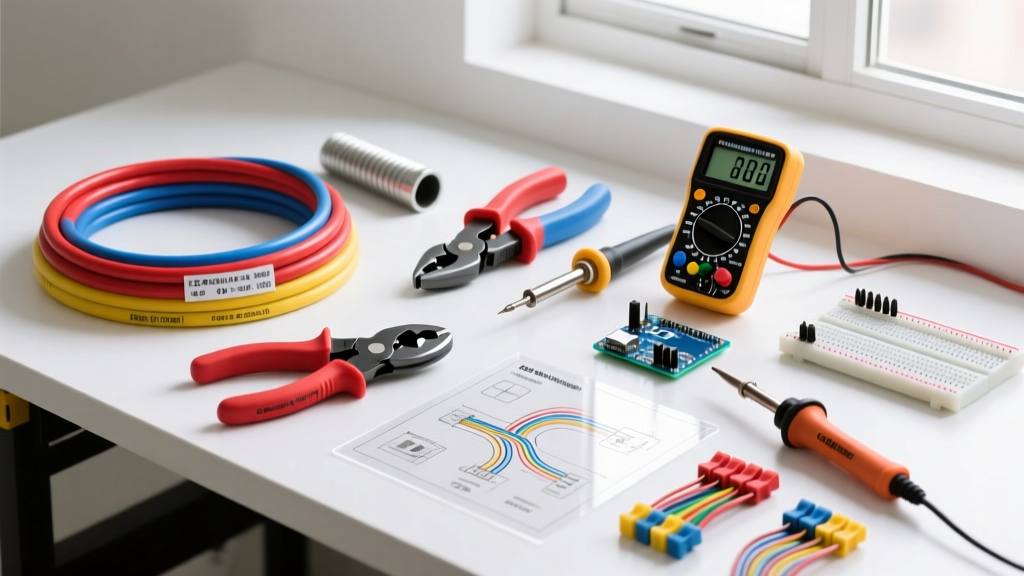
To execute and verify modern installations, electricians must upgrade beyond basic neon testers. Here are the essential tools for the 2026 Indian electrical contractor:
Diagnostic Instruments
- Clamp Meter: Fluke 325 or Meco 450B+. Essential for measuring neutral current and detecting phase imbalances without breaking the circuit.
- Insulation Resistance Tester (Megger): Megger MIT230. Mandatory for testing wire insulation integrity at 500V DC before energizing a new DB. Prevents hidden short-circuits caused by nail punctures in walls.
- Earth Resistance Tester: Kyoritsu 4105A. The industry standard for verifying the 1-ohm earth pit requirement using the 3-point fall-of-potential method.
Hand Tools
- Wire Strippers: Jokari automatic strippers. Prevents nicking the copper conductor, which creates hot-spots and fire hazards under high continuous loads.
- Crimping Tools: For terminating ferrules on multi-strand wires before inserting them into MCB terminals. Bare stranded wires splay out under screw terminals, leading to loose connections and arcing.
Final Inspection & Compliance
Before applying for the final meter connection from your local DISCOM (e.g., BESCOM, TSSPDCL, Tata Power), ensure your installation passes the CEA safety inspection. This includes verifying the polarity of all sockets, testing the trip time of all RCCBs (must trip within 300ms at 1x rated residual current), and submitting the insulation resistance test reports. By investing in premium, IS-certified materials and modern diagnostic tools, you ensure your India electrical wiring project is safe, future-proof, and fully compliant for decades to come.