
The NEC Mandate: Why Wire Colors Matter
Understanding the standard colors for electrical wiring is not just a matter of organizational preference; it is a critical safety requirement governed by the National Electrical Code (NEC), published by the National Fire Protection Association (NFPA). Proper color coding prevents catastrophic arc faults, mitigates electrocution risks, and ensures that future electricians can safely troubleshoot and modify your circuits. According to the NFPA 70 (NEC), specific insulation colors are legally restricted to designated conductor functions to eliminate ambiguity in the field.
Whether you are pulling THHN/THWN-2 conductors through EMT conduit in a commercial build or routing NM-B (Romex) cable through residential wall cavities, adhering to these color standards is mandatory for passing local inspections and maintaining a safe electrical infrastructure.
Standard AC Power Wiring Colors (120V/240V Residential)
In standard North American residential and light-commercial alternating current (AC) systems, the NEC strictly defines the roles of ungrounded (hot), grounded (neutral), and equipment grounding conductors. Below is the definitive matrix for single-phase and split-phase systems.
| Wire Color | Conductor Function | NEC Article Reference | Common Applications & Edge Cases |
|---|---|---|---|
| Black | Ungrounded (Hot) | Art. 210, 310 | Standard 120V hot feed; primary switch leg. |
| Red | Ungrounded (Hot 2) | Art. 210, 310 | 240V split-phase; 3-way switch travelers; MWBCs. |
| Blue / Yellow | Ungrounded (Hot 3/4) | Art. 210, 310 | Used in conduit for multi-way switching or 3-phase. |
| White / Gray | Grounded (Neutral) | Art. 200.6 | Current-carrying return path. Strictly prohibited as hot unless permanently re-identified. |
| Bare Copper | Equipment Ground | Art. 250.119 | Standard in NM-B cable; fault current path. |
| Green | Equipment Ground | Art. 250.119 | Used in conduit pulls and flexible cords. |
Deep Dive into Specific Conductor Roles
Grounded (Neutral) Conductors: White and Gray
NEC Article 200.6 mandates that grounded (neutral) conductors must be identified by a continuous white or gray outer finish. For larger conductors (4 AWG and larger) where colored insulation is not readily available, the NEC permits the use of three continuous white stripes on black insulation, or wrapping the conductor with white tape at all terminations.
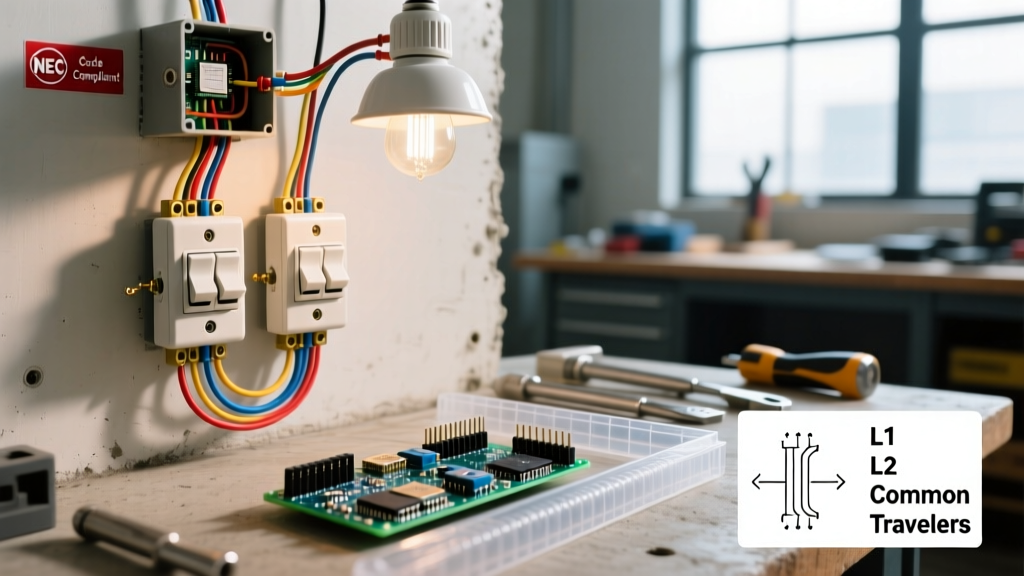
Code Exception (Switch Loops): In a cable assembly (like 14/2 NM-B), a white wire can be used as an ungrounded (hot) conductor for a switch leg, provided it is permanently re-identified with black tape or paint at both the switch and the fixture. However, since the 2011 NEC update (Article 404.2(C)), a neutral wire is now required at most switch boxes, drastically reducing the need for this exception in new construction.
Equipment Grounding Conductors: Green and Bare
Under NEC Article 250.119, equipment grounding conductors (EGCs) must be bare, covered, or insulated. If covered or insulated, the outer finish must be green, or green with one or more yellow stripes. The Occupational Safety and Health Administration (OSHA) heavily enforces this distinction in industrial settings to ensure workers never mistake a ground wire for a current-carrying neutral. You may never use green or bare copper as a current-carrying conductor under any circumstances.
Ungrounded (Hot) Conductors: Black, Red, and Blue
Ungrounded conductors carry the voltage from the panel to the load. While the NEC does not explicitly mandate black or red for 120V/240V single-phase systems (it only restricts white, gray, and green), black and red are the universally accepted industry standards. In Multi-Wire Branch Circuits (MWBCs), which share a single neutral, NEC Article 210.4 requires the ungrounded conductors to be distinctly identified (e.g., Black and Red) and mandates a simultaneous disconnect mechanism (like a double-pole breaker or handle tie) to prevent shock hazards during maintenance.
Commercial and Three-Phase Color Codes
When moving beyond residential split-phase into commercial three-phase power, the colors for electrical wiring shift to accommodate higher voltages and phase relationships. Maintaining consistent phase coloring across an entire facility is a best practice endorsed by the Electrical Safety Foundation International (ESFI) to prevent severe equipment damage from voltage mismatches.
| System Voltage | Phase A | Phase B | Phase C | Neutral | Ground |
|---|---|---|---|---|---|
| 208Y/120V (3-Phase) | Black | Red | Blue | White | Green/Bare |
| 480Y/277V (3-Phase) | Brown | Orange | Yellow | Gray | Green/Bare |
The High-Leg Delta Exception (Orange)
In older commercial facilities utilizing a 240V 3-phase High-Leg Delta system, one of the phases (Phase B) will measure 208V to neutral instead of the standard 120V. NEC Article 110.15 strictly requires this high leg to be identified by the color Orange. Connecting standard 120V appliances to the orange high-leg will instantly destroy the equipment and create a severe fire hazard.
NM-B Cable Jacket Colors: The Unsung Code
While the NEC governs the colors of the individual wire insulation inside a cable, the outer jacket color of Non-Metallic Sheathed Cable (NM-B, commonly known as Romex) follows a strict Underwriters Laboratories (UL) and manufacturer standard to indicate the wire gauge and ampacity at a glance:
- White Jacket: 14 AWG (Rated for 15 Amps) - Standard lighting circuits.
- Yellow Jacket: 12 AWG (Rated for 20 Amps) - Standard receptacle and kitchen circuits.
- Orange Jacket: 10 AWG (Rated for 30 Amps) - Electric dryers and water heaters.
- Black Jacket: 8 AWG or 6 AWG (Rated for 40-60 Amps) - Ranges, subpanels, and heavy machinery.
Pro Tip for Inspectors: If an inspector sees a white-jacketed NM-B cable on a 20-amp breaker, it will immediately fail inspection, as white denotes 14 AWG wire, which is only rated for 15 amps (NEC 240.4(D)).
Common Code Violations and Troubleshooting Edge Cases
When auditing existing panels or remodeling older homes, electricians frequently encounter dangerous deviations from standard wiring colors. Watch out for these specific failure modes:
- The 'French Cord' or Reversed Polarity: In older flexible appliance cords or DIY lamp repairs, the ribbed side of the cord should be neutral (white blade), and the smooth side should be hot (black blade). Reversing this leaves the lamp socket threaded shell energized, posing a severe shock risk when changing bulbs.
- Unidentified White Switch Legs in Conduit: Pulling white THHN through conduit to use as a hot wire without wrapping it in black electrical tape at both ends is a direct violation of NEC 200.6. This frequently leads to future technicians assuming the wire is dead when testing.
- Bootleg Grounds: In ungrounded older homes (pre-1960s), DIYers sometimes install a jumper wire between the neutral terminal and the ground screw on a 3-prong receptacle to trick a tester. This is incredibly dangerous; if the neutral fails, the appliance chassis becomes fully energized at 120V.
Frequently Asked Questions (FAQ)
Can I use any color for a hot wire as long as I tape it?
No. NEC Article 310.110 explicitly prohibits the use of white, gray, or green (with or without yellow stripes) as ungrounded (hot) conductors, even if you attempt to tape over them. You must use inherently colored wire (Black, Red, Blue, Brown, Orange, Yellow) for hot conductors in conduit pulls.
What color is the ground wire in older knob-and-tube or early NM cable?
Early NM cable (manufactured before the 1960s) often only contained a black (hot) and white (neutral) wire, with no equipment ground. In metallic conduit systems (like EMT or rigid steel), the metal conduit itself serves as the Equipment Grounding Conductor (EGC) per NEC Article 250.118, meaning no internal green or bare wire exists.
Do DC control circuits follow the same color codes?
No. DC and low-voltage control wiring (governed largely by NFPA 79 for industrial machinery) uses a different matrix. Typically, Red is used for DC positive (+), Black for DC negative (-), and White for DC ground. Always verify the specific schematic and applicable standard (like UL 508A) before terminating control panels.
Final Safety Directive
Never assume wire colors are correct in an existing structure. Previous owners or unlicensed handymen frequently ignore the NEC. Always use a non-contact voltage tester and a multimeter to verify the absence of voltage and confirm conductor roles before making any terminations. When in doubt, consult a licensed master electrician to ensure your project meets the latest local amendments to the NEC.