
Navigating Commercial Electricity Wiring Colours: Beyond Residential Basics
Transitioning from residential to commercial electrical work requires a fundamental shift in how you approach power distribution. While residential electricians primarily deal with single-phase 120/240V split-phase systems, commercial facilities rely heavily on three-phase power to drive heavy machinery, HVAC systems, and high-bay lighting. Consequently, understanding electricity wiring colours in a commercial context is not just about organization—it is a critical safety and code compliance imperative. Misidentifying a phase conductor in a 480V system can result in catastrophic equipment failure, arc flash incidents, or fatal electrical shocks.
In North America, the National Electrical Code (NEC) governs conductor identification. However, the NEC does not universally mandate specific colors for every ungrounded (hot) phase conductor across all voltage systems. Instead, it requires consistent identification within a facility and mandates specific colors for grounded (neutral) and grounding conductors. Local Authorities Having Jurisdiction (AHJs) and industry best practices have established de facto color standards that every commercial electrician must memorize. As we navigate the 2026 NEC adoption cycles, strict adherence to these phase-identification standards is being enforced more rigorously than ever.
The NEC Stance on Conductor Identification
Before pulling a single foot of THHN/THWN-2 wire, you must understand the baseline rules outlined by the National Fire Protection Association (NFPA 70). The NEC clearly defines the colors for neutral and ground wires, but leaves some flexibility for phase conductors, provided they are permanently identified.
- Grounded (Neutral) Conductor: NEC Article 200.2 mandates that grounded conductors must be white, gray, or have three continuous white stripes on other than green insulation.
- Equipment Grounding Conductor: NEC Article 250.119 requires bare, covered, or insulated green or green-with-yellow-stripes conductors.
- Ungrounded (Phase) Conductors: NEC Article 210.5(C) and 215.12(C) require that ungrounded conductors be identified by any color except green, gray, or white. Furthermore, if a building has multiple voltage systems (e.g., both 208V and 480V), the facility must have a permanent, documented color-coding scheme posted at every panelboard.
Standard Commercial Voltage Systems and Color Codes
Commercial buildings typically utilize one of three main three-phase voltage configurations. Using distinct electricity wiring colours for each voltage system prevents deadly cross-connections. Below is the industry-standard color matrix recognized across most North American commercial projects.
| Voltage System | Phase A | Phase B | Phase C | Neutral | Ground |
|---|---|---|---|---|---|
| 120/208V 3-Phase Wye | Black | Red | Blue | White | Green/Bare |
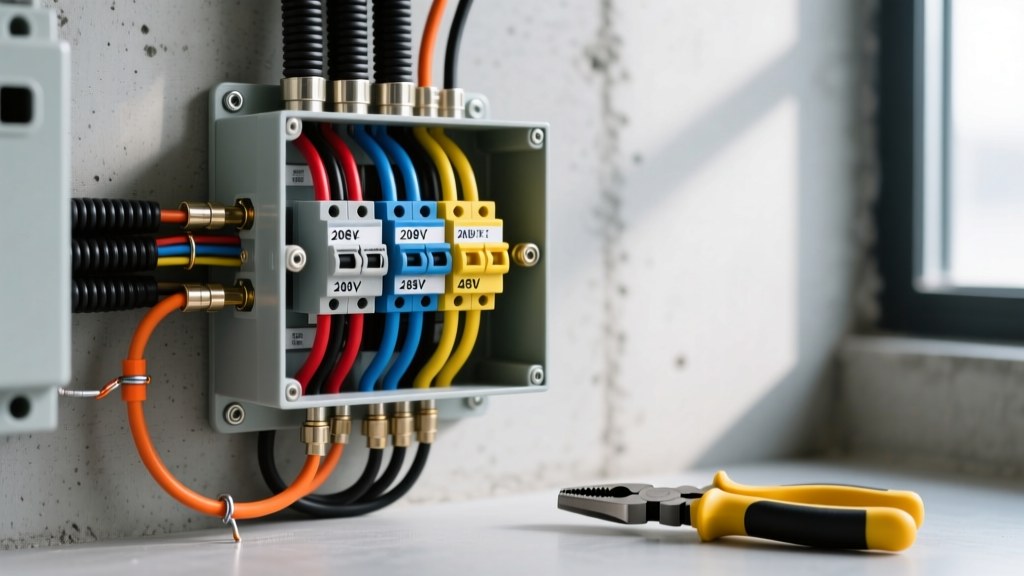
| 277/480V 3-Phase Wye | Brown | Orange | Yellow | Gray | Green/Bare |
| 120/240V 3-Phase Delta (High-Leg) | Black | Orange (High-Leg) | Blue | White | Green/Bare |
Deep Dive: 277/480V Systems in Large Facilities
The 277/480V Wye system is the backbone of large commercial facilities, warehouses, and manufacturing plants. The 480V phase-to-phase voltage is highly efficient for running heavy induction motors and minimizing voltage drop over long feeder runs, while the 277V phase-to-neutral voltage is the standard for commercial fluorescent and LED high-bay lighting.
For this system, the mandated electricity wiring colours are Brown, Orange, and Yellow for the phases, and Gray for the neutral. The use of gray for the 480V neutral is a critical safety distinction. If an electrician mistakenly uses a white neutral wire in a 480V panel, another technician might assume it belongs to a 208V circuit, leading to severe miswiring. When pulling XHHW-2 conductors in wet locations or underground PVC conduits for 480V feeders, always ensure the gray neutral is clearly marked if factory insulation colors are unavailable.
The High-Leg Delta Trap: Surviving Legacy 240V Systems
One of the most dangerous configurations an electrician will encounter in older commercial buildings or specific industrial retrofits is the 120/240V 3-Phase 4-Wire Delta system, commonly known as the "High-Leg" or "Wild-Leg" Delta. This system provides 240V three-phase for motors, but uses a center-tapped transformer on one winding to provide 120V single-phase for standard receptacles.
The catch? The voltage from the "B" phase (the high leg) to neutral is not 120V—it is 208V. If you wire a standard 120V HVAC control board or convenience receptacle to the B-phase and the neutral, you will instantly destroy the equipment and create a severe fire hazard. To prevent this, NEC 210.5(C) and OSHA Standard 1910.304 strictly require the high-leg conductor to be identified by the color ORANGE.
Field Warning: Never assume the orange wire in an older panel is the 480V B-phase. In a high-leg delta panel, orange signifies the 208V-to-ground wild leg. Always verify the panel schedule and test the voltage before terminating.
Field Phasing: Colored THHN vs. Phasing Tape
When installing large commercial feeders (e.g., 3/0 AWG to 500 MCM), sourcing factory-colored THHN wire in Brown, Orange, and Yellow can be a logistical nightmare. Many electrical supply houses only stock Black, Red, Blue, White, and Green in large spools. This forces contractors to choose between special-ordering colored wire or using black wire with phasing tape.
The Economics and Execution of Phasing Tape:
Special-ordering 500 feet of 4/0 AWG Brown THHN might carry a 30% premium and a two-week lead time. Using standard Black THHN and phasing it at the terminations is the industry-standard workaround. However, this must be done correctly to pass inspection.
- Material: Use high-grade vinyl electrical tape, such as 3M Scotch Super 33+ or Temflex. Cheap generic tape will unspool inside a hot panelboard within months.
- Application: Wrap the tape a minimum of 6 inches down the conductor from the termination point. Stretch the tape to about 3/4 of its natural width as you wrap, overlapping each layer by 50%. This creates a tight, waterproof seal that conforms to the wire.
- Panel Documentation: NEC requires a permanent directory at the panel. If you use black wire with tape, your panel schedule must explicitly state: "All ungrounded conductors are Black, phased with Brown, Orange, and Yellow tape at terminations."
Troubleshooting and Verification: Never Trust the Color
In commercial remodels and tenant improvements, you will frequently open panels that look like a rainbow of conflicting colors. Previous contractors may have ignored code, used leftover wire from a 208V job in a 480V panel, or failed to re-identify conductors. Relying solely on electricity wiring colours in an existing commercial facility is a recipe for disaster.
Before cutting, stripping, or terminating any conductor, you must perform a live-dead-live test using a reliable True-RMS digital multimeter, such as the Fluke 87V Industrial Multimeter.
- Test Phase-to-Ground: Verify the voltage matches the expected system (e.g., 277V on a 480V Wye system). If you read 208V to ground on an expected 277V leg, you may be dealing with an improperly identified high-leg delta or a back-fed transformer.
- Test Phase-to-Phase: Verify phase rotation and voltage balance. A 480V system should read approximately 480V (+/- 5%) between any two ungrounded phases.
- Verify the Neutral: Test the presumed neutral (gray or white) to ground. It should read near 0V. If it reads significant voltage, you have a floating neutral or a miswired multi-wire branch circuit (MWBC) sharing the wrong phases.
Labeling Best Practices for Modern Commercial Panels
Beyond the insulation color, physical labeling is your second line of defense. For commercial conduit runs and junction box pulls, utilize a Brady BMP21-PLUS or similar heat-shrink and vinyl label printer. Every wire entering a commercial junction box should be labeled with its source panel and circuit number. When dealing with multi-conductor cables (like Type MC or AC), use colored zip ties or heat shrink tubing (e.g., 3M FP-301) at the breakout points to maintain the brown/orange/yellow or black/red/blue visual hierarchy before the wires enter the conduit system.
Summary of Commercial Wiring Compliance
Mastering commercial electricity wiring colours requires a deep understanding of voltage systems, NEC mandates, and practical field applications. Whether you are pulling 120/208V branch circuits for office receptacles or terminating 480V feeders for a new chiller plant, strict adherence to color codes—Black/Red/Blue for 208V, Brown/Orange/Yellow for 480V, and the critical Orange high-leg identification—ensures the safety of your crew and the longevity of the facility's electrical infrastructure. Always document your facility's specific color code on the panel directory, use premium phasing materials when factory colors are unavailable, and verify every conductor with a calibrated meter before making a connection.