
The True Cost of Failing an Outdoor Rough-In
When learning how to run outdoor electrical wiring, most DIYers and junior electricians focus entirely on the physical labor of trenching and pulling wire. However, from an inspection and compliance perspective, the physical installation is only half the battle. Failing an outdoor rough-in or final electrical inspection doesn't just mean a delayed project; it often means trenching up a freshly landscaped yard, tearing apart rigid conduit runs, or replacing hundreds of feet of wire that was improperly rated for wet locations.
To ensure your outdoor electrical project passes inspection on the first visit in 2026, you must design your installation around the National Electrical Code (NEC). This guide breaks down the exact code articles, material specifications, and common failure points that inspectors look for when evaluating outdoor branch circuits and feeders.
Decoding NEC Article 300.5: Underground Burial Depths
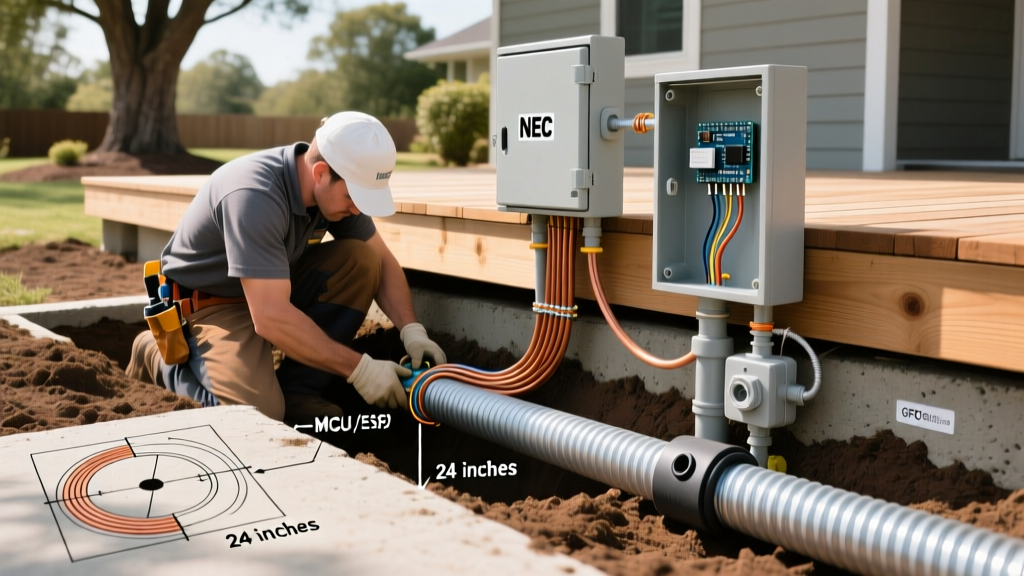
NEC Article 300.5 governs underground installations. Inspectors will verify your trench depth before any backfilling occurs. A common misconception is that all underground wiring must be buried at 24 inches. In reality, the required depth depends entirely on the wiring method and the circuit's voltage and amperage.
NEC Table 300.5 Burial Depth Matrix
| Wiring Method | Minimum Burial Depth (Inches) | Inspector Notes & Edge Cases |
|---|---|---|
| Direct Burial Cable (Type UF-B) | 24 inches | Must be protected by Schedule 80 PVC when emerging from the ground. |
| PVC Conduit (Schedule 40 or 80) with THWN-2 | 18 inches | Most common commercial and high-end residential method. Requires warning ribbon 12 inches above. |
| Residential 120V, 20A Max, GFCI Protected | 12 inches | Only applies to strictly residential branch circuits with GFCI protection at the source. |
| Rigid Metal Conduit (RMC) or IMC | 6 inches | Rarely used in residential due to cost ($18+/10ft), but common in commercial pads. |
Pro-Tip for Trenching: If your local jurisdiction requires an 18-inch burial depth for PVC conduit, dig your trench to 22 inches. This allows you to lay down 2 inches of sand bedding, place the conduit, and cover it with 2 inches of sand before adding native soil. Inspectors heavily penalize trenches where sharp rocks are resting directly against PVC conduit, as frost heave will eventually crack the pipe.
Above-Grade Conduit: Schedule 40 vs. Schedule 80 Compliance
Once your underground conduit transitions above ground to terminate at a structure, pole, or outdoor panel, the physical protection rules change dramatically. One of the most frequent inspection write-ups involves the misuse of Schedule 40 PVC in areas subject to physical damage.
According to NEC Section 352.12, Schedule 40 PVC cannot be used where subject to physical damage. Inspectors universally define the area from the finished grade up to 8 feet on a wall or pole as a 'physical damage zone.' Furthermore, any conduit installed across a driveway or within 5 feet of a parking pad requires heavy-duty protection.
Material Cost & Application Breakdown
- Schedule 40 PVC (3/4-inch): ~$2.10 per 10-foot stick. Use only for direct underground burial or above 8 feet on a protected wall.
- Schedule 80 PVC (3/4-inch): ~$4.50 per 10-foot stick. Mandatory for the transition from underground to above-ground up to the 8-foot mark.
- Rigid Galvanized Steel (RGS): ~$28.00 per 10-foot stick. Required in commercial applications or where vehicles might impact the conduit.
If you are running a circuit to a detached garage or a backyard shed, use Schedule 40 PVC in the trench, transition to a Schedule 80 PVC sweep elbow, and run Schedule 80 up the side of the building to your exterior disconnect.
The Moisture Migration Trap: Sealing Fittings
Outdoor temperature fluctuations cause condensation inside conduit. When warm, moist daytime air enters the top of an outdoor conduit and meets the cool underground earth, water condenses and pools at the lowest point. If that lowest point happens to be your indoor main panel or a subpanel in a detached garage, you will introduce catastrophic moisture into your breaker terminations.
To prevent this, NEC 300.7(A) requires sealing fittings where raceways pass from the interior to the exterior of a building, or where they pass from an underground system into an above-ground enclosure.
Compliance Fix: Install a Hubbell EYS or EZS sealing fitting (approx. $18-$25) at the base of your above-ground conduit run. After pulling your THWN-2 wires, pack the fitting with duct seal putty (e.g., Gardner Bender GBP-8). This creates an airtight, watertight barrier that stops moisture migration dead in its tracks. Inspectors will specifically look for this putty seal during a final walkthrough.
GFCI Mandates and Weatherproof Enclosures
The rules for outdoor receptacles have tightened significantly in recent code cycles, and 2026 enforcement is stricter than ever. Under ESFI guidelines and NEC 210.8(F), all outdoor receptacles rated 150 volts to ground or less, and 50 amperes or less, must have ground-fault circuit-interrupter (GFCI) protection.
Furthermore, the physical enclosure housing the receptacle must be rated for wet locations. You cannot use a standard flat metal cover. You must install an 'in-use' weatherproof cover, commonly known as a bubble cover.
Top-Rated In-Use Covers for Inspection Compliance
- Arlington Industries WP7226: Features a flip-lid design that accommodates large power tool plugs and smart home transformers without forcing the cover open.
- Hubbell TayMac MM420C: A rugged, die-cast aluminum in-use cover that resists UV degradation and physical impact far better than plastic alternatives.
Edge Case Warning: If your outdoor receptacle is located under a covered patio or porch, inspectors may still classify it as a 'damp' or 'wet' location depending on wind-driven rain exposure. Always default to a wet-location rated enclosure (NEMA 3R or 4) to avoid subjective inspector write-ups.
Common Inspection Failure Points (And How to Avoid Them)
Even with the right wire and conduit, minor detailing errors will result in a failed inspection. Review this checklist before calling your local AHJ (Authority Having Jurisdiction):
- Using NM-B (Romex) in Outdoor Conduit: This is an automatic fail. Conduit outdoors is considered a wet location due to condensation. NM-B paper wrapping will wick moisture and rot. You must use individual THWN-2 conductors.
- Missing Conduit Bushings: Where PVC or metal conduit enters an outdoor panel or junction box, NEC 373.6(C) requires an insulating bushing to protect wire insulation from sharp edges.
- Inadequate Working Space: NEC 110.26 requires 36 inches of clear working space in front of an outdoor disconnect or subpanel. If you mount your panel behind an AC condenser unit or next to a retaining wall, it will fail.
- Unidentified Conductors: All outdoor panel circuits must be clearly labeled on the panel directory. 'Outdoor Lights' is insufficient; 'North Eave Soffit Lighting' is compliant.
Final Pre-Inspection Verification Flow
Before scheduling your final inspection, walk the entire circuit path with this mental framework:
- Verify the Source: Test the GFCI breaker or receptacle with a calibrated tester (e.g., Amprobe GFI-5000) to ensure trip times are under 25 milliseconds.
- Check the Transition: Ensure the sweep elbow from the trench to the wall is Schedule 80 and securely strapped within 12 inches of the box.
- Inspect the Seal: Open the sealing fitting and verify the duct seal putty is fully packed around the individual conductors.
- Confirm Enclosures: Ensure all outdoor junction boxes have factory-threaded drainage plugs at the bottom, and that all blank cover plates are secured with stainless steel screws.
Mastering how to run outdoor electrical wiring is ultimately about anticipating how the environment will attack your installation over the next 20 years. By building to the strict letter of the NEC and understanding the specific failure modes that inspectors are trained to spot, you guarantee a safe, durable, and fully compliant outdoor electrical system.