
Decoding the Yellow Wire: NEC Standards and Real-World Applications
When opening a junction box or peering behind a switch plate, encountering an unfamiliar wire color can trigger immediate safety concerns. For homeowners and apprentice electricians alike, the most common question is: what is the yellow wire in electrical wiring? In standard United States residential and commercial AC mains wiring, governed by the National Electrical Code (NEC), the yellow wire is strictly classified as an ungrounded conductor—meaning it carries live current. It is never used as a neutral (white/gray) or an equipment ground (green/bare copper).
While black and red are the most common "hot" wire colors found in standard 12/2 or 12/3 NM-B (Romex) cables, yellow enters the picture when more complex circuits are required. Understanding its specific role is the dividing line between a successful DIY repair and a catastrophic electrical fire. Below, we analyze the exact scenarios where yellow wires are deployed and provide a rigorous DIY vs. Professional analysis to help you decide when to pick up a screwdriver and when to call a licensed contractor.
1. The Traveler Wire in 3-Way and 4-Way Switches
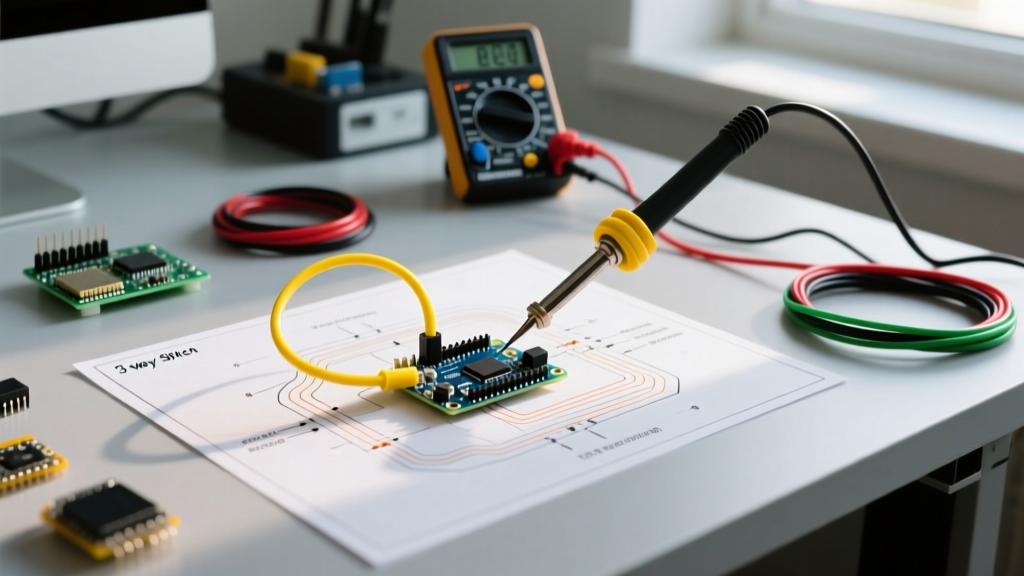
The most frequent encounter with a yellow wire in residential wiring is inside multi-location switch setups. When you control a single light fixture from two different locations (a 3-way switch) or three locations (a 4-way switch), electricians use 12/3 or 14/3 NM-B cable. This cable contains a black (hot), white (neutral), red (traveler), and bare (ground) wire. However, when running separate conduits or using specialized 12/4 cables, or when pulling individual THHN wires through EMT conduit, yellow is universally utilized as the second "traveler" wire alongside red.
Traveler wires do not have a fixed "always-on" status. Instead, they act as the bridge between switches, alternately carrying the 120V load depending on the physical toggle position of the switch. Misidentifying a traveler as a permanent hot or a neutral is a leading cause of short circuits in DIY lighting projects.
2. Multi-Wire Branch Circuits (MWBC) and Split Receptacles
In kitchens and workshops, electricians frequently install split-wired receptacles. This involves breaking the brass tab on the hot side of a standard 15A or 20A duplex outlet, allowing the top and bottom plugs to operate on independent circuits while sharing a single neutral wire. In conduit systems, a black wire and a yellow wire (or red wire) are pulled from two different breakers on opposite phases (Leg A and Leg B) to supply these outlets. This prevents the shared neutral from being overloaded, a critical safety requirement outlined in NEC Article 210.4.
3. 240V Appliance Circuits
For heavy-duty appliances like electric dryers, ranges, and subpanels, 10/3 or 8/3 NM-B cable is standard. While the outer jacket contains black, red, white, and bare wires, individual THHN wires pulled through conduit for 240V baseboard heaters or HVAC disconnects often use yellow as the secondary hot leg. Both the black and yellow wires will read 120V to ground, and 240V across each other.
DIY vs. Professional Analysis: Where Is the Line?
Knowing what the yellow wire does is only half the battle. The real challenge is determining whether you have the expertise to safely manipulate it. The electrical industry in 2026 sees a massive surge in DIY smart-home upgrades, but working with multi-pole circuits introduces severe risks. Below is a decision matrix for common yellow-wire scenarios.
| Scenario | DIY Feasibility | Pro Necessity | Risk Factor | Avg 2026 Pro Cost |
|---|---|---|---|---|
| Replacing a 3-Way Smart Switch | Moderate | Recommended | Medium (Traveler miswiring) | $150 - $250 |
| Split-Wired Kitchen Receptacle Repair | Low | Mandatory | High (MWBC Neutral overload) | $180 - $300 |
| 240V Baseboard Heater Thermostat | Low | Mandatory | Extreme (Arc flash / 240V shock) | $250 - $400 |
| Conduit Wire Pulling (THHN) | None | Mandatory | High (Insulation damage) | $300 - $600+ |
Critical Failure Modes for DIYers
When amateurs attempt to wire circuits involving yellow traveler or secondary hot wires, specific failure modes consistently emerge:
- The "Backstab" Traveler Failure: DIYers often push 14 AWG or 12 AWG yellow traveler wires into the quick-insert "backstab" holes on the rear of 3-way switches. Under heavy loads, these spring-loaded connections loosen over time, creating high-resistance arcing that melts the switch housing. Professionals always use the side-terminal screw connections or, preferably, screw-clamp plates.
- Missing MWBC Handle Ties: If a yellow wire and a black wire share a neutral on a Multi-Wire Branch Circuit, NEC Article 210.4(B) mandates a simultaneous disconnect. A licensed pro will install a 2-pole breaker or an approved handle tie. DIYers frequently replace a broken tandem breaker with two independent single-pole breakers, meaning turning off one "hot" leaves the shared neutral energized by the other leg—a potentially lethal shock hazard for anyone working on the downstream outlets.
- Smart Switch Neutral Confusion: Many modern smart switches (like the Lutron Caseta or Kasa Smart lines) require a dedicated neutral. In older 3-way switch boxes, the white wire in a 12/3 cable might actually be re-marked with black or yellow tape to serve as a traveler or hot. A DIYer who assumes "white is always neutral" will connect the smart switch's neutral pigtail to a live traveler, instantly destroying the switch's internal logic board and tripping the AFCI breaker.
Essential Diagnostic Tools for Wire Identification
You should never rely solely on wire color to determine a circuit's status. Previous homeowners or unlicensed handymen may have used yellow THHN wire as a substitute for other colors due to material shortages. Before touching any yellow wire, verify its status with professional-grade diagnostic tools:
- Non-Contact Voltage Tester (NCVT): The Fluke 1AC-A1-II VoltAlert (approx. $35) is the industry standard for quickly detecting the presence of AC voltage without stripping insulation. Use this to verify the circuit is dead at the breaker panel before removing wire nuts.
- Clamp Meter with Continuity: A tool like the Klein Tools CL800 (approx. $140) allows you to measure AC voltage across the yellow wire and ground (to confirm if it is a hot/traveler) and test continuity to map out traveler paths between 3-way switches without guessing.
- Wire Tracing Toner: For complex 4-way switch loops where yellow wires disappear into walls, a Fox and Hound toner helps trace the exact path of the conductor to the corresponding junction box.
⚠️ CRITICAL SAFETY DIRECTIVE: The Occupational Safety and Health Administration (OSHA) and the Consumer Product Safety Commission (CPSC) report hundreds of fatal residential electrocutions annually. Never assume a yellow, red, or black wire is de-energized simply because a wall switch is in the "off" position. Always test at the point of contact with a calibrated meter after locking out the breaker.
Code Compliance and Safety Directives
The National Fire Protection Association (NFPA) updates the NEC on a three-year cycle, and modern code enforcement is incredibly strict regarding ungrounded conductors. If you are pulling new wire or remodeling, you must adhere to the following:
- NEC Article 200.6 (Identification of Neutral): Yellow wire must never be used as a grounded neutral conductor. If you are pulling individual THHN wires and need a neutral, you must use white or gray. Using yellow for a neutral will fail inspection and create a severe shock hazard if the neutral bond is broken downstream.
- NEC Article 404.2 (Switch Connections): Switches must be connected so that the neutral is not switched. When wiring a 3-way circuit with yellow travelers, ensure the white wire is reserved strictly for the line or load neutral, and is pigtailed correctly in the switch box to maintain a continuous neutral path for smart devices.
- AFCI/GFCI Requirements: In 2026, virtually all 120V, 15A, and 20A branch circuits in living spaces require Arc-Fault Circuit Interrupter (AFCI) protection, while kitchens and bathrooms require Ground-Fault Circuit Interrupter (GFCI) protection. Multi-pole circuits with yellow travelers can sometimes cause nuisance tripping on older AFCI breakers if the travelers are run too close to inductive loads or if the neutral and hot do not travel through the same conduit (violating NEC 300.3). Always use 2-pole AFCI breakers for MWBCs.
The Verdict: When to Call a Professional
If your project involves simply swapping a standard single-pole switch where the yellow wire is clearly acting as a switched leg, a competent DIYer with a voltage tester and basic wire-stripping skills can manage the task safely. However, if the yellow wire is part of a 3-way switch loop, a Multi-Wire Branch Circuit, or a 240V appliance feed, the complexity and danger scale exponentially. Hiring a licensed electrician in 2026 typically costs between $85 and $150 per hour. While the upfront cost may sting, a professional will ensure that handle ties are installed, travelers are correctly mapped, and torque screwdrivers are used to meet the exact pound-inch specifications required by modern NEC terminal codes. When dealing with the ungrounded current carried by a yellow wire, the cost of a professional is always lower than the cost of an electrical fire or a life-threatening shock.