
The Foundation: NEC Mandates for AC Power Identification
Understanding and strictly applying the correct color codes for wiring electrical systems is the baseline for safety, code compliance, and long-term maintainability in any residential or commercial build. Misidentified conductors are a leading cause of arc faults, fatal shocks, and catastrophic equipment failure during panel upgrades. In the United States, the National Fire Protection Association (NFPA) publishes the National Electrical Code (NEC), which dictates the legal requirements for conductor identification.
While the NEC does not mandate a universal color for ungrounded (hot) conductors in standard single-phase residential wiring, it strictly regulates the colors for grounded (neutral) and equipment grounding conductors. Furthermore, industry standards have solidified specific color conventions for alternating current (AC) power systems to ensure uniformity across the trade. As an electrician or advanced DIYer working in 2026, relying on guesswork or localized habits rather than NEC Articles 200, 250, and 310 is a liability you cannot afford.
Master Color Code Matrix for AC Building Wiring
The following matrix outlines the standard industry color codes for the most common AC voltage systems found in North American residential and commercial construction. Always verify local amendments, as some municipalities enforce stricter color-coding ordinances.
| System Voltage | Phase A (Hot) | Phase B (Hot) | Phase C (Hot) | Neutral (Grounded) | Ground (Equipment) |
|---|---|---|---|---|---|
| 120/240V Single-Phase | Black | Red (Multi-wire) | N/A | White or Gray | Bare, Green, or Green/Yellow |
| 208Y/120V 3-Phase | Black | Red | Blue | White or Gray | Bare, Green, or Green/Yellow |
| 480Y/277V 3-Phase | Brown | Orange | Yellow | Gray | Bare, Green, or Green/Yellow |
| 240V Delta (High-Leg) | Black | Orange (High-Leg) | Red | White (Center Tap) | Bare, Green, or Green/Yellow |
The High-Leg Delta Exception
One of the most dangerous edge cases in commercial wiring is the 240V 3-Phase Delta system with a center-tapped neutral. This setup provides 120V for standard receptacles but yields 208V from the 'wild leg' to neutral. NEC 408.3(E) explicitly mandates that this high-leg must be identified by the color Orange. Connecting a standard 120V appliance to the orange high-leg will instantly destroy the equipment and pose a severe fire hazard.
Material Breakdown: NM-B Cable vs. THHN/THWN-2 Conductors
When sourcing materials, it is vital to distinguish between the color of the outer cable jacket and the color of the individual conductors inside. Manufacturers like Southwire utilize jacket colors on Non-Metallic Sheathed Cable (NM-B, commonly known as Romex) strictly for gauge identification, not circuit function.
NM-B (Romex) Jacket Color Standards
- White Jacket: 14 AWG (15-Amp circuits, typically lighting)
- Yellow Jacket: 12 AWG (20-Amp circuits, standard receptacles)
- Orange Jacket: 10 AWG (30-Amp circuits, dryers, water heaters)
- Black Jacket: 8 AWG and larger (40-Amp to 60-Amp circuits)
Note: The individual wires inside these cables will still follow the standard black (hot), white (neutral), and bare (ground) color codes.
THHN/THWN-2 in Conduit Systems
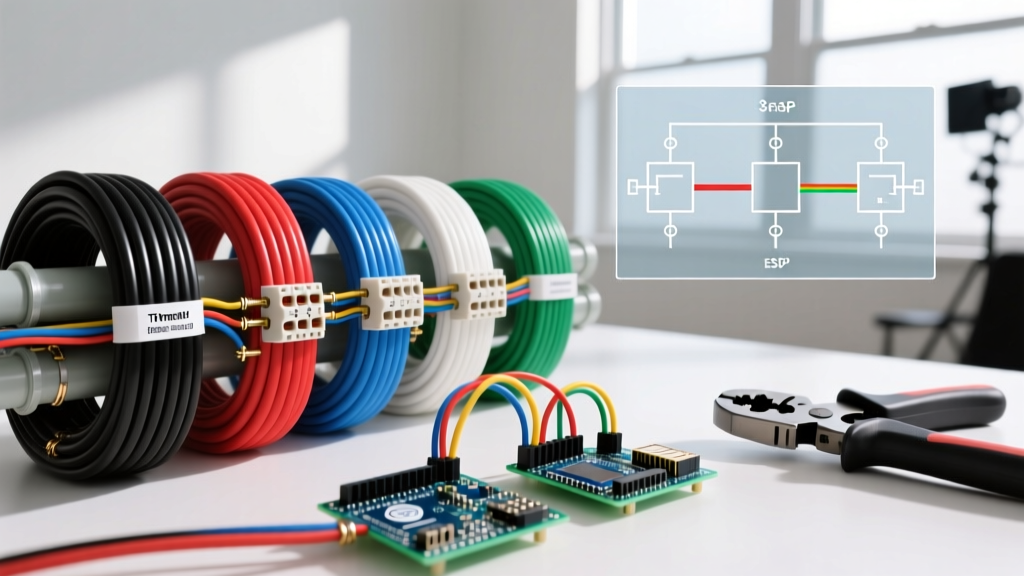
For commercial builds or residential conduit runs (e.g., EMT or PVC), you pull individual THHN/THWN-2 stranded or solid conductors. Here, the insulation color is the only visual identifier. You must purchase specific colored spools or use phase tape. For a standard 208V 3-phase panel, you are required to pull Black, Red, Blue, White, and Green wires. Mixing up Phase B (Red) and Phase C (Blue) can cause phase rotation issues in 3-phase HVAC motors, leading to reverse operation and compressor damage.
Critical Edge Cases: When White Isn't Neutral
Assuming a white wire is always a neutral is a fatal mistake for novice electricians. The NEC outlines specific scenarios where a white or gray conductor is permitted to be used as an ungrounded (hot) conductor, provided it is properly re-identified.
NEC 200.7(C)(2) Re-identification Rule: A white or gray conductor shall be permitted to be used as an ungrounded conductor where permanently re-identified at each location where the conductor is visible and accessible. Identification must encircle the insulation and be a color other than white, gray, or green (typically black or red electrical tape or marker).
Common Scenarios Requiring Re-identification:
- Switch Loops: In older or standard 2-wire switch loops, the white wire in the NM-B cable is sent down to the switch to act as the 'hot' feed, while the black wire returns as the switched leg. The white wire must be wrapped in black tape at both the panel and the switch box.
- 240V Appliances: Baseboard heaters, well pumps, and AC disconnects often use 2-wire NM-B cable. Both the black and white wires are hot (120V each, totaling 240V). The white wire must be re-identified with red or black tape at both terminations.
- Multi-Wire Branch Circuits (MWBC): While the neutral remains white, the two hot legs (Black and Red) share it. If the red leg is not present in a specific junction box but the circuit continues, meticulous labeling is required to prevent overloading the shared neutral.
Essential Tools for Wire Identification and Phase Taping
To maintain strict adherence to color codes for wiring electrical systems, professionals rely on specialized identification tools. Standard vinyl tape degrades over time, peeling off inside warm panels and leaving conductors unidentified. Invest in the following materials:
- Klein Tools 57194 Phase Tape Kit: Includes dedicated rolls of brown, orange, yellow, and gray tape for 480V systems. The adhesive is formulated to resist heat and UV degradation inside metal enclosures. (Approx. $22 per kit).
- 3M Super 33+ Vinyl Electrical Tape: The industry standard for re-identifying white wires in switch loops. It stretches tightly and maintains adhesion up to 176°F (80°C). Never use cheap 'dollar store' tape, which dries out and falls off within two years.
- Brady Cable ID Markers: For commercial panels, wrapping wires with heat-shrink or adhesive-backed circuit ID tags (e.g., 'Panel A, Ckt 14, Receptacles') is a best practice that goes beyond basic color coding, saving hours of troubleshooting during future renovations.
- Fluke T6-1000 Electrical Tester: Before trusting any wire color, test it. The Fluke T6 allows you to measure AC voltage and current without metal-to-metal contact, verifying if a suspected 'white neutral' is actually carrying 120V due to a previous electrician's code violation.
Troubleshooting Common Wiring Color Violations
When remodeling older homes (pre-1980s) or auditing commercial spaces, you will inevitably encounter severe color code violations. Recognizing these failure modes is critical for safe remediation.
1. The 'Bootleg' Ground
In an attempt to upgrade a 2-prong receptacle to a 3-prong without running a new ground wire, unethical handymen will install a jumper wire between the neutral (silver) terminal and the ground (green) terminal. The wire colors appear correct on the surface, but this creates a lethal shock hazard if the neutral connection ever fails upstream. Always use a dedicated ground wire (bare or green) tied back to the panel's grounding bus bar.
2. Reversed Polarity
Connecting the black (hot) wire to the silver terminal and the white (neutral) wire to the brass terminal on a receptacle. While the device may still power on, the internal fuse or switch mechanism of the plugged-in appliance will only interrupt the neutral path, leaving the internal components energized at 120V even when turned 'off'.
3. Improper Grounding Conductor Colors
OSHA regulations and NEC Article 250.119 strictly prohibit using green or green/yellow insulation for anything other than an equipment grounding conductor. Using a green wire as a hot or neutral conductor in a control circuit or multi-conductor cable is a severe code violation that can lead to a technician touching a supposedly 'safe' ground wire that is actually carrying lethal voltage.
Conclusion: Verification is Your Final Defense
Mastering the color codes for wiring electrical circuits is about more than memorizing a chart; it is about understanding the physics, the code intent, and the physical materials you are handling. Whether you are pulling 480V 3-phase THHN through EMT conduit in a commercial warehouse or roughing in 12 AWG NM-B for a residential kitchen remodel, strict adherence to NEC identification standards protects lives and property. Always verify conductor function with a calibrated digital multimeter or non-contact voltage tester before making any physical contact, regardless of the insulation color.