
The Foundation: Understanding the National Electrical Code (NEC)
When discussing home electrical wiring basics, the most critical concept to internalize is that the National Electrical Code (NEC), officially known as NFPA 70, is not merely a guideline—it is the legally enforceable baseline for life safety and fire prevention in the United States. Published by the National Fire Protection Association (NFPA), the NEC is updated every three years. As of 2026, the vast majority of US jurisdictions have fully adopted the 2023 NEC, while several progressive states and municipalities have already begun enforcing the 2026 revisions.
Before cutting into a single stud, you must identify your local Authority Having Jurisdiction (AHJ). The AHJ is typically your city or county electrical inspector. While the NEC is a national standard, local AHJs often add municipal amendments. For instance, some regions require arc-fault protection in areas where the base NEC might not yet mandate it, or they may require specific types of grounding electrodes due to local soil resistivity.
Pro-Tip for DIYers: Never assume a YouTube tutorial is code-compliant for your specific zip code. Always call your local building department to ask which NEC edition is currently enforced and whether your specific project (like finishing a basement or adding a detached garage subpanel) requires a permit and rough-in inspection.
Wire Sizing and Ampacity: The Core of Home Electrical Wiring Basics
At the heart of residential wiring is the concept of ampacity—the maximum current a conductor can carry continuously under conditions of use without exceeding its temperature rating. In modern homes, we primarily use Nonmetallic-Sheathed Cable (NM-B), commonly referred to by the brand name Romex. NM-B conductors are typically rated for 60°C or 90°C, but NEC Article 240.4(D) strictly limits small conductors to the 60°C column for overcurrent protection.
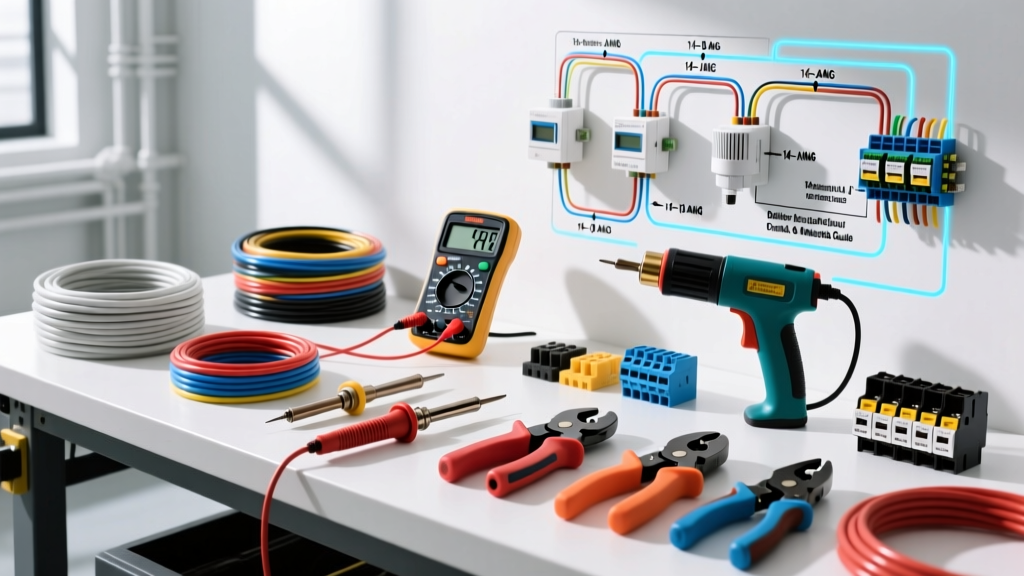
Below is a definitive guide to standard copper wire gauges, their maximum ampacities, and 2026 market pricing for 250-foot spools of NM-B cable.
| AWG Size | Max Ampacity (60°C) | Standard Breaker | Common Residential Application | Avg. Cost per Ft (2026) |
|---|---|---|---|---|
| 14 AWG | 15 Amps | 15A (Single Pole) | General lighting, bedroom/living room receptacles | $0.48 |
| 12 AWG | 20 Amps | 20A (Single Pole) | Kitchen small appliance, bathroom, laundry, garage | $0.68 |
| 10 AWG | 30 Amps | 30A (Double Pole) | Electric water heaters, window AC units | $1.25 |
| 8 AWG | 40 Amps | 40A (Double Pole) | Level 2 EV chargers, older electric ranges | $2.30 |
| 6 AWG | 55 Amps | 60A (Double Pole) | Modern electric ranges, 60A subpanel feeders | $3.95 |
| 4 AWG | 70 Amps | 70A / 80A | 100A subpanel feeders (copper) | $6.50 |
Copper vs. Aluminum Conductors
While copper is the undisputed king for interior branch circuits, aluminum (specifically AA-8000 series alloy) is heavily utilized for service entrance cables and large subpanel feeders due to its cost-effectiveness and lighter weight. If you are running a 200-amp feeder to a detached workshop, 4/0 AWG aluminum (XHHW-2 or SER cable) is the standard choice, costing roughly $4.50 per foot compared to over $18.00 per foot for the copper equivalent. Always use an anti-oxidant compound like Noalox on aluminum terminations and ensure your lugs are rated for AL/CU.
Overcurrent Protection: Breakers and the AFCI/GFCI Mandate
Understanding home electrical wiring basics requires a deep dive into overcurrent protection, governed by NEC Article 240. The breaker's sole job is to protect the wire from melting, not to protect the appliance plugged into it. This is why you can never place a 14 AWG wire on a 20-amp breaker; the wire will catch fire before the breaker trips.
Beyond standard thermal-magnetic breakers (like the ubiquitous Eaton BR220 or Square D HOM120), modern code heavily mandates advanced protection:
- AFCI (Arc-Fault Circuit Interrupter): Required by NEC Article 210.12 for nearly all 120V, 15A and 20A branch circuits supplying living areas, bedrooms, kitchens, and laundry rooms. AFCIs detect dangerous parallel and series arcing that standard breakers miss. A 2026-era Dual-Function (DF) breaker, such as the Siemens Q120DF, costs between $45 and $60.
- GFCI (Ground-Fault Circuit Interrupter): Required by Article 210.8 for areas with water exposure: bathrooms, garages, outdoors, crawlspaces, kitchens, and laundry sinks. GFCIs trip when they detect a current imbalance as small as 4 to 6 milliamps between the hot and neutral wires, preventing lethal electrocution.
- Dual-Function (DF) Breakers: In spaces like kitchens and laundry rooms, the NEC requires both AFCI and GFCI protection. Rather than installing a GFCI receptacle downstream of an AFCI breaker (which can cause nuisance tripping), electricians now use DF breakers that combine both technologies in the panel.
Box Fill Calculations: Avoiding Overcrowding (Article 314)
One of the most frequently violated home electrical wiring basics by amateur DIYers is stuffing too many wires into a junction or device box. NEC Article 314.16 dictates strict volume requirements to prevent wire insulation damage and allow heat dissipation.
To calculate box fill, you must assign 'volumes' to every item inside the box based on the largest wire gauge present. For 14 AWG wire, each volume is 2.0 cubic inches. For 12 AWG, it is 2.25 cubic inches.
Step-by-Step Box Fill Example (14 AWG Single Gang Switch)
Imagine a plastic single-gang 'old work' box with integral clamps, containing one 14/2 NM-B cable entering and one 14/2 NM-B cable exiting to a light fixture.
- Hot and Neutral Wires: 4 current-carrying wires (2 hots, 2 neutrals) = 4 volumes.
- Equipment Grounding Wires: All bare grounds in the box count as exactly 1 volume combined.
- Clamps: Integral plastic clamps count as 0 volumes. (Metal boxes with internal metal clamps count as 1 volume).
- Device (The Switch): The yoke of the switch counts as 2 volumes.
- Total Volumes: 4 + 1 + 0 + 2 = 7 volumes.
- Required Box Size: 7 volumes × 2.0 cu in (for 14 AWG) = 14.0 cubic inches minimum.
If you use a standard 12.5 cu in 'pancake' or shallow old-work box for this setup, you are violating code. Always buy deep 18 cu in or 22 cu in boxes to give yourself a margin of error and make wire folding significantly easier.
Grounding and Bonding: Article 250 Explained
According to the U.S. Consumer Product Safety Commission (CPSC), improper grounding is a leading cause of residential electrical shocks and fires. To master home electrical wiring basics, you must understand the difference between grounding and bonding.
- Grounding (Earthing): Connecting the electrical system to the physical earth to dissipate lightning strikes and stabilize voltage. This is achieved via Grounding Electrodes (ground rods, metal water pipes, or Ufer grounds).
- Bonding: Connecting all non-current-carrying metal parts (boxes, panels, appliance frames) together via an Equipment Grounding Conductor (EGC) to create a low-impedance path back to the panel. This ensures that if a hot wire touches a metal box, the breaker trips instantly.
The Ufer Ground (Concrete-Encased Electrode)
NEC Article 250.52(A)(3) requires a concrete-encased electrode (commonly called a Ufer ground) if present on the premises. This consists of at least 20 feet of either 1/2-inch bare steel rebar or 4 AWG bare copper wire encased in the concrete footing of the home. It provides a vastly superior, low-resistance connection to the earth compared to a standard 8-foot copper ground rod, which can suffer from high resistance in dry or rocky soil.
Common Code Violations to Avoid in DIY Wiring
When inspectors evaluate rough-in wiring, they look for specific, recurring errors. Avoid these common pitfalls:
- Missing Nail Plates (Article 300.4): If you drill a hole through a wood stud and the edge of the hole is less than 1.25 inches from the face of the stud, you must install a 1/16-inch thick steel nail plate over the stud face. This prevents drywall installers from driving screws directly into your NM-B cable.
- Stapling Too Close to the Box (Article 300.11 & 334.30): NM-B cable must be secured within 8 inches of a single-gang box without internal clamps, or within 12 inches of a box with clamps. However, do not staple the cable so tightly that you crush the sheathing.
- Splices Outside of Junction Boxes: Every wire splice must be contained within an accessible junction box. 'Buried' splices hidden behind drywall are a massive fire hazard and an immediate inspection failure. If you must extend a wire inside a wall where the box will be inaccessible, you must use listed, maintenance-free splice kits (like the Tyco Electronics AMP Netconnect), though running a continuous new wire is always preferred.
- Reversed Polarity: The brass screw on a receptacle is for the hot (black) wire; the silver screw is for the neutral (white) wire. Reversing these means the internal switch of a plugged-in lamp will only disconnect the neutral, leaving the bulb socket energized and dangerous to touch even when 'off'.
When to Call a Licensed Electrician
While understanding home electrical wiring basics empowers you to handle branch circuit extensions, receptacle replacements, and fixture swaps, certain projects demand professional intervention. Service panel upgrades (e.g., moving from 100A to 200A), installing new meter mains, and working on the service drop conductors involve lethal utility-side amperage that cannot be deactivated by your main breaker. Furthermore, the 2026 landscape of residential solar integration and bidirectional EV charging requires complex load calculations (NEC Article 220) and specialized busbar rating assessments that are best left to licensed, insured professionals.