
The Reality of Residential Electrical Hazards
When fixing electrical wiring in residential or light commercial environments, the margin for error is effectively zero. According to the National Fire Protection Association (NFPA), electrical failures and malfunctions account for roughly 46,700 home fires annually, causing over $1.5 billion in direct property damage. As jurisdictions progressively adopt the 2023 and upcoming 2026 National Electrical Code (NEC) cycles, the safety standards for both professionals and advanced DIYers have become significantly more rigorous.
This guide details the exact safety protocols, personal protective equipment (PPE), and verification matrices required when fixing electrical wiring, moving beyond generic advice into actionable, code-compliant procedures.
The Hazard Matrix: Identifying Risks Before Contact
Before opening a junction box or panel cover, you must categorize the specific hazards present. The Occupational Safety and Health Administration (OSHA) identifies electrocution as one of the 'Fatal Four' construction hazards, but residential repair introduces unique variables like degraded insulation and undocumented modifications.
| Hazard Type | Primary Cause in Residential Wiring | Preventative Protocol |
|---|---|---|
| Arc Flash | Short circuits in main service panels; dropped tools across bus bars. | Use insulated tools (rated 1000V); wear arc-rated face shields. |
| Electric Shock | Contact with energized 120V/240V conductors; backfed neutrals. | Strict Lockout/Tagout (LOTO); verify absence of voltage with CAT III/IV meters. |
| Thermal Burns | Overloaded conductors melting insulation; high-resistance connections. | Thermal imaging scan prior to de-energizing; torque verification. |
| Secondary Falls | Involuntary muscle contraction from minor 120V shock while on a ladder. | Use fiberglass ladders; maintain 3 points of contact; tie-off at heights. |
Pre-Repair Lockout/Tagout (LOTO) Procedures
Flipping a breaker is not a safety protocol; it is merely the first step. A rigorous LOTO procedure ensures that the circuit you are fixing remains de-energized, even if someone else enters the premises.
Step-by-Step Residential LOTO Flow
- Notification: Inform all occupants that the panel will be locked and power will be unavailable for a specific timeframe.
- Identification: Use a circuit tracer (e.g., Klein Tools ET910) to identify the exact breaker controlling the target circuit.
- De-energization: Switch the breaker to the OFF position. If working on the main service conductors, the utility company must pull the meter or disconnect at the weatherhead.
- Lockout Application: Apply a breaker lockout device (e.g., Master Lock 493B) and secure it with a keyed padlock. Keep the only key on your person.
- Verification (The Critical Step): Use a non-contact voltage tester (NCVT) to check the receptacle. Then, verify the NCVT's functionality on a known live source. Finally, test the target circuit with a True-RMS multimeter (like the Fluke 117) measuring line-to-neutral, line-to-ground, and neutral-to-ground.
Expert Insight: Never rely solely on a non-contact voltage tester (NCVT). NCVTs can fail to detect voltage in shielded cables or give false positives due to phantom voltage. A direct-contact CAT III or CAT IV multimeter is mandatory for the final 'Test Before Touch' verification.
Required PPE for Residential Wiring Repairs
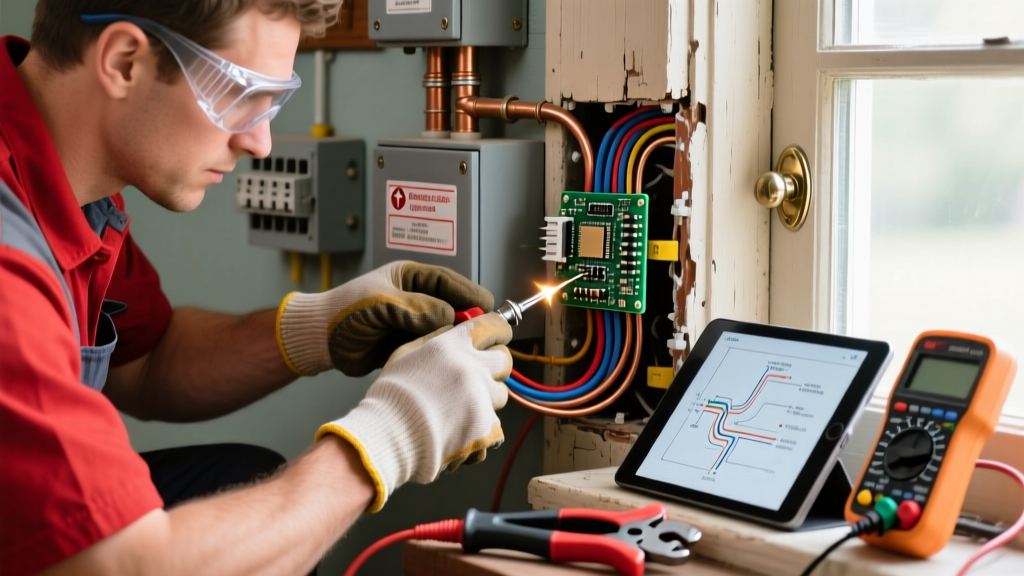
While full arc-flash suits are rarely required for standard 120V/240V residential branch circuits, specific PPE is non-negotiable when fixing electrical wiring inside panelboards or dealing with unknown fault currents. The Electrical Safety Foundation International (ESFI) strongly advocates for proper PPE to mitigate shock and flash injuries.
| Equipment Category | Recommended Specification | Example Model / Brand | Estimated Cost (2026) |
|---|---|---|---|
| Voltage Rated Gloves | Class 0 (Rated for 1000V AC) | Salisbury PRON20B (with leather protectors) | $85 - $110 |
| Safety Eyewear | ANSI Z87.1+ with side shields | 3M Virtua CCS Anti-Fog | $12 - $18 |
| Insulated Hand Tools | IEC 60900 rated to 1000V | Klein Tools 1000V Insulated Screwdriver Set | $45 - $65 |
| Footwear | ASTM F2413 EH (Electrical Hazard) rated | Red Wing IronRange EH Boots | $250 - $300 |
Edge Case: The Hidden Dangers of Multi-Wire Branch Circuits (MWBC)
One of the most lethal scenarios when fixing electrical wiring in homes built between 1970 and 2005 is the Multi-Wire Branch Circuit (MWBC). An MWBC shares a single neutral wire between two hot legs (typically a red and a black wire on opposite phases).
The Shared Neutral Trap
If you turn off only one breaker to fix a receptacle on an MWBC, the neutral wire remains energized by the return current of the second, still-live hot leg. Disconnecting the shared neutral while the other phase is live will result in a severe shock and can destroy connected appliances by sending 240V through 120V devices.
Mandatory Safety Protocol for MWBCs:
- Identify MWBCs by looking for 3-conductor cable (e.g., 14/3 or 12/3 NM-B) entering the panel.
- Verify that the two hot breakers are tied together with a manufacturer-approved handle tie or a common-trip 2-pole breaker (NEC 210.4(B)).
- Lock out BOTH poles of the MWBC before opening any junction box or receptacle on that circuit.
Termination Safety: NEC Torque Requirements
Loose connections are a primary cause of high-resistance faults, leading to arcing and fires. As highlighted by the International Association of Electrical Inspectors (IAEI Magazine), NEC 110.14(D) mandates that all electrical terminations be tightened to the manufacturer's specified torque values using a calibrated torque tool.
Torque Specifications by Conductor Size
While you must always check the specific breaker or terminal manufacturer's data sheet, standard residential breakers (such as Square D QO or Eaton BR) generally require the following settings:
- 14 AWG Copper: 20 to 25 inch-pounds (in-lbs)
- 12 AWG Copper: 25 to 30 inch-pounds (in-lbs)
- 10 AWG Copper: 30 to 35 inch-pounds (in-lbs)
Note: Do not use standard inch-pound torque wrenches meant for automotive work; they lack the fine calibration required for small electrical fasteners. Invest in a dedicated electrical torque screwdriver, such as the CDI 1002MFRMHSS (10-100 in-lbs), which costs approximately $140.
Tool Verification and Calibration Matrix
Your safety is only as reliable as your testing equipment. Before fixing electrical wiring, ensure your tools meet the following verification standards.
| Tool | Required Rating | Pre-Use Verification Step |
|---|---|---|
| Digital Multimeter | CAT III 600V or CAT IV 600V minimum | Test on a known live 120V source; verify leads are in correct ports (V/Ω, not A). |
| Insulated Screwdrivers | IEC 60900 (1000V) | Inspect for nicks, cuts, or peeling in the dielectric coating. Discard if inner metal is visible. |
| Torque Screwdriver | Calibrated within 12 months | Check calibration sticker; set to required in-lbs; listen/feel for the 'click' or 'break' mechanism. |
Frequently Asked Questions (FAQ)
Is it safe to fix electrical wiring if I wear rubber-soled shoes?
No. While standard rubber soles provide some insulation, they are not rated or tested for electrical hazard (EH) protection. Dirt, moisture, and wear can compromise the sole's resistance. Always wear ASTM F2413 EH-rated footwear or stand on a certified dielectric mat when working inside energized panels.
What should I do if I encounter knob-and-tube wiring while fixing a circuit?
Knob-and-tube (K&T) wiring lacks an equipment grounding conductor and its insulation becomes brittle with age. If you discover K&T, do not attempt to splice it with modern NM-B cable using standard wire nuts. The repair must be handled by a licensed electrician, and most jurisdictions require the complete abatement and replacement of K&T systems to meet current NEC safety standards.
Can I use a standard hardware store voltage tester for panel work?
Standard two-prong neon or solenoid voltage testers (often sold for $10-$15) are generally only rated for CAT II or low-end CAT III. When fixing wiring at the service panel where available fault current can exceed 10,000 amps, you must use a CAT IV rated True-RMS multimeter to protect against transient voltage spikes and arc flash blowouts.