
Navigating the electrical code for bathroom outlets is one of the most critical aspects of residential and commercial wiring. Because bathrooms combine high-wattage personal care appliances with plumbing and moisture, the National Electrical Code (NEC) enforces strict, uncompromising standards to prevent electrocution and electrical fires. Whether you are remodeling a master bath or wiring new construction in 2026, understanding the intersection of NEC Articles 210.8, 210.11, and 210.52 is mandatory for passing inspection and ensuring occupant safety.
In this comprehensive code explainer, we break down the exact circuit requirements, GFCI mandates, receptacle placement rules, and common inspection failures associated with bathroom wiring, referencing the latest NEC adoption cycles and current market pricing for compliant materials.
The Core Mandate: NEC Article 210.52(D) Explained
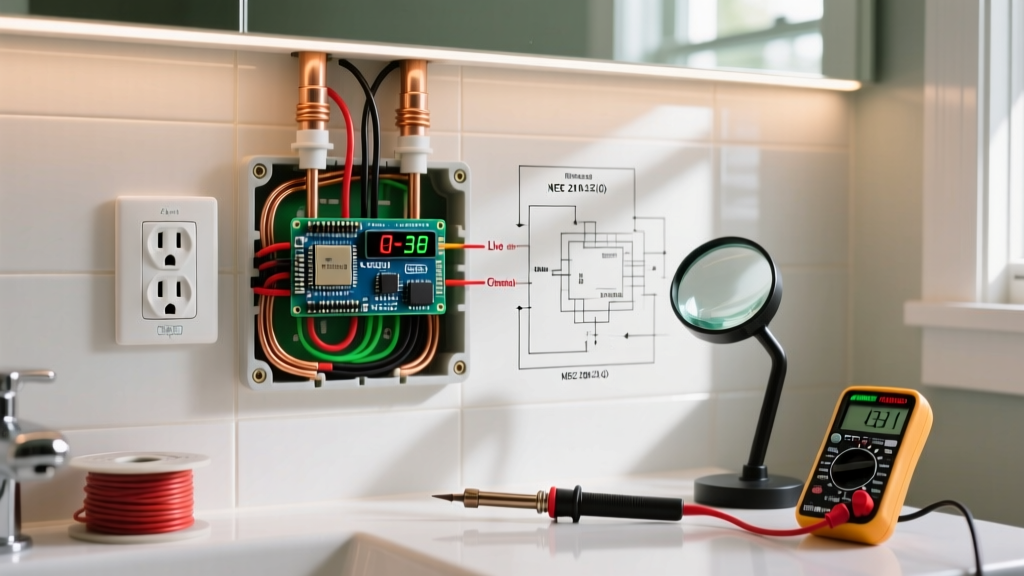
The foundational rule for bathroom receptacles resides in NEC Article 210.52(D). This section dictates that at least one 120-volt, 20-ampere receptacle outlet must be installed adjacent to the basin location. The code does not merely suggest this; it is a strict baseline. If you have a double-sink vanity, the code requires at least one receptacle for each basin, though a single duplex receptacle placed centrally between the two basins can satisfy the requirement for both, provided it is within the specified distance constraints.
Code Note: The NEC defines a 'bathroom' as an area including a basin with one or more of the following: a toilet, a urinal, a tub, a shower, a bidet, or similar plumbing fixtures. A room with only a toilet and a sink (a water closet) still qualifies as a bathroom under NEC definitions and is subject to all bathroom-specific outlet rules.
Circuit Requirements: Dedicated 20-Amp Feeds
Under NEC Article 210.11(C)(3), bathrooms require specific branch circuit configurations. You cannot simply extend a 15-amp bedroom circuit into a bathroom to feed a hair dryer. The code mandates at least one 20-amp branch circuit to supply bathroom receptacle outlets.
The Shared vs. Dedicated Circuit Matrix
One of the most common points of confusion for DIYers and junior electricians is whether the bathroom lighting and exhaust fans can share the 20-amp receptacle circuit. The answer depends entirely on how many bathrooms the circuit serves.
| Circuit Configuration | Permitted Loads | NEC Reference |
|---|---|---|
| Single Bathroom Circuit | Can supply receptacles, lighting, and exhaust fans for that specific bathroom only. | 210.11(C)(3) Exception 1 |
| Multi-Bathroom Circuit | Can only supply receptacle outlets. Lighting and fans must be on a separate circuit. | 210.11(C)(3) Exception 2 |
2026 Material Context: To wire these circuits, you must use 12 AWG copper wire. As of early 2026, a 250-foot spool of 12/2 NM-B (Romex) averages between $55 and $68, reflecting stabilized but historically elevated copper commodity prices. Always pair 12 AWG wire with a 20-amp breaker; using 14 AWG wire on a 20-amp breaker is a severe fire hazard and an immediate inspection failure.
GFCI Protection and Tamper-Resistant (TR) Mandates
Ground-Fault Circuit Interrupter (GFCI) protection is non-negotiable in wet environments. NEC Article 210.8(A)(1) requires that all 125-volt through 250-volt, 15-ampere and 20-ampere receptacles installed in bathrooms have GFCI protection. Furthermore, NEC Article 406.4(D) mandates that all 15A and 20A, 125V and 250V non-locking receptacles in bathrooms must be Tamper-Resistant (TR), featuring internal shutters that prevent children from inserting foreign objects.
Selecting the Right Receptacle Device
While the NEC allows a 15-amp rated duplex receptacle to be installed on a 20-amp circuit (provided there is more than one receptacle on the circuit, per Table 210.21(B)(3)), best practice and local amendments often dictate using 20-amp rated devices for the primary bathroom GFCI to handle the continuous high-draw of modern heated styling tools.
- Leviton GFNT2-W (20A GFCI TR): Priced around $32 in 2026, this is the industry standard for residential bathrooms. It features a slim profile for easy box installation and an auto-monitoring function that continuously checks for ground faults.
- Hubbell GFR83W (20A GFCI TR): Priced around $38, Hubbell's commercial-grade alternative offers heavy-duty brass contacts and superior impact resistance, ideal for high-traffic commercial restrooms.
For deeper technical breakdowns on GFCI trip thresholds and equipment ground requirements, refer to the Electrical Construction & Maintenance (EC&M) guide on bathroom receptacles.
Placement Rules: The 3-Foot Basin Rule
Knowing what to install is only half the battle; knowing where to install it is where many remodels fail inspection. NEC 210.52(D) outlines strict spatial constraints:
- The 36-Inch Radius: At least one receptacle must be located within 36 inches (3 feet) of the outside edge of the basin basin edge. Measure from the outside edge of the sink bowl, not the countertop edge.
- The 12-Inch Drop Limit: Receptacles cannot be installed more than 12 inches below the top of the basin or basin countertop. This prevents cords from draping across wet sinks or hanging dangerously low near the floor.
- No Face-Up Countertop Receptacles: Under NEC 406.5(E), receptacles shall not be installed in a face-up position in countertops or work surfaces in bathrooms or kitchens. Water pooling on the countertop can easily seep into a face-up outlet, causing a short circuit or shock hazard.
- Shower and Tub Zones: Receptacles are strictly prohibited from being installed within the wet zone of a bathtub or shower stall. They must be positioned safely away from direct splash zones.
Common Inspection Failures and How to Avoid Them
Even experienced contractors occasionally trip over nuanced code updates. Here are the most frequent bathroom wiring failures cited by municipal inspectors:
1. Missing Equipment Ground on GFCI Replacements
When upgrading older homes (pre-1970s) that lack an equipment grounding conductor, the NEC allows you to install a GFCI receptacle to provide shock protection. However, the receptacle must be marked 'No Equipment Ground' (using the stickers provided in the box), and it still must be TR rated. Many electricians forget the TR requirement on ungrounded retrofits.
2. Daisy-Chaining Lighting to a Multi-Bathroom Circuit
As outlined in the matrix above, if your 20-amp GFCI circuit feeds receptacles in two different bathrooms, you cannot legally tie the vanity lights or exhaust fans into that same circuit. Inspectors will trace the wiring in the attic or junction boxes; if lighting is found on a shared multi-bathroom receptacle circuit, you will be forced to pull new wire.
3. Using Standard Weather-Resistant (WR) Covers Indoors
While WR receptacles are required for outdoor damp locations, they are not strictly mandated for standard indoor bathrooms unless the receptacle is within a specific damp zone (like an outdoor-accessible window alcove). However, using 'in-use' bubble covers inside a bathroom is a code violation if it forces the cord to be pinched or prevents the cover from closing properly when a standard plug is inserted.
Frequently Asked Questions (FAQ)
Can I put a bathroom GFCI outlet on a 15-amp breaker?
No. NEC 210.11(C)(3) explicitly requires a 20-ampere branch circuit for bathroom receptacles. While a 15A GFCI device might physically fit and function on a 15A breaker, it violates the dedicated 20A circuit mandate designed to handle high-wattage hair dryers and space heaters without tripping.
Do smart bidets require a dedicated circuit?
Heated smart bidet seats (like the Toto Washlet or Bio Bidet Bliss) typically draw between 800W and 1200W when the water heater and seat warmer activate simultaneously. While they do not legally require a dedicated circuit under the NEC, they must be plugged into the required 20-amp GFCI-protected bathroom receptacle. If the bidet is hardwired, it must still be GFCI protected and connected to a 20-amp circuit.
Where can I find the official NEC text?
The National Fire Protection Association (NFPA) provides free, read-only access to the National Electrical Code. You can review the latest adopted standards, including Articles 210 and 406, directly via the NFPA NEC Portal.
Final Thoughts on Code Compliance
Adhering to the electrical code for bathroom outlets is not merely about satisfying a municipal inspector; it is about engineering a space that respects the inherent dangers of mixing electricity and water. By strictly utilizing 12 AWG wiring, 20-amp breakers, premium 20A TR/GFCI receptacles like the Leviton GFNT2-W, and respecting the 36-inch placement rule, you ensure a bathroom that is safe, functional, and fully compliant with modern NEC standards.