
The Compliance Reality of Wiring Repairs
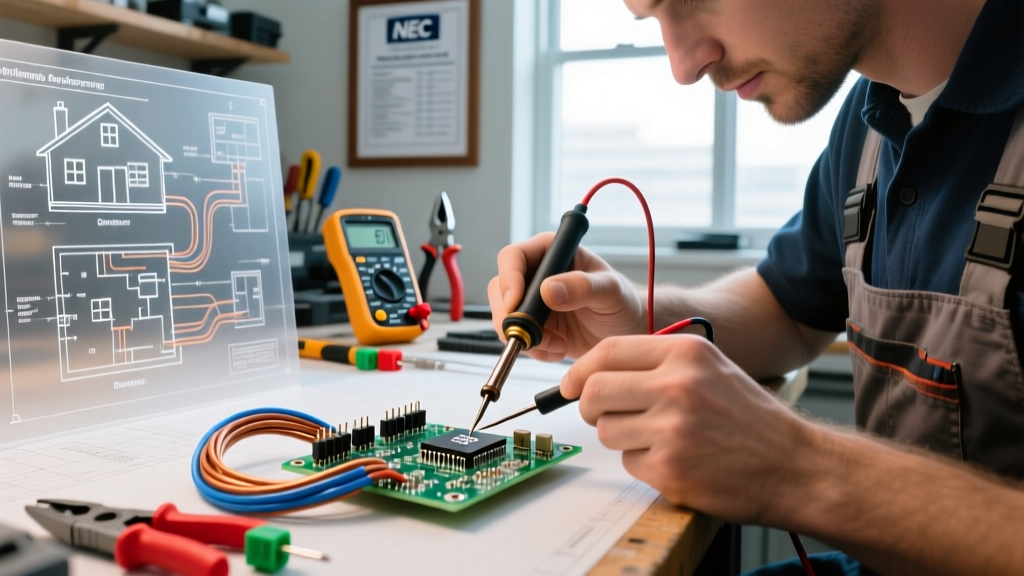
When a circuit fails or a wire is damaged, the immediate instinct is to restore power as quickly as possible. However, from an inspection and compliance standpoint, the way you repair electrical wiring dictates whether your home remains safe, insurable, and legally compliant. According to the National Fire Protection Association (NFPA), electrical failures and malfunctions are a leading cause of home structure fires, often stemming from unpermitted, non-compliant splicing and improper terminations.
As we navigate the 2026 enforcement landscape, Authorities Having Jurisdiction (AHJs) are strictly enforcing the latest National Electrical Code (NEC) cycles. Inspectors are no longer just looking for basic continuity; they are checking for torque specifications, box fill calculations, and updated arc-fault protections. This guide provides a deep-dive, inspector-level framework for executing wiring repairs that will pass the rough-in and final inspections on the first attempt.
When Does a Wiring Repair Require a Permit?
Not every interaction with your electrical system requires a permit, but misunderstanding the threshold is a common compliance trap. Here is the decision matrix inspectors use:
- Like-for-Like Replacement (No Permit Required): Swapping a damaged receptacle, light switch, or light fixture with an identical specification unit. Replacing a broken section of Romex with the exact same gauge and type inside an accessible junction box.
- Circuit Alteration or Extension (Permit Required): Extending a circuit to a new location, upgrading a 15A circuit to 20A, replacing a fuse box with a breaker panel, or adding a new junction box inside a closed wall cavity.
- System Upgrades Triggered by Repair (Permit Required): If repairing a damaged wire in a bedroom requires replacing the breaker, NEC 210.12 now mandates that the new breaker must be an Arc-Fault Circuit Interrupter (AFCI), which requires inspection.
Top 4 NEC Code Violations Found During Wiring Repairs
When inspectors evaluate a repaired circuit, they look for specific failure points. Avoiding these four violations will save you from a failed inspection and a mandatory rework order.
1. Floating Splices (NEC 300.15)
A "floating splice" occurs when wires are connected outside of an approved enclosure. In older homes, it is common to find wires twisted together and wrapped in electrical tape inside a wall cavity. NEC Article 300.15 strictly requires a box or conduit body at every conductor splice point. If you must repair a wire inside a closed wall, you must use a listed, retrofit junction box (such as the Arlington Industries BE1) that remains permanently accessible, or pull new continuous wire from the panel to the termination point.
2. Box Fill Overcrowding (NEC 314.16)
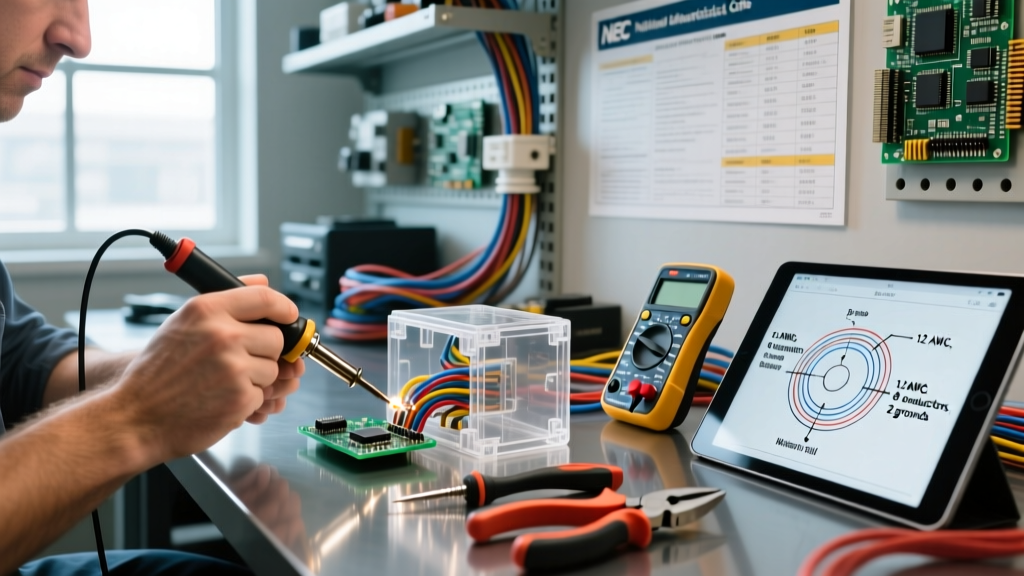
Inspectors carry calculators for a reason. Every junction box has a maximum cubic inch capacity based on the gauge of the wires entering it. For example, 12 AWG wire requires 2.25 cubic inches per conductor.
Calculation Example: If your repair box contains four 12 AWG current-carrying conductors, one equipment grounding conductor (counts as one), and internal cable clamps (counts as one), you have six allowances. 6 x 2.25 = 13.5 cubic inches minimum. Using a standard 12-cubic-inch handy box here is an automatic violation.
3. Untorqued Terminations (NEC 110.14(D))
This is the most frequently cited violation in modern inspections. The NEC mandates that terminations on breakers and lugs must be tightened to the manufacturer's specified torque using a calibrated torque tool. Hand-tightening a repaired neutral wire on a 200A service lug with a standard screwdriver is a fail. Inspectors increasingly require electricians to use calibrated torque screwdrivers, such as the Klein Tools 70050, and may ask for the torque value printed on the breaker label to be verified.
4. Missing AFCI/GFCI Protection on Repaired Circuits
If your repair involves replacing a damaged breaker or extending a circuit, the new work must comply with current code, not the code from the year the house was built. Kitchens, bathrooms, and laundry rooms require GFCI protection (NEC 210.8), while living areas and bedrooms require AFCI protection (NEC 210.12). Splicing a repaired wire into an older, non-AFCI bedroom circuit without upgrading the breaker will result in a failed final inspection.
Step-by-Step: Executing a Compliant Wiring Repair
Follow this standardized procedure to ensure safety and compliance, aligning with OSHA electrical safety guidelines for lockout/tagout and verification.
- Isolate and Verify: Turn off the breaker and apply a physical lockout tag. Verify zero voltage using a CAT III rated multimeter (e.g., Fluke 117) testing phase-to-phase and phase-to-ground.
- Strip to Exact Specifications: Use precision wire strippers (Klein Tools 11055). Strip exactly 3/4 inch of insulation for standard wire nuts, or 11-12mm for lever-nut connectors. Do not nick the copper conductor, which creates a micro-fracture and a localized hot spot.
- Terminate with Listed Connectors: Abandon twist-on wire nuts for critical repairs in tight spaces. Use WAGO 221 Series Lever-Nuts (UL 486C listed). They provide a gas-tight connection, allow for easy inspection of the wire strip length through the transparent housing, and eliminate the risk of a wire nut backing off due to thermal cycling.
- Secure and Route: NEC 300.11 requires cables to be secured and supported. Staple the repaired Romex within 8 inches of the junction box and every 4.5 feet thereafter using proper cable staples (do not use standard office staples, which can crush the jacket and damage the insulation).
2026 Cost Breakdown: DIY Repair vs. Licensed Electrician
Understanding the financial scope of compliant repairs helps homeowners and property managers budget accurately. Below is the current 2026 market pricing for standard wiring repairs.
| Repair Component | DIY Cost (Materials & Permits) | Licensed Electrician Cost |
|---|---|---|
| Electrical Permit (Standard Alteration) | $50 - $125 | $75 - $150 (Included in billing) |
| Labor (Hourly Rate) | $0 (Your Time) | $95 - $165 / hour |
| WAGO 221 Lever-Nuts & Junction Box | $12 - $18 | $25 - $40 (Markup applied) |
| Torquing & Testing Equipment | $150+ (Tool purchase) | $0 (Already owned) |
| Total Estimated Cost (2-Hour Repair) | $62 - $293 | $290 - $530 |
The Inspector's Final Checklist
What the AHJ Inspector Looks For:
1. Are all wire splices contained within a listed, accessible junction box?
2. Is the box fill calculation within the cubic inch limits of the enclosure?
3. Are all grounding conductors properly pigtailed to the box (if metal) and the device (NEC 250.148)?
4. Is the cable jacket secured within 1/4 inch of the box knockout?
5. Have AFCI/GFCI protections been upgraded to current code standards where applicable?
Frequently Asked Questions (FAQ)
Can I use electrical tape to repair a nicked wire jacket?
Minor abrasions to the outer PVC jacket of non-metallic (NM) cable that do not expose the inner conductors or ground wire can be wrapped with high-quality 3M Super 33+ vinyl electrical tape. However, if the inner conductor insulation is nicked or the ground wire is exposed, the NEC requires the damaged section to be cut out and spliced in an approved junction box. Inspectors will fail a repair if they see tape used to mask compromised conductor insulation.
Do I need to replace aluminum wiring when repairing a circuit?
You are not legally required to rewire an entire house if you are only repairing a single branch circuit. However, any repair involving aluminum wiring requires strict compliance with NEC 110.14. You must use CO/ALR rated devices or splice the aluminum to copper pigtails using approved COPALUM crimps or Alumiconn lug connectors. Standard wire nuts are a severe fire hazard with aluminum wire and will result in an immediate inspection failure.
Where can I find my local electrical code amendments?
While the NFPA publishes the base NEC, local municipalities often adopt specific amendments. The U.S. Department of Energy recommends checking your local city or county building department's website. Search for "Electrical Code Amendments [Your County]" or call the local building permits office directly to ask which NEC cycle (2020, 2023, or 2026) is currently enforced in your jurisdiction.