
The High-Stakes Kitchen Environment
Upgrading your kitchen electrical wiring is fundamentally different from rewiring a bedroom or living space. The kitchen is the highest-load, most code-scrutinized environment in a modern home. As of 2026, local jurisdictions are widely enforcing the latest National Electrical Code (NEC) updates, which demand rigorous ground-fault and arc-fault protection, dedicated high-amperage circuits, and strict box-fill calculations. A standard 15-amp lighting circuit simply will not survive the simultaneous draw of a microwave, air fryer, and coffee maker.
This comprehensive material and tool guide provides the exact specifications, product model numbers, and professional techniques required to execute a flawless kitchen electrical wiring project. Whether you are pulling new circuits for a full remodel or upgrading existing receptacles to meet modern safety standards, using the right materials prevents nuisance tripping, voltage drop, and catastrophic thermal failures.
Core Wiring Materials: Gauges, Cables, and Conduit
The backbone of any kitchen electrical wiring project is the cable. While older homes may feature 14 AWG wire on 15-amp breakers, modern code strictly mandates 20-amp Small Appliance Branch Circuits (SABCs) for all countertop receptacles. This requires 12 AWG copper.
Small Appliance Branch Circuits (SABCs)
- 12/2 NM-B (Romex): The standard for 20A countertop circuits. We recommend Southwire SIMpull 12/2 NM-B. The SIMpull jacket reduces friction by up to 50%, making it significantly easier to fish through existing walls during remodels. As of 2026, expect to pay between $115 and $135 for a 250-foot coil.
- 12/3 NM-B: Essential if you are running Multi-Wire Branch Circuits (MWBCs) to share a single neutral between two 120V circuits. Edge Case Warning: NEC Section 210.4 requires simultaneous disconnection of all ungrounded conductors. You must use a 2-pole 20A breaker or approved handle ties to prevent shared-neutral overloads.
Heavy Appliance Dedicated Circuits
- 10/3 NM-B (30A): Used for older or smaller wall-mounted ovens and heavy-duty garbage disposals.
- 8/3 NM-B or 8/3 SE Cable (40A-50A): The standard for freestanding electric ranges. If your run exceeds 50 feet, you must step up to 6/3 to mitigate voltage drop.
- 6/3 NM-B (60A): Required for modern, high-draw induction cooktops (e.g., Bosch or GE Profile 36-inch models) that can pull upwards of 48 amps continuously.
Boxes, Receptacles, and Code Compliance
The most common failure point in DIY kitchen wiring is the junction box. Standard 18-cubic-inch single-gang boxes are entirely insufficient for modern GFCI receptacles, which have massive internal electronics housings.
Deep Boxes and Box Fill Calculations
Per NEC Article 314.16, you must calculate box fill before selecting your electrical box. A 12 AWG wire requires 2.25 cubic inches of space per conductor. A GFCI receptacle counts as two conductors. If you have one incoming 12/2 cable, one outgoing 12/2 cable, and a GFCI device, your minimum required volume is 20.25 cubic inches. Always use 22 or 24 cubic-inch deep boxes (such as the Carlon B618R-UPC 22 cu. in. Super Blue) to prevent wire crush damage and allow for heat dissipation.
GFCI and AFCI Receptacles
Countertop receptacles require Ground-Fault Circuit Interrupter (GFCI) protection. While AFCI (Arc-Fault) protection is typically handled at the breaker panel for kitchen lighting and appliance circuits, the countertop GFCIs must be rated for 20 amps and feature tamper-resistant (TR) shutters.
Top Pick: The Leviton SmartlockPro GFNT2-W (20A Self-Testing GFCI). This model performs an automatic self-test every 3 seconds. According to Leviton's official specifications, it features a patented lockout action that prevents reset if the GFCI circuitry is damaged, a critical safety feature for wet environments.
2026 Material Cost Estimator
Budgeting accurately is vital for remodeling. Below is a 2026 pricing matrix for premium-grade kitchen wiring materials based on current national electrical distributor averages.
| Material Category | Specific Product / Spec | Estimated Unit Cost (2026) | Project Quantity (Avg Kitchen) |
|---|---|---|---|
| Branch Circuit Wire | Southwire 12/2 NM-B (250ft coil) | $125.00 | 2 coils |
| Range Circuit Wire | Cerro 8/3 NM-B (50ft coil) | $85.00 | 1 coil |
| Receptacles (SABC) | Leviton GFNT2-W 20A GFCI | $22.50 | 4 to 6 units |
| Junction Boxes | Carlon 22 cu. in. Deep Single-Gang | $1.85 | 8 to 12 units |
| Wire Nuts | Ideal 341 Yellow Winged (Box of 100) | $14.00 | 1 box |
| Breakers | Square D Homeline 20A Single-Pole | $6.50 | 4 units |
The Professional Tool Loadout
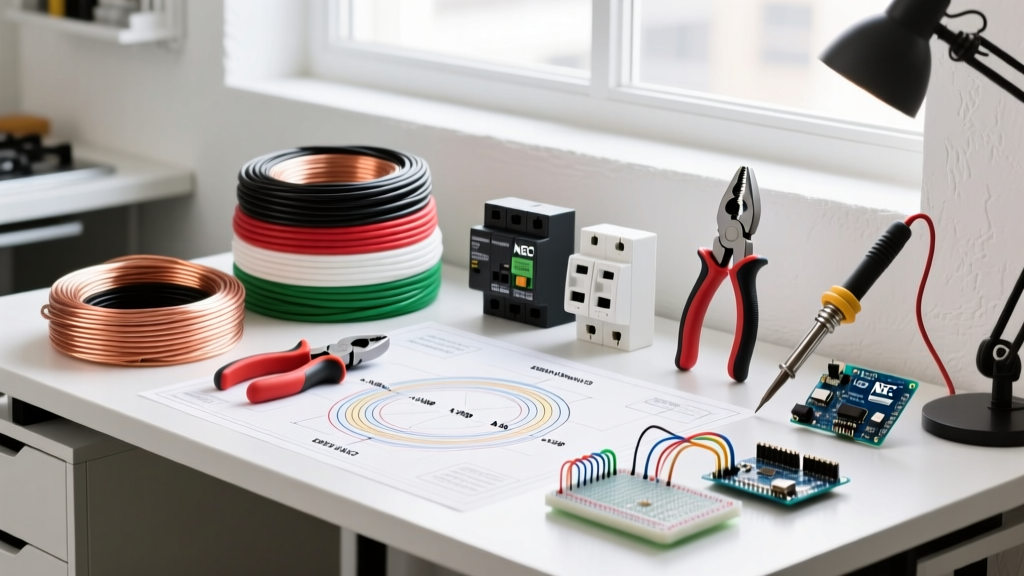
You cannot execute precision kitchen electrical wiring with hardware-store bargain tools. Stripped insulation, under-torqued terminals, and misidentified neutrals lead to fires. Equip yourself with the following professional-grade tools:
- Wire Strippers: Klein Tools 11055 (10-18 AWG). The precision-machined stripping holes prevent nicking the copper conductor, which creates a weak point that can snap under thermal expansion.
- Voltage Tester: Fluke T+PRO. Never rely on a non-contact voltage tick-tracer for final verification. The Fluke T+PRO provides solenoid-based testing, which works even if the battery dies, and can distinguish between phantom voltage and live current on long kitchen cable runs.
- Torque Screwdriver: Wiha 320P Insulated Torque Screwdriver. NEC Section 110.14(D) strictly requires electrical connections to be torqued to the manufacturer's specifications. For the Leviton GFNT2-W, the terminal torque requirement is 14 in-lbs. Hand-tightening often results in under-torqued connections that arc and melt over time.
- Fish Tape: Milwaukee 48-22-4108 (50ft Steel). Essential for pulling 12/2 NM-B through finished walls and above kitchen cabinets where access is restricted.
Common Failure Modes and Edge Cases
Even experienced electricians encounter edge cases in kitchen environments. Anticipating these failure modes will save you from failed inspections and callbacks.
The Island and Peninsula Receptacle Dilemma
A major shift in recent NEC cycles (carrying through 2026 adoptions) involves island and peninsula receptacles. Under NEC 210.52(C)(2), receptacles are no longer strictly required to be installed at islands if the homeowner does not want them, eliminating the need for ugly pop-up boxes or side-mounted brackets. However, if you choose to install a receptacle at the island, it must be GFCI protected and cannot be the sole receptacle serving the required countertop spaces. Always verify with your local Authority Having Jurisdiction (AHJ), as local amendments frequently override national code relaxations.
Pigtailing vs. Backwiring on GFCIs
Never use the 'push-in' backwire holes on standard receptacles for 12 AWG wire; they are notorious for losing grip over time. For GFCIs, use the screw terminals. If you are daisy-chaining downstream receptacles, do not use the 'LOAD' terminals on the GFCI unless you specifically intend to protect those downstream devices. In most kitchen layouts, it is vastly superior to use a pigtail method: wire-nut all line-side neutrals and hots together with a 6-inch 12 AWG pigtail leading to the GFCI 'LINE' terminals. This ensures that if the GFCI fails, the rest of the kitchen counter remains powered, and it eliminates shared-neutral nuisance tripping.
Safety and Verification Protocols
Before energizing any new kitchen circuit, perform a dead-front continuity test. Ensure all bare copper ground wires are securely bonded to the back of the metal junction boxes (if using metal) and properly pigtailed to the green ground screw on every receptacle. The National Fire Protection Association (NFPA) emphasizes that improper grounding in wet locations is a leading cause of fatal residential shocks.
Furthermore, consult UL's electrical safety guidelines regarding the use of only listed and labeled materials. Counterfeit breakers and unlisted imported GFCIs flood online marketplaces; always source your critical safety devices from authorized local electrical supply houses or direct from the manufacturer.
Final Thoughts on Execution
Successful kitchen electrical wiring relies on meticulous planning, adherence to box-fill mathematics, and the use of premium, code-compliant materials. By investing in deep junction boxes, self-testing 20A GFCIs, and a calibrated torque screwdriver, you ensure that your kitchen will safely handle the culinary demands of 2026 and beyond without a single tripped breaker or melted terminal.