
The Undisputed Standard: Material Science Meets the NEC
When electrical engineers and licensed contractors design residential or commercial circuits, material selection is a high-stakes balancing act involving conductivity, mechanical strength, and long-term safety. Across the globe, copper is used in electrical wiring because it offers an unmatched synthesis of physical and chemical properties that outperform cheaper alternatives. While aluminum has carved out a niche in heavy commercial feeder lines and silver remains a luxury reserved for specialized aerospace applications, copper dominates the National Electrical Code (NEC) ampacity tables for branch circuits.
As of 2026, with copper commodity prices hovering around $4.10 per pound, the upfront material cost is undeniably higher than aluminum. However, the total lifecycle cost, combined with the elimination of specialized termination protocols, makes copper the only logical choice for standard branch wiring. Below, we break down the exact metallurgical and physical reasons behind this industry standard, supported by data and field-tested tooling practices.
1. The Physics of Conductivity: The IACS Benchmark
The primary reason for copper's dominance is its electrical conductivity. In the early 20th century, the International Electrotechnical Commission (IEC) established the International Annealed Copper Standard (IACS), setting pure annealed copper at exactly 100% conductivity. This translates to a resistivity of just 1.68 x 10^-8 ohm-meters at 20°C.
When calculating voltage drop over long conduit runs, electricians use the formula: VD = (2 x K x I x D) / CM. For copper, the 'K' constant (specific resistance) is approximately 12.9 ohms per mil-foot. Compare this to aluminum, which sits at roughly 21.2 ohms per mil-foot. Because copper conducts electricity so efficiently, a 12 AWG copper wire can safely carry 20 amps over a standard distance with minimal voltage drop, whereas aluminum would require upsizing to 10 AWG to achieve the same performance and safety margin.
2. Thermal Expansion and the 'Creep' Factor
One of the most critical failure modes in electrical systems occurs at the termination point—where the wire meets the receptacle or breaker. Under load, wires heat up and expand; when the load drops, they cool and contract.
- Copper's Coefficient of Thermal Expansion: ~16.5 x 10^-6 /°C
- Aluminum's Coefficient of Thermal Expansion: ~23.1 x 10^-6 /°C
Because aluminum expands nearly 40% more than copper under the same thermal load, it is prone to a phenomenon known as thermal creep. Over years of heating and cooling cycles, aluminum wires slowly deform and loosen under standard brass or nickel-plated steel terminal screws (such as those found on a Leviton 5366 duplex receptacle). This loosening increases contact resistance, generating immense localized heat and potentially causing arc faults or fires. Copper's superior dimensional stability ensures that once a termination is torqued to spec, it remains mechanically sound for decades.
3. Oxidation Dynamics: Conductive vs. Insulating Oxides
All metals oxidize when exposed to atmospheric oxygen, but the electrical properties of the resulting oxide layer dictate the metal's viability for wiring.
The Oxide Rule of Thumb: Aluminum oxide forms in milliseconds upon exposure to air and acts as a strict electrical insulator (resistivity of ~10^14 ohm-meters). Copper oxide forms slowly and is a semiconductor (resistivity of ~10^5 ohm-meters).
Because aluminum oxide is an insulator, aluminum wiring requires meticulous preparation: wire brushing to bare metal and the immediate application of an antioxidant paste (like Noalox) to prevent re-oxidation. Copper, conversely, does not require antioxidant pastes for standard indoor terminations. Even if a copper wire develops a surface patina, the copper oxide layer is thin and relatively conductive enough not to impede standard 15A or 20A branch circuit currents.
4. Ductility and Tensile Strength in the Field
Wiring a commercial building often involves pulling hundreds of feet of cable through tight conduit bends. Copper's ductility allows it to be drawn down to thin gauges (like 14 AWG or 12 AWG) without becoming brittle. Hard-drawn copper wire boasts a tensile strength of approximately 350 MPa, compared to just 90 MPa for pure aluminum.
When an electrician uses a Greenlee 750lb capacity puller to drag four 10 AWG THHN copper conductors through 3/4-inch EMT conduit, the copper withstands the mechanical stress without snapping or stretching. If aluminum were subjected to the same pulling tension at the same gauge, it would risk micro-fractures inside the insulation, creating hidden hot spots that only reveal themselves under heavy continuous loads.
5. NEC Compliance and Ampacity Derating
The National Fire Protection Association (NFPA) structures NEC Table 310.16 heavily around copper's predictable thermal behavior. When circuits are bundled together in a single raceway, heat dissipation is restricted, requiring ampacity derating.
For example, if you pull six current-carrying 12 AWG THHN (90°C rated) copper conductors in a single conduit, you must apply an 80% adjustment factor. The baseline 90°C ampacity for 12 AWG copper is 30A. After derating (30A x 0.80), the allowable ampacity is 24A, which is still more than sufficient to protect a standard 20A overcurrent device. Aluminum's lower thermal mass and higher resistance make these derating calculations far more restrictive, often forcing contractors to upsize conduit and wire, negating the initial material savings.
Material Comparison Matrix
| Property | Copper (C11000) | Aluminum (1350-H19) | Silver (Pure) |
|---|---|---|---|
| IACS Conductivity | 100% | 61% | 105% |
| Resistivity (ohm-m at 20°C) | 1.68 x 10^-8 | 2.82 x 10^-8 | 1.59 x 10^-8 |
| Tensile Strength | ~350 MPa | ~90 MPa | ~170 MPa |
| Oxide Conductivity | Semiconductor | Insulator | Highly Conductive |
| Approx. 2026 Raw Cost | ~$4.10 / lb | ~$1.15 / lb | ~$380.00 / lb |
Data synthesized from the Copper Development Association and 2026 commodity market averages.
Tooling and Termination Best Practices for Copper
While copper is forgiving, poor workmanship can still compromise its advantages. To maximize the lifespan and safety of copper branch circuits, professionals must use precise tooling:
- Stripping Without Nicking: A nick in a copper wire reduces its cross-sectional area, creating a localized resistor that will overheat. Use a calibrated automatic stripper like the Klein Tools 11055, specifically adjusted for 12 AWG or 14 AWG THHN insulation depth. Never use a utility knife to ring-cut the insulation.
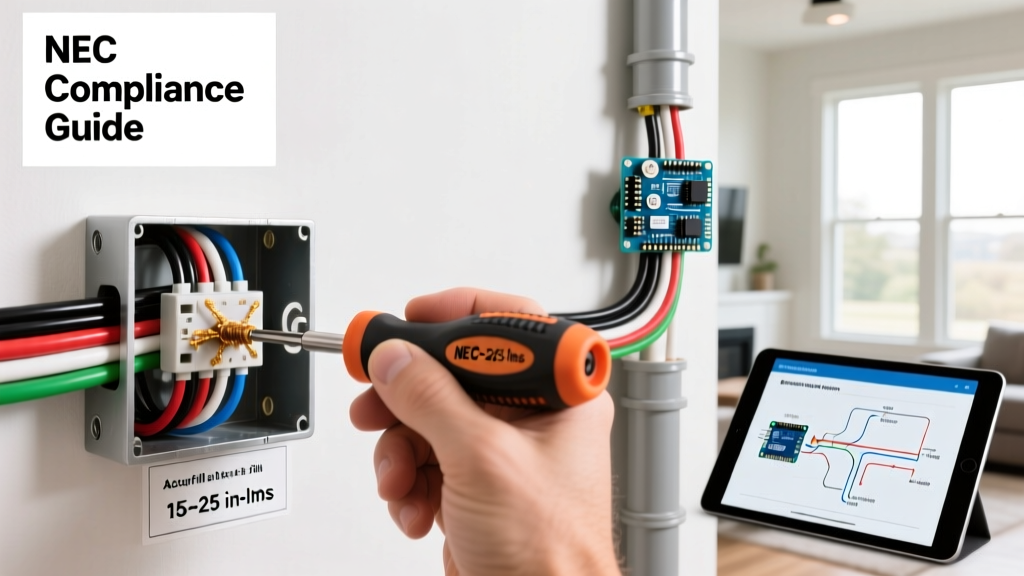
- Precision Torquing: The NEC now mandates that terminations be torqued to the manufacturer's specifications. For standard 15A and 20A commercial receptacles, the target torque is typically between 12 and 16 inch-pounds. Use a calibrated torque screwdriver, such as the Wiha 32000 series, to ensure the screw bites firmly into the copper without crushing the strands or leaving a loose connection.
- Straight Hook Orientation: When terminating on screw lugs, wrap the copper wire clockwise. This ensures that as the screw is tightened, the loop pulls tighter around the shaft rather than splaying outward, maximizing the surface contact area and minimizing transition resistance.
Frequently Asked Questions (FAQ)
Why isn't silver used for home wiring if it has higher conductivity?
While silver is roughly 5% more conductive than copper (105% IACS), its cost is astronomically higher (over $380 per ounce in 2026). Furthermore, silver is mechanically softer and more prone to creep than hard-drawn copper. The marginal gain in conductivity does not justify a 10,000% increase in material cost for standard 120V/240V residential applications.
Can I mix copper and aluminum wires in the same junction box?
Directly connecting copper and aluminum via a standard wire nut is a severe fire hazard due to galvanic corrosion. When these two dissimilar metals touch in the presence of ambient moisture, an electrochemical reaction occurs that rapidly degrades the aluminum. If you must transition between copper branch wiring and aluminum feeder wiring, you must use a UL-listed mechanical connector specifically rated for both metals, such as the AlumiConn lug connector, and apply antioxidant paste.
Does the type of copper insulation (THHN vs. XHHW-2) change the metal's properties?
No, the insulation does not alter the metallurgical properties of the copper conductor itself. However, XHHW-2 (cross-linked polyethylene) insulation has a smaller overall diameter than THHN (PVC/nylon) for the same AWG size. This allows electricians to pull more copper conductors into a single conduit, optimizing space and reducing the physical footprint of the raceway system.