
Pole Barn Electrical Wiring: Navigating the NEC for Post-Frame Buildings
Wiring a pole barn (post-frame construction) is fundamentally different from wiring a standard residential garage or commercial warehouse. The expansive spans, exposure to agricultural dust, moisture, and the potential presence of livestock introduce unique electrical hazards. Whether you are building a 40x60 hobby shop or a 60x120 working agricultural facility, understanding the governing codes is non-negotiable. In this guide, we break down the National Electrical Code (NEC) requirements for pole barn electrical wiring, focusing on feeder sizing, interior branch circuits, and the critical equipotential bonding grid.
Step 1: Determine Your NEC Classification
Before pulling a single foot of wire, you must determine how your local Authority Having Jurisdiction (AHJ) classifies your pole barn. The NEC splits post-frame buildings into two primary categories, each governed by different articles:
Residential Accessory Building (NEC Article 210 & 225)
If your pole barn is strictly a hobby shop, vehicle storage, or residential workshop with no livestock and minimal agricultural dust, it falls under standard residential accessory building rules. You will follow NEC Article 210 for branch circuits and Article 225 for outside feeders. Standard AFCI and GFCI rules apply, and standard NEMA 1 or 3R enclosures are generally acceptable.
Agricultural Building (NEC Article 547)
If the building houses livestock, stores hay, or is subject to excessive dust and moisture (like a wash bay or equipment maintenance shed), it triggers NEC Article 547 (Agricultural Buildings). This classification imposes strict rules on corrosion resistance, dust-ignition-proof fixtures, and equipotential bonding. According to the OSHA electrical safety guidelines, agricultural environments are highly corrosive due to animal waste and fertilizers, necessitating specialized wiring methods.
Code Insight: You cannot mix classifications in a single open space. If a pole barn is partially used for livestock and partially as a workshop, the entire building must generally be wired to the more stringent Article 547 standards unless separated by a permanent, dust-tight, and vapor-sealed firewall.
Feeder Sizing and Voltage Drop Calculations
Pole barns are typically located far from the main utility service. Long underground feeder runs are notorious for voltage drop, which can damage heavy machinery, welders, and air compressors. The NEC recommends (and many local codes mandate) a maximum voltage drop of 3% for feeders and 5% total from source to the furthest outlet.
Real-World Sizing Example: 200A Subpanel at 300 Feet
For a standard 40x60 pole barn requiring a 200-amp subpanel located 300 feet from the main house panel, standard 2/0 AWG copper will result in a voltage drop of roughly 4.8% at full load—failing the 3% recommendation. To achieve a compliant and efficient run, you must upsize the conductors.
| Conductor Material | Wire Size | Approx. Voltage Drop | Estimated 2026 Material Cost | NEC Trench Depth (Direct Burial) |
|---|---|---|---|---|
| Copper (THWN-2 in PVC) | 4/0 AWG | 2.1% | $4,800 - $5,500 | 18 inches |
| Aluminum (URD Direct Burial) | 4/0 AWG (AA-8000) | 3.4%* | $1,600 - $2,100 | 24 inches |
| Aluminum (THWN-2 in PVC) | 250 kcmil | 2.8% | $2,400 - $2,900 | 18 inches |
*Note: While 4/0 Aluminum URD slightly exceeds the 3% ideal at absolute maximum continuous load, it is universally accepted by AHJs for 200A residential/ag feeders due to the diversity factor of actual loads. For strict 3% compliance on AL, step up to 250 kcmil.
For the subpanel itself, a reliable choice is the Eaton BR2040B200V25 (200A, 40-space, main breaker). The main breaker acts as the required disconnecting means for the separate structure per NEC 225.33.
Interior Wiring Methods & Branch Circuits
The interior environment of a pole barn dictates your wiring method. Exposed Romex (NM-B) is strictly prohibited in agricultural buildings (Article 547) and highly discouraged in residential pole barns due to the risk of physical damage and rodent infestation.
Approved Wiring Methods
- THWN-2 in EMT or Rigid Metal Conduit: The gold standard for pole barns. Provides maximum physical protection against impact and rodents. Must use compression fittings, not set-screw, in damp environments.
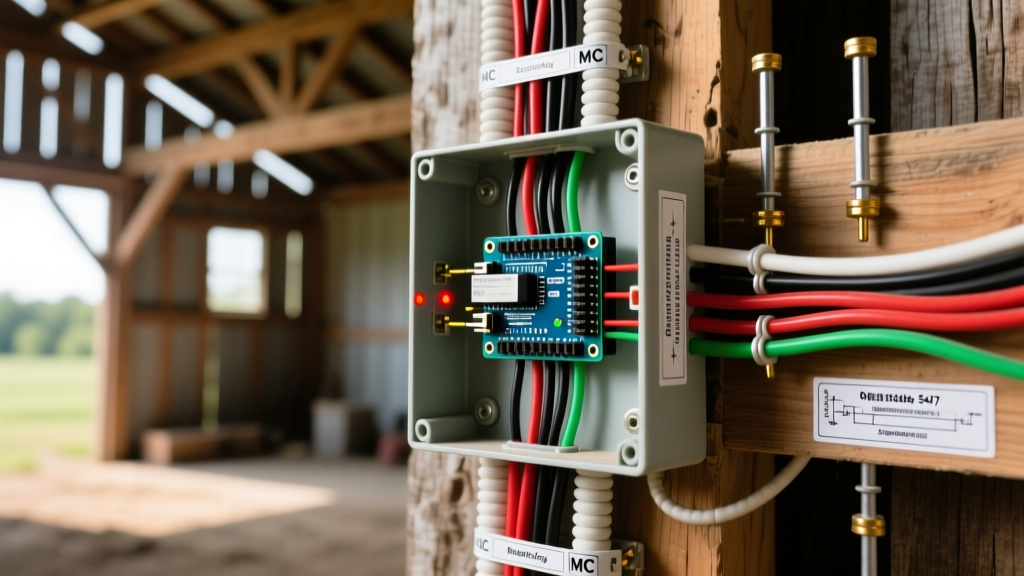
- MC (Metal Clad) Cable: Acceptable for residential accessory buildings where physical damage is unlikely. Must be secured every 4.5 feet and within 12 inches of every box.
- UF-B (Underground Feeder): Can be used indoors if protected by conduit where subject to physical damage, but generally avoided due to the difficulty of stripping and terminating.
Receptacle Spacing and GFCI Protection
Under NEC 210.52(G), at least one receptacle outlet is required in accessory buildings with electricity. However, practical pole barn wiring demands much more. Plan for a 20-amp receptacle on every structural post (typically spaced 8 to 12 feet apart) to eliminate the need for extension cords.
Crucial Code Requirement: NEC 210.8(A)(2) mandates that all 125-volt through 250-volt receptacles supplied by single-phase branch circuits rated 150 volts or less to ground, 50 amperes or less, and three-phase branch circuits rated 150 volts or less to ground, 100 amperes or less, installed in accessory buildings must have GFCI protection. Use 20A GFCI breakers in the subpanel rather than individual GFCI receptacles to save money and simplify troubleshooting in dusty environments.
The Equipotential Bonding Grid (EBG) Requirement
If your pole barn falls under Article 547 and houses livestock (horses, cattle, swine), you must install an Equipotential Bonding Grid (EBG) per NEC 547.10. Animals are highly sensitive to stray voltage; as little as 1 volt of potential difference between their front and rear hooves can cause behavioral issues, reduced milk production, or fatal shock.
How to Construct a Code-Compliant EBG
- Material: Use 8 AWG bare solid copper wire.
- Grid Spacing: Embed the wire in the concrete floor in a grid pattern not exceeding 3 feet by 3 feet.
- Bonding Targets: The grid must be bonded to all metal structures, water pipes, stanchions, and equipment grounding conductors.
- Connections: Use listed bronze or copper grounding clamps. Standard steel clamps will corrode rapidly in the presence of animal waste and concrete alkalinity.
Lighting and Fixture Selection
Pole barns require high-lumen, durable lighting. Standard residential fixtures will fail quickly due to dust ingress and temperature fluctuations.
| Zone / Application | Required NEMA / IP Rating | Recommended Fixture Type | NEC Code Consideration |
|---|---|---|---|
| General Workshop Area | NEMA 3R / IP54 | LED High Bay (150W-200W) | Must be GFCI protected if plugged in; hardwired preferred. |
| Livestock / Wash Bay | NEMA 4X / IP66 | Vapor-tight LED Linear | Must withstand high-pressure washdown and corrosive ammonia. |
| Hay Storage Area | NEMA 9 (Dust-Ignition Proof) | Sealed LED Hazardous Location | NEC 547.8 requires dust-tight fixtures where combustible dust exists. |
Common Inspection Failures to Avoid
Based on field data and AHJ reports, here are the most frequent reasons pole barn electrical installations fail inspection:
- Missing Grounding Electrode System (GES): Even if you run an equipment grounding conductor with your feeder, NEC 250.32(B) requires a grounding electrode (like two 8-foot copper ground rods spaced 6 feet apart) at the separate structure. The neutral and ground must remain isolated in the subpanel.
- Improper Conduit Sealing: When running conduit from the underground trench into the pole barn, inspectors look for duct seal (not silicone or spray foam) at the conduit ends to prevent moisture and radon gas from entering the panel.
- Using NM-B (Romex) in Ag Buildings: An automatic fail under Article 547. You must use THWN-2 in conduit or approved MC cable.
- Lack of Physical Protection: Receptacles mounted on structural posts below 8 feet must be protected by physical guards (like steel pipe sleeves or heavy-duty bubble covers) to prevent damage from moving equipment or livestock.
2026 Cost Breakdown for a 40x60 Pole Barn (200A Service)
Budgeting for a code-compliant pole barn electrical installation requires accounting for heavy-gauge wire and specialized enclosures. Below is a realistic material cost breakdown for a 40x60 residential accessory workshop (no livestock, 200A subpanel, 300-foot underground run using 4/0 AL URD).
- 4/0-4/0-4/0-2/0 Aluminum URD (300 ft): $1,800
- Trenching & Backfill (Machine Rental/Labor): $1,200 - $2,500
- 200A Main Breaker Subpanel (Eaton BR): $260
- Conduit, Fittings, & Duct Seal: $350
- Interior Wiring (THWN-2, 3/4" EMT, Boxes): $1,400
- LED High Bay Lighting (Qty 8): $600
- GFCI Breakers & Standard Breakers: $450
- Total Estimated Material Cost: $6,060 - $7,360
Note: Professional electrical labor for this scope typically adds $4,500 to $8,000 depending on regional rates and site conditions.
Final Thoughts on Compliance and Safety
Successful pole barn electrical wiring hinges on respecting the environment the building creates. Whether you are navigating the stringent demands of NEC Article 547 for agricultural use or simply ensuring a robust, voltage-drop-free feeder for your home workshop, cutting corners on wire sizing or enclosure ratings will inevitably lead to failed inspections or hazardous conditions. Always consult with your local electrical inspector during the planning phase to confirm local amendments to the NEC, and ensure your trench depth and bonding methods are verified before any concrete is poured or dirt is backfilled.