
The Regulatory Divide: Building Codes vs. Automotive Standards
When enthusiasts begin a custom build, a common and dangerous misconception is applying residential electrical logic to automotive platforms. The National Electrical Code (NEC / NFPA 70) governs stationary building wiring, but hot rod electrical wiring falls strictly under the jurisdiction of the Society of Automotive Engineers (SAE) and federal safety guidelines outlined by the National Highway Traffic Safety Administration (NHTSA). Furthermore, for a hot rod to be street-legal, it must adhere to state-level equipment standards often guided by SEMA (Specialty Equipment Market Association) legislative frameworks.
Applying NEC standards (like using solid-core Romex or THHN stranded building wire) to a vehicle will result in catastrophic failure. Automotive environments subject wiring to extreme thermal cycling, continuous high-frequency vibration, and exposure to hydrocarbons (oil, fuel, brake fluid). This guide breaks down the exact SAE standards, material specifications, and circuit protection protocols required for a safe, reliable, and street-legal hot rod build.
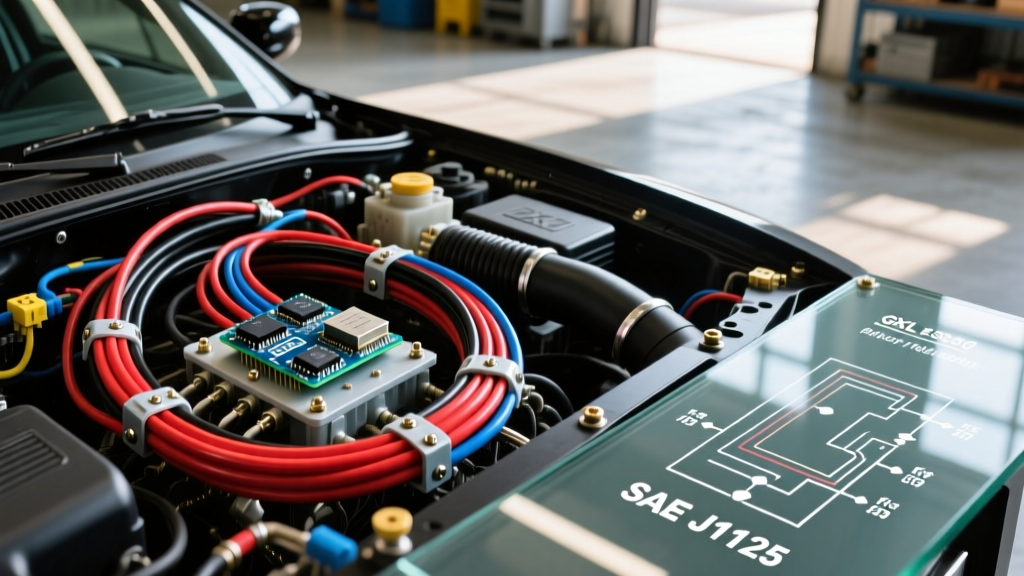
Wire Insulation Standards: The SAE J1128 Specification
Under SAE J1128 (Low Tension Primary Cable), automotive wire must utilize specific insulation compounds designed for under-hood and chassis environments. The industry standard for modern hot rod wiring is Cross-Linked Polyethylene (XLPE). Unlike standard PVC (Polyvinyl Chloride), XLPE undergoes a chemical or irradiation process that creates a three-dimensional molecular bond, drastically increasing its thermal and abrasion resistance.
Insulation Type Comparison Matrix
| Wire Type | Insulation Material | Max Temp Rating | Wall Thickness | Hot Rod Application |
|---|---|---|---|---|
| TXL | Cross-Linked (XLPE) | 125°C (257°F) | Thin (0.58mm) | Tight harness wraps, dash clusters, tight looms. |
| GXL | Cross-Linked (XLPE) | 125°C (257°F) | General (0.76mm) | General chassis routing, engine bay, standard harnesses. |
| SXL | Cross-Linked (XLPE) | 125°C (257°F) | Special (1.02mm) | High-abrasion zones, firewall pass-throughs, exhaust proximity. |
| THHN | PVC / Nylon | 90°C (194°F) | Variable | ILLEGAL / UNSAFE for automotive use. Melts, cracks under vibration. |
Expert Warning: Never use THHN building wire in a hot rod. While it is stranded, the stranding is too coarse for vibration resistance, and the PVC insulation will melt when routed near exhaust headers or engine blocks, leading to dead shorts and vehicle fires.
Battery and Alternator Cables: SAE J1284 Compliance
For high-amperage circuits (starter, alternator, main battery feeds), SAE J1284 dictates the standard for battery cables. Hot rods equipped with modern LS/LT swaps or high-compression big blocks require massive cranking amps (often exceeding 800 CCA).
- Conductor Stranding: You must use fine-strand copper (often 2,000+ strands for a 1/0 AWG cable). This ensures flexibility and prevents work-hardening and snapping under engine torque roll.
- Sizing for 12V/14.4V Systems: A standard 150-amp alternator requires a minimum of 1/0 AWG wire for runs under 5 feet, and 2/0 AWG for runs exceeding 5 feet to prevent voltage drop. High-output 250-amp alternators (like the Powermaster 48225) mandate 2/0 AWG regardless of length.
- Tinned vs. Bare Copper: While bare copper is standard, marine-grade tinned copper (meeting SAE J1128 and UL 1426) is highly recommended for hot rods stored in unclimate-controlled garages, as the tin coating prevents copper oxidation (green corrosion) that increases resistance over time.
Circuit Protection and Fusing Standards
The NHTSA and SAE guidelines emphasize that overcurrent protection must be placed as close to the power source as possible. In hot rod electrical wiring, the main power cable from the battery to the starter solenoid or main distribution block is the most vulnerable point.
The 7-Inch Main Cutoff Rule
Industry best practice—borrowed from marine ABYC standards and universally adopted by premium hot rod harness manufacturers—dictates that the main system fuse or circuit breaker must be installed within 7 inches of the battery positive terminal. If a crash severs the main harness, this fuse prevents the battery from shorting through the chassis and igniting the vehicle.
Automotive Fuse Selection Guide
| Fuse Type | Amperage Range | Standard / Specification | Application in Hot Rods |
|---|---|---|---|
| MEGA / AMG | 100A - 500A | ISO 8820-3 / SAE J1284 | Main battery feed, high-output alternator charging lines. |
| ANL | 35A - 750A | Proprietary / SAE equivalent | Starter solenoid feeds, massive audio amplifiers, EV swaps. |
| MAXI | 20A - 120A | SAE J554 / ISO 7588 | Cooling fan relays, main headlight feeds, fuel pumps. |
| ATC / ATO | 1A - 40A | SAE J554 / ISO 7588 | Standard accessory circuits (wipers, radio, ECU ignition). |
| MINI / Low-Profile | 2A - 30A | ISO 7588-3 | Modern ECU sensors, low-draw LED lighting, dash illumination. |
Grounding Topologies: Star vs. Daisy Chain
Electrical faults in hot rods are rarely caused by the positive supply; 85% of electrical gremlins stem from poor ground return paths. Because a hot rod chassis is a dynamic, vibrating metal structure, relying on random chassis bolts for grounding is a recipe for voltage drop and EMI (Electromagnetic Interference) that can disrupt modern EFI systems like the Holley Terminator X or FiTech.
The Star Grounding Method
Instead of daisy-chaining grounds from the engine to the frame, to the body, and to the dash, utilize a Star Ground topology:
- Engine Block to Chassis: Use a dedicated 1/0 AWG ground strap from the engine block to the chassis, and a secondary 2 AWG from the cylinder head to the firewall. (Cylinder head grounds are critical for spark plug coil return paths).
- Chassis to Battery: The main negative battery cable must bolt directly to a clean, bare-metal point on the chassis or engine block, not to a painted surface or a thin sheet metal bracket.
- Central Ground Bus: Mount a heavy-duty copper ground bus bar (e.g., Blue Sea Systems 250A busbar) in the cabin or trunk. Run individual ground wires from all accessories back to this single bus, and run one massive ground cable from the bus to the chassis.
Pro-Tip: When prepping a chassis grounding point, remove all paint and powder coat down to bare steel. Apply a small amount of anti-oxidant compound (like Noalox or Penetrox A) to the connection, torque to spec, and then seal the exterior of the connection with dielectric grease or liquid electrical tape to prevent moisture ingress.
2026 Harness Market: American Autowire vs. Painless Performance
For builders not wiring from scratch, universal harness kits remain the most efficient route. As of 2026, the market is dominated by two major players, each with distinct engineering philosophies.
| Brand & Model | Wire Standard | Pre-Terminated Ends | Avg. 2026 Pricing | Best For |
|---|---|---|---|---|
| American Autowire Classic Update (Kit #500622) | GXL (Cross-Linked) | Yes (Bulkhead & Dash) | $850 - $950 | Restomods, classic trucks, builds requiring factory-style bulkhead routing. |
| Painless Performance 28-Circuit (Kit #10428) | TXL (Cross-Linked) | Partial (Dash plugs) | $700 - $780 | Traditional hot rods, open-frame roadsters, custom tube chassis. |
| Kwik Wire 22-Circuit Universal | GXL (Cross-Linked) | No (Crimp your own) | $550 - $620 | Budget builds, experienced fabricators who prefer custom terminal ends. |
Diagnostic Matrix: Voltage Drop Troubleshooting
When a hot rod component underperforms (e.g., dim headlights, slow cranking, weak fuel pump pressure), do not immediately replace the component. Perform a Voltage Drop Test using a digital multimeter (DMM). According to SAE guidelines, a healthy circuit should exhibit less than a 0.10V drop across any single connection or switch, and less than a 0.36V drop (3% of 12V) across the entire wire run.
- Symptom: Headlights dim when cooling fans engage.
Root Cause: Fans and headlights share a common ground point that is overloaded or corroded. Fix: Separate the high-amperage fan ground from the lighting ground bus. - Symptom: Starter clicks once, but engine does not turn over (battery tested at 12.6V).
Root Cause: Voltage drop across the main positive battery cable or engine ground strap. Fix: Place DMM positive probe on battery post and negative probe on starter lug while cranking. If reading exceeds 0.5V, the cable is internally corroded or undersized. - Symptom: EFI system resets during cranking.
Root Cause: ECU power wire is tied to the ignition switch "Start" circuit, which drops below 9V during cranking. Fix: Wire the ECU main relay trigger to an "Ignition Run" source that remains hot during both Run and Start positions.
Final Word on Compliance and Safety
Building a hot rod is an exercise in freedom, but electrical safety is not an area for creative interpretation. By strictly adhering to SAE J1128 for primary wire, utilizing XLPE insulation, enforcing the 7-inch main fuse rule, and implementing a dedicated star-ground topology, you ensure your vehicle is not only street-legal but fundamentally safe. Always use a calibrated wire strippers and a ratcheting crimping tool (never solder-only for high-vibration automotive terminals) to guarantee connections that will survive the brutal environment of the open road.