
The Hostile Environment: Why Electrical Wiring Outdoor Systems Fail
Executing electrical wiring outdoor projects requires a fundamental shift in mindset from interior rough-ins. Above ground, wires are protected by drywall and climate control. Below ground and exposed to the elements, they face UV degradation, thermal expansion, water ingress, frost heave, and rodent intrusion. According to the National Fire Protection Association (NFPA), improper outdoor wiring methods are a leading cause of residential electrical fires and shock hazards. As we navigate the 2026 landscape—where outdoor EV Level 2 chargers and high-draw smart landscape lighting are pushing residential branch circuits to their limits—adhering to rigorous safety best practices is non-negotiable.
NEC Burial Depths and Conduit Matrix
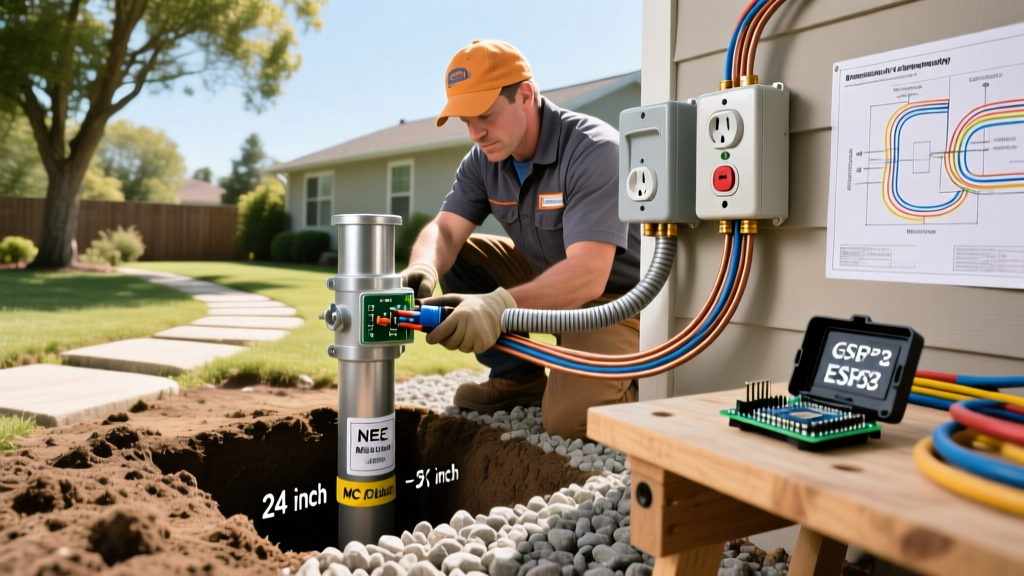
The National Electrical Code (NEC) Article 300.5 and Article 230 dictate minimum cover requirements for underground services and feeders. Failing to meet these depths risks severing lines during future landscaping or suffering insulation breakdown from surface-level temperature extremes. Below is the definitive matrix for residential and light-commercial applications.
| Wiring Method | Minimum Burial Depth | Max Voltage | Best Application & Edge Cases |
|---|---|---|---|
| UF-B Cable (Direct Burial) | 24 inches | 600V | Short branch circuits to sheds/lights. Vulnerable to sharp rocks and rodent teeth. |
| PVC Schedule 40 w/ THWN-2 | 18 inches | 600V | Standard residential runs, hot tubs, and EV chargers. Allows future wire pulling. |
| PVC Schedule 80 | 18 inches | 600V | Areas subject to physical damage (e.g., under driveways, near retaining walls). |
| Rigid Metal Conduit (RMC) | 6 inches | 600V | Commercial applications, heavy impact zones, and rock-heavy soil where PVC crushes. |
| Low-Voltage Landscape Wire | 6 inches | 30V | LED path lighting. Must still be protected from aerators and shovel strikes. |
Direct Burial vs. Conduit: A Cost and Durability Analysis
Many DIYers default to Underground Feeder (UF-B) cable because it eliminates the need to glue and pull conduit. However, from a lifecycle and safety perspective, conduit is vastly superior for runs over 30 feet. Consider the economics and failure modes:
- UF-B Cable (10/3 AWG): Costs approximately $2.80 per foot. If a ground fault occurs or you need to upgrade a 40A EV circuit to 60A, you must dig up the entire trench and replace the cable.
- 1-inch PVC Schedule 40 + THWN-2: Carlon PVC costs roughly $1.20 per foot, and three strands of 10 AWG THWN-2 cost about $0.60 per foot combined. Total: $1.80 per foot. It is cheaper upfront for larger gauges, and upgrading later only requires pulling new wire through the existing sweep.
Expert Warning: Never use standard NM-B (Romex) inside outdoor conduit. While conduit protects from physical damage, it is not waterproof. Condensation will accumulate inside the pipe, turning it into a water-filled tube that will destroy the paper-wrapped NM-B insulation and cause a dead short.
Weatherproofing Junctions: Beyond the Standard Wire Nut
Water is the ultimate enemy of electrical wiring outdoor connections. Standard twist-on wire nuts, even those rated for damp locations, will fail when subjected to the freeze-thaw cycles and high humidity of an exterior environment. The Occupational Safety and Health Administration (OSHA) frequently cites improper outdoor splicing as a severe shock hazard in wet conditions.
Direct Burial Splices
If you must splice UF-B underground (which should be avoided if possible), use a silicone-filled splice kit like the 3M Scotchlok DBR/Y-6. These capsules contain a dielectric silicone gel that completely encapsulates the connection, displacing moisture and preventing corrosion. Heat-shrink tubing with an adhesive inner lining (such as Raychem ATUM) is the second-best alternative, provided you use a heat gun to ensure the adhesive melts and seals the cable jacket.
Above-Ground Junction Boxes
For exterior wall or post-mounted boxes, rely on cast aluminum or heavy-duty polycarbonate enclosures. The Hubbell Bell Box series with neoprene gaskets and stainless-steel faceplate screws is the industry standard. When sealing conduit entries into these boxes, use Gardner Bender Duct Seal compound rather than silicone caulk. Duct seal remains pliable across extreme temperature ranges (-40°F to 180°F), whereas silicone can detach from PVC during severe thermal contraction.
The Condensation Trap in Vertical Conduit Runs
One of the most overlooked failure modes in outdoor wiring is the 'chimney effect.' When PVC conduit runs horizontally underground and then turns vertically up a wall or post to a receptacle, it creates a thermal siphon. Warm, moist ground air rises through the conduit, hits the cooler above-ground section, condenses into liquid water, and drips directly onto your GFCI receptacle terminals.
The Fix:
- Drill two 1/4-inch weep holes at the absolute lowest point of the underground sweep before backfilling. This allows accumulated water to drain into the gravel base.
- Pack the top conduit entry (where it enters the weatherproof box) tightly with duct seal to block the airflow driving the chimney effect.
- Leave the bottom drain hole of the exterior junction box unobstructed and facing downward.
GFCI Protection and 2026 Code Compliance
The NEC mandates Ground Fault Circuit Interrupter (GFCI) protection for all 125-volt through 250-volt receptacles supplied by single-phase branch circuits rated 150 volts or less to ground, 50 amperes or less. This includes outdoor outlets, garages, and sheds.
When selecting hardware, standard indoor GFCIs will degrade rapidly under UV exposure and moisture. You must specify Weather-Resistant (WR) receptacles. Models like the Leviton GFNT2-W utilize UV-stabilized polycarbonate faceplates and nickel-plated brass terminal screws to resist galvanic corrosion. Pair this with an extra-duty, in-use weather cover (often called a 'bubble cover') to ensure the outlet remains protected even when a heavy-duty extension cord is plugged in for holiday lighting or power tools.
Real-World Edge Cases: Frost Heave and Thermal Expansion
In northern climates (USDA Hardiness Zones 4 and below), the ground freezes and thaws, causing the soil to expand and contract violently. This frost heave can snap rigid PVC conduit or pull it out of the ground entirely.
To mitigate this, install expansion fittings on all vertical risers longer than 15 feet. A product like the Carlon E943J PVC Expansion Joint allows the pipe to slide up to 6 inches internally, absorbing the movement of the earth without transferring stress to the glued joints or the wiring inside. Furthermore, the U.S. Department of Energy recommends using flexible, liquid-tight nonmetallic conduit (LFNC) for the final 24 inches connecting a buried sweep to a ground-mounted light fixture, allowing for minor soil shifting without breaking the seal.
Final Safety Checklist Before Backfilling
Before you cover your trench, execute this mandatory verification sequence:
- Megger Test: Use a megohmmeter to test the insulation resistance of the conductors before and after pulling them through the conduit. A drop in resistance indicates a nicked wire jacket.
- Torque Verification: Use a calibrated inch-pound torque screwdriver on all terminal lugs. Over-tightening strips aluminum threads; under-tightening causes arcing under high loads (like EV charging).
- Warning Tape: Lay brightly colored, detectable underground warning tape (e.g., 'Caution: Buried Electric Line Below') exactly 12 inches above the conduit. This provides a visual and metallic-detector warning for anyone digging in the future.
By treating electrical wiring outdoor installations as hostile-environment engineering projects rather than simple extensions of indoor wiring, you ensure a system that is safe, code-compliant, and built to last decades without maintenance.