
The Hidden Costs of Commercial Wiring Faults
In commercial and industrial environments, electrical wiring problems are rarely just an inconvenience; they are a direct threat to operational continuity and life safety. A single degraded feeder cable or loose neutral connection can halt a manufacturing line, destroy sensitive HVAC control boards, or trigger a catastrophic arc flash event. As facilities integrate higher densities of non-linear loads and EV charging infrastructure, legacy wiring systems are being pushed far beyond their original design parameters.
According to the NFPA 70 National Electrical Code (NEC), commercial wiring must meet rigorous standards for ampacity, voltage drop, and termination torque. However, the reality on the ground is that many facilities built between 1990 and 2010 are currently experiencing severe wiring degradation. In 2026, commercial electrician diagnostic rates average between $150 and $250 per hour, and manufacturing downtime can cost upwards of $10,000 per hour. Proactive, highly specific troubleshooting is no longer optional—it is a financial imperative.
The 2026 Landscape: Non-Linear Loads and Aging Infrastructure
Modern commercial spaces are dominated by Variable Frequency Drives (VFDs), LED lighting with switching power supplies, and IT server racks. These devices draw current in abrupt pulses rather than smooth sine waves, generating harmonic distortion. When combined with the thermal expansion and contraction of aging THHN/THWN-2 insulation in crowded conduit runs, the stage is set for complex, multi-layered wiring failures that standard multimeters simply cannot detect.
Top 4 Commercial Electrical Wiring Problems & Diagnostic Protocols
1. Neutral Conductor Overloading from Triplen Harmonics
In a standard 120/208V 3-phase Wye system, balanced linear loads cancel out current on the shared neutral wire. However, non-linear loads generate "triplen" harmonics (3rd, 9th, 15th). Instead of canceling out, these harmonic currents add up arithmetically on the neutral conductor. It is entirely common to measure 150% to 200% more current on the neutral than on the phase conductors.
The Failure Mode: The neutral wire overheats, melting the XHHW-2 or THHN insulation and causing ground faults or fires, even though the phase breakers never trip because they only monitor the hot legs.
The Fix: Per OSHA Electrical Safety Standards and NEC Article 310.15(B)(5)(c), facilities with heavy data or LED loads must upsize the neutral conductor. If your phase conductors are #1 AWG copper, your neutral must be upgraded to 2/0 AWG or even 3/0 AWG to handle the harmonic heat. Additionally, install a K-rated transformer to isolate and manage the harmonic flux.
2. Voltage Drop in Long 480V Feeder Runs
While the NEC recommends a maximum 3% voltage drop on branch circuits and 5% total for feeder and branch combined (NEC 210.19 Informational Note), many commercial warehouse designs ignore this to save on copper costs. When a large 50HP HVAC compressor kicks on at the end of a 400-foot 480V feeder run, the voltage sag can drop below 430V.
The Failure Mode: Motors draw excessive amperage to compensate for low voltage, leading to premature winding insulation breakdown and contactor welding.
The Fix: Calculate the exact voltage drop using the formula: VD = (1.732 × K × I × D) / CM. For a 400A load over 350 feet, standard 500 kcmil copper might yield a 4.1% drop. Upsizing to 750 kcmil copper or paralleling two sets of 350 kcmil XHHW-2 aluminum conductors will bring the drop well under the 2.5% threshold, ensuring motor longevity.
3. Thermal Degradation at Panel Terminations
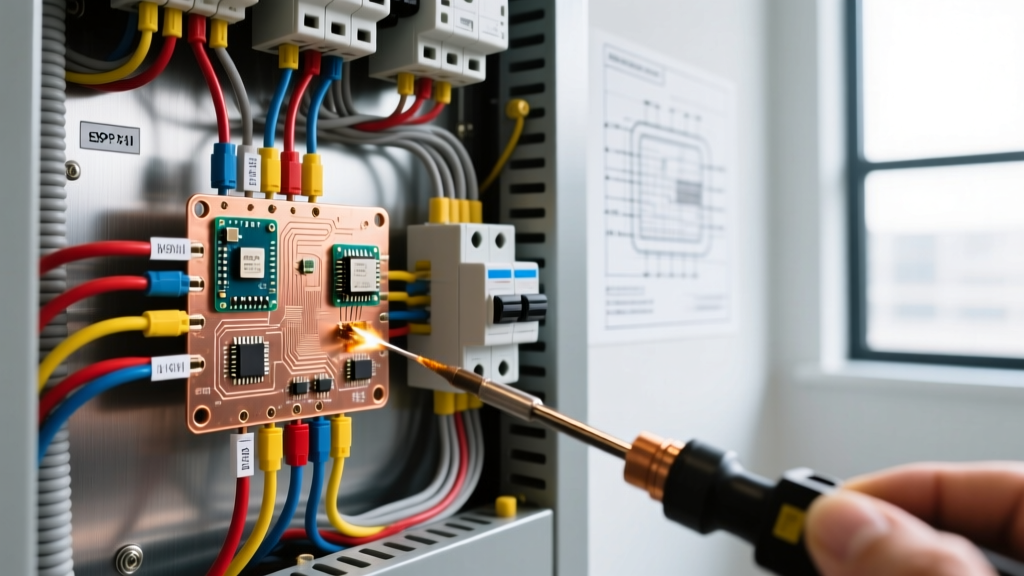
Commercial panels experience massive thermal cycling. As loads peak during the day and drop at night, the aluminum and copper bus bars expand and contract. Over a decade, this mechanical stress causes termination lugs to loosen. A loose connection increases resistance, which generates exponential heat (I²R losses), further loosening the lug in a destructive feedback loop.
The Failure Mode: Phase-to-ground arcing at the main breaker lugs, resulting in an arc flash incident and total panel destruction.
The Fix: Implement annual thermographic inspections using a tool like the Fluke Ti480 PRO infrared camera. Look for delta-T (temperature differences) greater than 15°C between identical phases. During shutdowns, verify all lug torques using a calibrated torque screwdriver. For example, a standard 3/8" lug on a 100A molded case breaker typically requires exactly 40 in-lbs of torque. Never guess the torque.
4. Multi-Wire Branch Circuit (MWBC) Shared Neutral Failures
Commercial lighting and receptacle circuits frequently utilize MWBCs to save conduit space, sharing one neutral between two or three phase conductors. If a maintenance technician accidentally removes the shared neutral while the circuit is energized, or if a neutral splice fails in a junction box, the 120V loads become wired in series across 208V.
The Failure Mode: The load with the higher resistance receives upwards of 180V-200V, instantly vaporizing LED drivers, computer power supplies, and smart thermostats.
The Fix: NEC 210.4(B) requires all ungrounded conductors of an MWBC to be opened simultaneously. Ensure all MWBCs are tied together with approved handle ties or utilize common-trip multi-pole breakers (e.g., Siemens QT2020). Never work on an MWBC neutral without locking out all associated phase poles.
Diagnostic Tool Matrix for Commercial Facilities
Standard digital multimeters are insufficient for modern commercial diagnostics. Facility managers and electrical contractors must invest in power quality and thermal analysis tools to identify invisible wiring problems.
| Diagnostic Tool | Recommended Model (2026) | Primary Application | Approx. Price Range |
|---|---|---|---|
| Power Quality Analyzer | Fluke 435 Series II | Measuring triplen harmonics, voltage sags, and power factor | $5,500 - $6,800 |
| Thermal Imaging Camera | Fluke Ti480 PRO | Identifying high-resistance terminations and overloaded neutrals | $12,000 - $14,500 |
| Insulation Resistance Tester | Megger MIT485/2 | Testing THHN/XHHW insulation breakdown at 500V/1000V | $1,200 - $1,600 |
| Torque Screwdriver | CDI Torque 401SM | Verifying panel bus and breaker lug termination tightness | $250 - $350 |
Step-by-Step: Executing a Preventative Wiring Audit
To systematically eliminate commercial electrical wiring problems before they cause downtime, follow this 5-step audit protocol:
- Baseline Power Quality Logging: Attach a power quality analyzer to the main service entrance for 7 days. Capture the worst-case harmonic distortion (THDi) and voltage unbalance.
- Infrared Thermography Sweep: Under peak loading conditions (typically mid-afternoon in summer), scan all distribution panels, VFDs, and disconnect switches. Document any termination showing a >15°C rise above ambient or adjacent phases.
- Neutral Current Verification: Use a true-RMS clamp meter (e.g., Fluke 376 FC) to measure the neutral current on all 3-phase feeders. If neutral current exceeds 80% of the phase current, schedule a harmonic mitigation retrofit.
- Insulation Resistance Testing: During scheduled shutdowns, isolate critical underground feeders and long conduit runs. Perform a 1-minute spot reading test at 1000V DC. Readings below 10 Megohms indicate moisture ingress or insulation micro-fractures.
- Torque Verification & Retightening: Using calibrated torque tools, verify all busbar connections and breaker lugs against the manufacturer's spec sheet. Apply torque-seal witness marks to confirm completion.
When to Call for Professional Engineering vs. Standard Maintenance
"Routine maintenance can fix a loose lug or replace a degraded branch circuit, but systemic issues like chronic voltage drop, severe harmonic distortion, or repeated neutral failures require a licensed Professional Engineer (PE) to redesign the single-line diagram and recalculate the fault current coordination study."
If your facility is adding Level 3 DC Fast Chargers or expanding server rack density, do not rely on standard electrical contractors to simply "add more breakers." The existing service transformer and feeder wiring must be re-evaluated for the new thermal and harmonic profiles.
FAQ: Commercial Wiring Troubleshooting
Why do my commercial LED lights keep failing prematurely?
Premature LED driver failure in commercial spaces is rarely a product defect; it is usually a wiring problem. High Total Harmonic Distortion (THD) on the circuit, voltage spikes from nearby VFDs, or a shared neutral carrying excessive triplen harmonics will overheat and destroy the internal capacitors of the LED drivers. Install isolated ground circuits and harmonic filters to resolve this.
Is aluminum wiring still used in commercial buildings?
Yes, aluminum wiring (specifically AA-8000 series alloy) is heavily used in 2026 for commercial feeders and service entrance conductors due to its cost-effectiveness and lighter weight compared to copper. However, it requires specific anti-oxidant paste (like Noalox) and strict adherence to torque specifications to prevent thermal creep and subsequent connection failures.
How often should commercial electrical panels be thermally scanned?
According to Fluke Electrical Troubleshooting Resources and standard preventative maintenance guidelines, critical commercial and industrial electrical panels should undergo infrared thermographic inspections at least annually. Facilities with high dust, moisture, or continuous heavy manufacturing loads should schedule scans bi-annually.