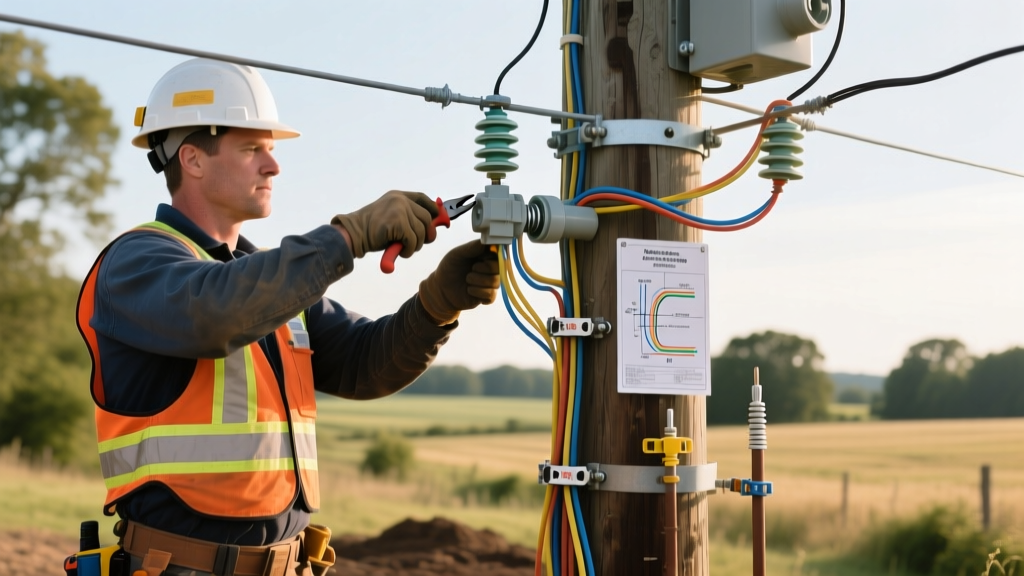

The Critical Intersection of Electric Pole Wiring and Site Safety
When professionals and advanced DIYers discuss electric pole wiring, they are typically referring to two distinct, high-risk domains: temporary power poles for construction sites and standalone rural meter poles for agricultural or remote residential properties. Unlike utility-owned distribution poles, which are maintained by certified linemen, customer-owned pole wiring falls squarely under the jurisdiction of the National Electrical Code (NEC) and the Occupational Safety and Health Administration (OSHA). In 2026, with the widespread adoption of the latest NEC updates and stricter OSHA enforcement on job sites, understanding the precise safety parameters for overhead drops, mast installations, and temporary ped poles is non-negotiable.
Improper electric pole wiring leads to catastrophic failure modes, including arc flashes, pole uplift during high winds, and fatal electrocution from floating neutrals. This guide provides an in-depth, actionable framework for executing safe, code-compliant pole wiring, complete with specific material requirements, clearance matrices, and grounding protocols.
Decoding NEC and OSHA Clearance Mandates
The most frequent code violation in overhead electric pole wiring involves inadequate vertical and horizontal clearances. Both National Fire Protection Association (NFPA) guidelines and OSHA 1926.405 Wiring Methods dictate strict minimum distances to prevent accidental contact with vehicles, machinery, and pedestrians.
Vertical Clearance Matrix (NEC Article 230.24 & OSHA 1926)
| Location / Scenario | Minimum Vertical Clearance | Governing Code / Standard |
|---|---|---|
| Over public streets, roads, and highways | 18 feet (minimum) | NEC 230.24(B)(1) |
| Over residential driveways (no truck traffic) | 12 feet (minimum) | NEC 230.24(B)(2) |
| Over commercial parking lots and agricultural yards | 15 feet (minimum) | NEC 230.24(B)(3) |
| Temporary construction ped poles (pedestrian areas) | 10 feet (minimum) | NEC 590.4 / OSHA 1926 |
Temporary Construction Power Poles: Step-by-Step Safety
Temporary electric pole wiring, often called a "temp pole" or "ped pole," is the lifeblood of a construction site. Governed by NEC Article 590, these installations must withstand harsh environmental conditions, physical abuse from heavy machinery, and constant plugging/unplugging of high-draw tools.
1. Pole Selection and Burial Depth
Never use untreated lumber or repurposed fencing for a temp pole. You must use a pressure-treated, ground-contact rated (UC4A or UC4B) wooden pole or a fiberglass composite pole. The standard rule for burial depth is 10% of the pole length plus 2 feet. For a standard 20-foot temp pole, this means a minimum burial depth of 4 feet. In areas with high frost lines or sandy soil, encase the base in a 2-foot diameter concrete footer to prevent uplift and lateral shifting.
2. The 25-Ohm Grounding Rule
Expert Callout: Grounding Electrode Systems
Per NEC 250.53(A)(2), a single ground rod is rarely sufficient. You must drive two 8-foot copper-bonded ground rods (minimum 5/8-inch diameter) at least 8 feet apart. If the ground resistance exceeds 25 ohms (measured with a fall-of-potential tester), you must drive a third rod. Do not rely on the "three rod myth"—always test the resistance in dry, rocky soil conditions.
3. GFCI Protection and Weatherproof Enclosures
All 15-amp and 20-amp, 125-volt receptacles on a temporary pole must have GFCI protection. In 2026, the industry standard is to use industrial-grade, weather-resistant (WR) GFCI receptacles housed in NEMA 3R die-cast aluminum enclosures. Brands like Hubbell (e.g., Hubbell GFR83) or Bryant offer heavy-duty models with internal shutters that prevent dust and moisture ingress, which is the leading cause of nuisance tripping on job sites.
Rural and Standalone Meter Pole Wiring
For rural properties where the utility transformer is located far from the main residence, a standalone meter pole is required to transition from overhead to underground service. This electric pole wiring setup requires careful coordination with the local utility and strict adherence to NEC Article 230.
Mast Strength and Weatherhead Specifications
The service mast (the pipe extending above the pole to support the weatherhead) must withstand the physical tension of the service drop cables. While 2-inch rigid galvanized steel (RGS) was the historical standard, modern engineering often requires 2.5-inch or 3-inch RGS for spans exceeding 100 feet to prevent the mast from snapping under ice loading or high winds. The weatherhead must be a metallic, lay-in style to allow for easy inspection and maintenance of the Service Entrance (SE) conductors.
Conductor Selection: USE-2 vs. XHHW-2
For the overhead span from the utility pole to your customer-owned meter pole, you must use conductors rated for sunlight resistance and wet locations. USE-2 (Underground Service Entrance) or XHHW-2 (Cross-Linked Polyethylene High Heat Water Resistant) are the mandatory choices. Never use standard THHN in an overhead outdoor span, as UV radiation will degrade the insulation within months, leading to short circuits and arc faults.
Common Failure Modes and Edge Cases
Even experienced electricians make critical errors when executing electric pole wiring. Watch out for these specific failure modes:
- Neutral-Ground Bond Errors: On a temporary pole with a main breaker, the neutral and ground must be bonded. On a rural meter pole acting solely as a service disconnect, the bonding screw must be installed. However, if the pole only houses a meter socket and the disconnect is downstream, the neutral must remain isolated from the ground bar. A double-bonded neutral creates parallel neutral paths, electrifying the pole's grounding system.
- Thermal Sagging: Aluminum conductors expand significantly more than copper. When stringing a 150-foot overhead span in the winter, you must leave adequate sag. If pulled drum-tight in 30°F weather, the summer heat will cause the aluminum to expand and snap the service mast or pull the weatherhead apart.
- Wood Rot at the Grade Line: The ground-line interface is where oxygen, moisture, and fungi meet. Treat the bottom 4 feet of wooden poles with a copper naphthenate wood preservative before burial, and slope the backfill dirt away from the pole base to shed surface water.
2026 Material Checklist & Cost Estimates
Budgeting for a compliant, safe pole wiring project requires accounting for current material costs. Below is a realistic estimate for a standard 200-amp rural meter pole or heavy-duty temp pole setup (excluding utility connection fees and heavy equipment rental for pole setting).
| Component | Specification / Model | Est. Cost (2026) |
|---|---|---|
| Treated Wood Pole (Class 5) | 25-ft, UC4B Ground Contact Rated | $350 - $500 |
| Meter Socket / Temp Panel | 200A NEMA 3R Ring-Type (Siemens/Milbank) | $250 - $400 |
| Service Mast (RGS) | 2.5-inch Rigid Galvanized Steel, 10ft | $180 - $250 |
| Grounding Electrodes | Two 8-ft Copper-Bonded Rods + Acorn Clamps | $60 - $85 |
| Overhead Conductors | 4/0-4/0-2/0 AL Triplex (USE-2), per foot | $4.50 - $6.00 / ft |
Frequently Asked Questions (FAQ)
Can I use PVC conduit for the service mast on an overhead pole?
No. PVC conduit lacks the structural tensile strength to support the physical pull of overhead service drop cables, especially under ice or wind loading. NEC 230.28 explicitly requires the service mast to be of adequate strength. Rigid Metal Conduit (RMC) or Rigid Galvanized Steel (RGS) is mandatory for mast applications.
Do I need a disconnect switch on a rural meter pole?
Yes. Modern NEC requirements (and most utility company "Green Books" or service manuals) mandate an exterior disconnecting means at the meter pole. This allows first responders or utility workers to kill power to the downstream underground feeders without entering the structure or pulling the meter, which can be dangerous under load.
How often should temporary construction poles be inspected?
OSHA requires that temporary wiring installations be inspected regularly. Best practice dictates a documented visual inspection weekly, and immediately following any severe weather event (high winds, heavy snow, or flooding) to check for pole lean, conductor sag, and GFCI functionality. For deeper insights into agricultural and temporary site safety, refer to resources provided by the USDA Rural Utilities Service (RUS) and local OSHA compliance directives.