
The NEC Framework for Detached Structures
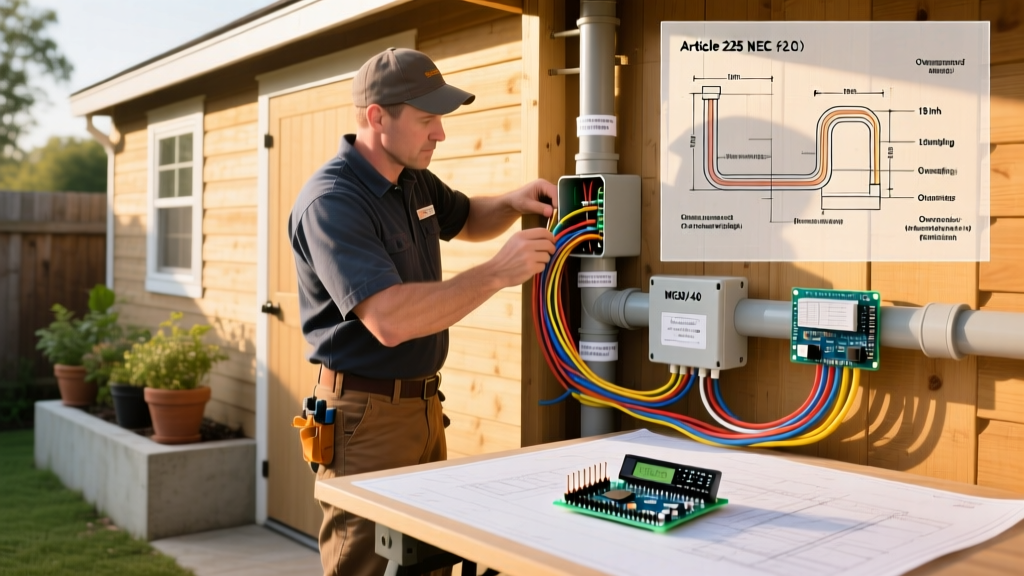
Executing safe and compliant garden shed electrical wiring requires bridging basic DIY construction skills with strict commercial-grade code compliance. When you run power to a detached outbuilding, you are no longer just extending a room; you are creating a separately derived power delivery system that must withstand moisture, physical damage, and soil corrosion. According to the National Fire Protection Association (NFPA 70), also known as the National Electrical Code (NEC), outbuilding wiring is primarily governed by Article 225 (Outside Branch Circuits and Feeders), Article 250 (Grounding and Bonding), and Article 300 (General Requirements for Wiring Methods).
In this 2026 code explainer, we dissect the exact NEC requirements for powering a garden shed, moving past generic advice to provide specific wire gauges, trenching depths, torque specifications, and subpanel configurations that will pass your local Authority Having Jurisdiction (AHJ) inspection.
Power Delivery: Branch Circuit vs. Subpanel Feeder
The first critical decision in your garden shed electrical wiring project is determining the power delivery method. This depends entirely on your anticipated load. If you only need a single light and a receptacle for a battery charger, a single branch circuit suffices. However, if you plan to run a mini-split HVAC, a welder, or multiple workbench circuits, a dedicated subpanel feeder is mandatory.
| Delivery Method | Wire / Conduit Type | Max Overcurrent | Min. Trench Depth | Est. Material Cost (50ft) |
|---|---|---|---|---|
| Single 120V Branch | UF-B 12/2 (Direct Burial) | 20 Amps | 24 inches | $115.00 |
| Multi-Wire Branch (MWBC) | UF-B 10/3 (Direct Burial) | 30 Amps | 24 inches | $185.00 |
| 60A Subpanel Feeder | 4 AWG XHHW-2 Al. in 1.5" PVC | 60 Amps | 18 inches | $310.00 |
Note: While 6 AWG Copper THWN-2 is acceptable for 60A, 4 AWG Aluminum XHHW-2 is the industry standard for residential feeders in 2026 due to copper price volatility, offering identical ampacity at roughly 40% of the cost per foot.
Trenching, Conduit, and Physical Protection (Article 300)
Underground wiring is where most DIY garden shed electrical wiring projects fail inspection. NEC Article 300.5 dictates minimum cover requirements based on the wiring method used. The measurements below are from the top of the conduit or cable to the finished grade surface.
- Direct Burial UF Cable (No Conduit): Requires a minimum depth of 24 inches. This is labor-intensive to dig by hand and highly susceptible to future shovel strikes.
- Schedule 40 PVC Conduit: Requires a minimum depth of 18 inches. This is the preferred method for subpanel feeders, as it allows you to pull THWN-2 or XHHW-2 individual conductors, which are easier to terminate than stiff UF cable.
- Rigid Metal Conduit (RMC) or Intermediate Metal Conduit (IMC): Requires a minimum depth of 6 inches, though this is rarely used in residential shed applications due to material costs and threading requirements.
Code Alert: The Warning Ribbon Requirement
Per NEC 300.5(D)(3), if you are using direct-burial cable or non-concrete-encased PVC conduit, you must install a continuous warning ribbon (usually bright yellow or red, labeled "CAUTION: BURIED ELECTRIC LINE BELOW") at least 12 inches above the underground installation. Inspectors will actively look for this ribbon protruding from the trench before backfilling.
The Grounding and Bonding Matrix (Article 250)
Grounding a detached shed is the most misunderstood aspect of outbuilding wiring. The International Association of Electrical Inspectors (IAEI) frequently highlights improper subpanel bonding as a leading cause of shock hazards and failed inspections.
1. Separate the Neutral and Ground
At the main service panel in your house, the neutral (grounded conductor) and ground (equipment grounding conductor) are bonded together. At the garden shed subpanel, they must remain strictly isolated. You must purchase a separate equipment grounding bar (e.g., Square D PK7GTA) for the subpanel and ensure the green main bonding screw is removed from the neutral bar. If neutral current returns to the main panel via the grounding system, it creates parallel neutral paths, posing a severe electrocution risk.
2. The Grounding Electrode System (GES)
Even if you run a dedicated equipment grounding wire (EGC) back to the main panel, NEC 250.32 requires a Grounding Electrode System at the detached structure if a feeder panel is installed.
- Drive two 8-foot, 5/8-inch copper-bonded ground rods into the soil.
- Space them at least 6 feet apart.
- Connect them using a continuous 8 AWG or 6 AWG bare copper grounding electrode conductor (GEC).
- Use acorn clamps rated for direct burial to secure the wire to the rods.
Exception: If you can prove via a fall-of-potential test that a single rod has a resistance to ground of 25 ohms or less, one rod is sufficient. However, the test equipment costs over $1,500, so installing the second rod is the universal standard practice to satisfy the AHJ without testing.
GFCI, AFCI, and Disconnect Requirements
Safety protection devices have seen massive expansions in recent NEC cycles. For your garden shed electrical wiring, adhere to these rules:
- Disconnecting Means (NEC 225.31): A detached structure with more than one branch circuit must have a local disconnecting means. Installing a main breaker panel (e.g., Square D HOM612L100PGC with a 60A main breaker) satisfies this requirement natively.
- GFCI Protection (NEC 210.8): All 125-volt, 15- and 20-ampere receptacles installed in the shed must have Ground-Fault Circuit Interrupter (GFCI) protection. You can achieve this via GFCI receptacles at the point of use or a GFCI breaker in the subpanel.
- AFCI Protection (NEC 210.12): While sheds are not always classified as dwelling unit rooms requiring Arc-Fault Circuit Interrupter (AFCI) protection, if your shed is wired as an extension of a bedroom or living space circuit, AFCI may be triggered. For dedicated shed lighting circuits, standard breakers are generally acceptable unless local amendments dictate otherwise.
Inspector Red Flags: 5 Fatal Code Violations
To ensure your project passes on the first visit, avoid these common failure modes that electrical inspectors flag immediately:
- Using NM-B (Romex) in Wet Locations: You cannot transition from underground PVC conduit directly into the shed wall using Romex if the conduit is exposed to condensation or moisture. THWN-2 individual wires must be pulled all the way into a weatherproof junction box or the subpanel enclosure.
- Improper PVC Solvent Welding: Using the wrong glue (e.g., using all-purpose clear cement instead of medium-body gray PVC cement for Schedule 40) or failing to prime the joints. Inspectors will check for the purple primer stain on exterior joints.
- Missing Conductor Identification: If you pull individual THWN-2 wires, you must use white or gray tape to re-identify the neutral wire at both ends if your pulled wire was black, red, blue, etc. Furthermore, the equipment ground must be green or bare.
- Untorqued Lug Connections: NEC 110.14(D) requires that all mechanical connector terminals be tightened to the manufacturer's specified torque. Using a standard screwdriver is a violation. You must use a calibrated torque screwdriver (like the Klein Tools 32500TORQ) set to the exact inch-pound spec printed on the subpanel label (typically 35-45 in-lbs for 4 AWG aluminum).
- Oversized Breakers for Wire Gauge: Pairing a 60A breaker with 8 AWG wire. Remember the strict copper limits: 14 AWG = 15A, 12 AWG = 20A, 10 AWG = 30A. Aluminum feeder sizing requires consulting NEC Table 310.12.
Final Thoughts on Permitting
Never bypass the permitting process for garden shed electrical wiring. A permitted project ensures that your trench depth, wire sizing, and grounding matrix are verified by a licensed inspector before the dirt is backfilled and the drywall is hung. The cost of a residential electrical permit (typically $75 to $150 depending on your municipality) is a fraction of the cost of tearing out failed underground conduit or, worse, dealing with a liability claim from an ungrounded outbuilding shock hazard. Plan your trench, buy the correct XHHW-2 aluminum feeder wire, isolate that neutral bar, and torque your lugs to spec.