
Understanding the Code: NEC Requirements for Dryer Circuits
Wiring an electric dryer is a high-stakes electrical project that demands strict adherence to the National Electrical Code (NEC). Unlike standard 120-volt household circuits, an electric dryer requires a dedicated 240-volt, 30-amp circuit capable of handling continuous high-draw loads for heating elements and motors. According to the National Fire Protection Association (NFPA), improper dryer wiring is a leading cause of residential electrical fires, often stemming from undersized wire gauges, loose terminal connections, or improper grounding.
In modern installations, the NEC strictly mandates a 4-wire setup (two hots, one neutral, one ground) for all new construction and remodels. This separates the neutral return path from the equipment grounding conductor, a critical safety upgrade that prevents the dryer's metal chassis from becoming energized if the neutral wire fails. Furthermore, recent NEC cycles have introduced GFCI (Ground Fault Circuit Interrupter) requirements for laundry areas, fundamentally changing the type of breaker you must purchase for a new installation.
The Essential Materials List (With Brand Recommendations)
Selecting the correct materials is non-negotiable. Using undersized cables or unlisted components will fail inspection and create severe fire hazards. Below is the definitive material list for a standard 30-amp electric dryer circuit.
1. The Cable: 10/4 NM-B vs. 10/3 MC
For standard indoor, dry-location runs through wall cavities, 10 AWG 4-conductor NM-B (Non-Metallic Sheathed Cable) is the industry standard. Brands like Southwire or Cerro Wire manufacture 10/4 NM-B with a black, red, white, and bare copper ground wire. This cable is rated for 30 amps at 60°C/75°C. If you are running the circuit through an exposed basement ceiling, a garage, or outdoors, NM-B is illegal; you must use 10/3 MC (Metal Clad) cable or pull four individual 10 AWG THHN/THWN wires through rigid metal or PVC conduit.
Expert Note: Never use 10 AWG aluminum wire for dryer circuits. Aluminum requires larger gauge sizing (8 AWG) for 30 amps and is prone to thermal creep at termination points, leading to arcing.
2. The Breaker: 30-Amp Double-Pole (Standard vs. GFCI)
The circuit must be protected by a 30-amp double-pole breaker. The specific model depends on your panel brand (e.g., Square D HOM230CP for Homeline panels, or Eaton BR230 for Cutler-Hammer panels). However, if your laundry room is classified under recent NEC Article 210.8(A)(10) requirements for GFCI protection in laundry areas, you must upgrade to a 30-Amp Double-Pole GFCI Breaker (such as the Square D HOM230GFIC). These breakers cost significantly more (often $60-$90 compared to $12 for a standard breaker) but are legally required in many jurisdictions for new 120/240V split-phase receptacles.
3. The Receptacle: NEMA 14-30R
The standard receptacle for a modern electric dryer is the NEMA 14-30R. This 4-slot receptacle accommodates two hot blades, an L-shaped neutral blade, and a U-shaped ground pin. We recommend heavy-duty commercial-grade models like the Leviton 278-S00 or the Bryant 9430FR. Avoid builder-grade residential receptacles, as their internal brass contacts tend to lose tension over years of thermal cycling, leading to melted faceplates.
4. The Pigtail Cord Kit and Strain Relief
Dryers are typically sold without power cords. You must purchase a 4-prong, 30-amp dryer cord kit (usually 4 to 6 feet long, featuring 10/4 SOOW flexible cord). Crucially, you must also purchase a UL-listed SE-104 strain relief connector. This metal clamp secures the thick cord to the dryer's rear access panel, ensuring that if the cord is pulled, the tension is absorbed by the clamp and not the delicate terminal block screws.
Must-Have Tools for Safe Termination
Proper tools ensure clean terminations and verifiable safety. Relying on improvised tools leads to frayed strands and loose connections.
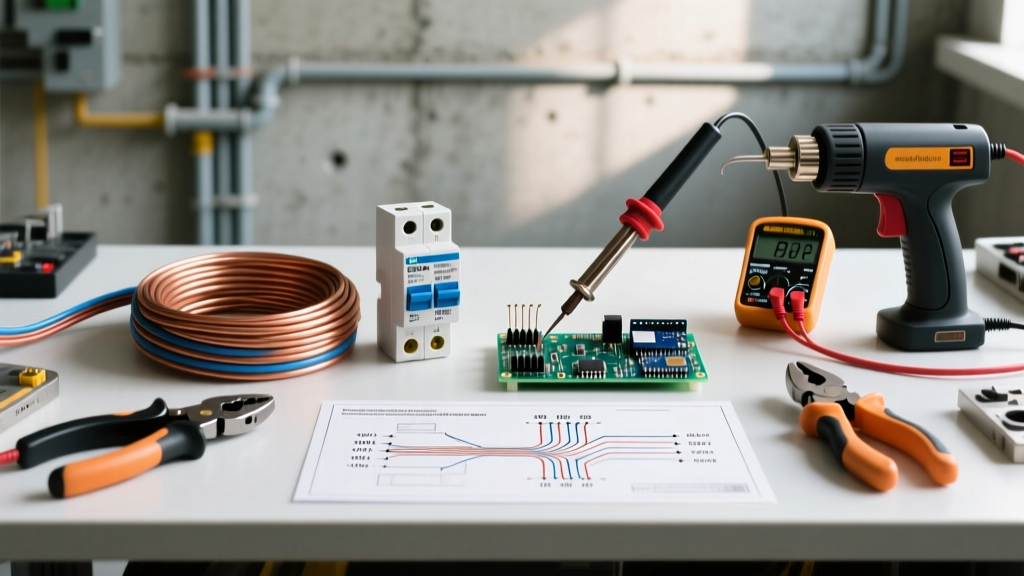
- Wire Strippers: Use a dedicated heavy-gauge stripper like the Klein Tools 11055 or Knipex Automatic Wire Strippers. Standard pliers will nick the 10 AWG copper, creating a hot spot.
- Torque Screwdriver: This is the most overlooked tool. NEC 110.14(D) requires terminations to be torqued to the manufacturer's specifications. A calibrated torque screwdriver (like the CDI 401SM) set to 12-15 inch-pounds ensures the terminal lugs are tight enough to prevent arcing, but not so tight that they shear the screw heads.
- Digital Multimeter: A CAT III rated multimeter (such as the Fluke 117) is mandatory for verifying 240V across the hot legs and 120V from each hot leg to neutral before plugging in the appliance.
- Non-Contact Voltage Tester: For initial dead-circuit verification before touching any bare wires.
- Heavy-Duty Cable Ripper: A tool like the Southwire Romex Ripper safely slices the outer PVC jacket of 10/4 NM-B without scoring the inner wire insulation.
2026 Material and Tool Cost Matrix
Budgeting for a dryer circuit requires accounting for both standard and code-mandated GFCI components. Below is a realistic cost breakdown for a standard 50-foot run.
| Component | Specification | Estimated Cost (2026) |
|---|---|---|
| 10/4 NM-B Cable | 50 ft roll (Southwire/Cerro) | $75.00 - $95.00 |
| Standard 30A Breaker | Double-Pole (Non-GFCI) | $12.00 - $18.00 |
| GFCI 30A Breaker | Double-Pole (Code Required in some areas) | $65.00 - $95.00 |
| NEMA 14-30R Receptacle | Commercial Grade (Leviton/Bryant) | $18.00 - $28.00 |
| 4-Prong Dryer Cord | 6 ft, 10/4 SOOW with SE-104 Clamp | $25.00 - $35.00 |
| Deep Electrical Box | Single Gang, 22 cu. in. minimum | $4.00 - $8.00 |
Edge Cases and Common Installation Failures
Even experienced DIYers make critical errors when wiring electric dryers. Avoid these specific failure modes:
The 3-Prong to 4-Prong Conversion Trap
If you are moving an older dryer with a 3-prong cord into a home with a modern 4-prong NEMA 14-30R receptacle, do not use an adapter plug. Adapters are illegal and bypass the equipment ground. Instead, buy a new 4-prong cord. When installing it, you must locate the green grounding strap (or bonding jumper) on the dryer's terminal block and remove it or fold it back. In a 3-prong setup, this strap bonds the neutral to the chassis. In a 4-prong setup, leaving this strap in place creates a parallel neutral path on the ground wire, which will immediately trip a GFCI breaker and violate NEC 250.140.
Undersized Junction Boxes
10/4 NM-B is exceptionally thick and stiff. Standard 16-cubic-inch single-gang boxes do not provide adequate volume for the required wire bending radius. NEC Article 314 requires a minimum of 22 cubic inches for a 14-30R receptacle wired with 10 AWG conductors. Always use an extra-deep masonry or metal device box to prevent crushing the wires behind the receptacle yoke.
Thermal Creep at Terminals
Dryer cycles cause massive temperature fluctuations in the surrounding wall cavity. If terminal screws are only tightened by 'feel', the copper wire will expand and contract, eventually loosening the screw. This creates a high-resistance connection that generates intense heat, melting the receptacle. This is why the torque screwdriver mentioned in the tools section is not optional—it is your primary defense against thermal creep.
Frequently Asked Questions
Can I use a 40-amp breaker for a 30-amp dryer cord?
No. The breaker must be sized to protect the weakest link in the circuit. A standard dryer cord and NEMA 14-30R receptacle are rated for exactly 30 amps. Using a 40-amp breaker means the wire and cord could overheat and catch fire before the breaker ever trips. Always match the breaker to the 30-amp rating of the receptacle and cord.
Does the U.S. Department of Energy recommend specific wiring for efficiency?
While the DOE focuses on appliance efficiency rather than branch circuit wiring, proper wiring ensures the dryer receives the full 240 volts without voltage drop. Undersized or excessively long wire runs can cause voltage drop, forcing the dryer's heating elements to draw more current and run longer, artificially inflating your energy bills and reducing the appliance's lifespan.
What if my panel is full and I need to add a 30-amp double-pole breaker?
If your panel lacks physical space, do not use tandem breakers to cheat space; a 30-amp double-pole requires two full, adjacent 1-inch slots. You may need to install a sub-panel or upgrade your main service panel. Consult a licensed electrician to perform a load calculation per NEC Article 220 before adding high-draw appliances to an older 100-amp service.