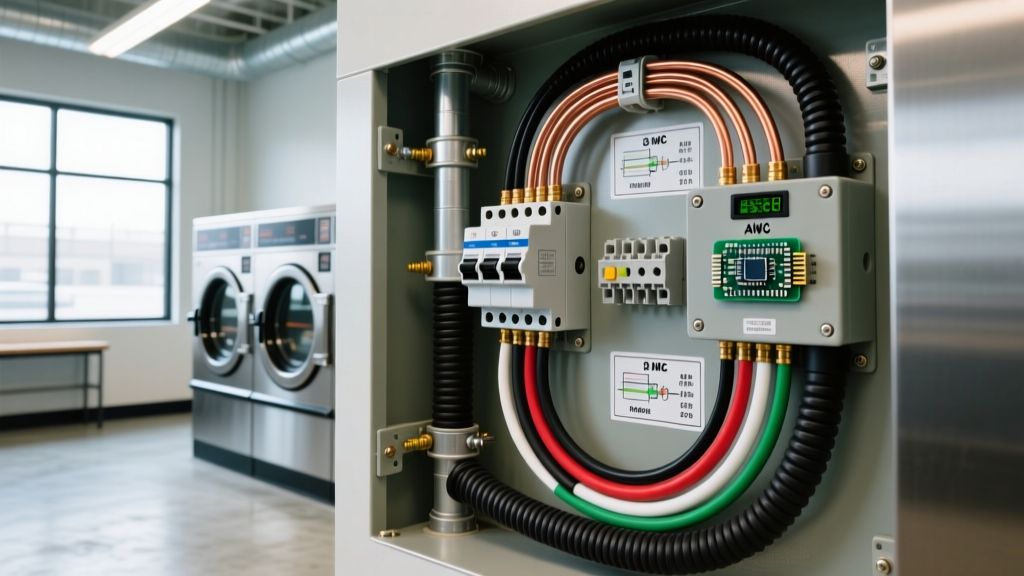

Why Commercial Dryer Wiring Differs from Residential
When determining the correct electric dryer wiring size for commercial applications—such as laundromats, multi-family housing complexes, and hotel laundry facilities—residential rules of thumb no longer apply. In a standard home, an electrician might pull a 10/3 NM-B cable for a 30-amp, 240-volt residential dryer. However, commercial environments demand rigorous adherence to the National Electrical Code (NEC) regarding continuous loads, conduit fill, voltage drop over long distances, and specific demand factors.
As of 2026, the shift toward high-efficiency commercial dryers equipped with Variable Frequency Drives (VFDs) and inverter motors (such as the Dexter T-Series and Speed Queen Quantum models) has introduced new considerations for harmonic distortion and neutral conductor sizing. This guide provides a deep-dive technical framework for commercial electricians and facility managers to accurately size branch circuits and feeders for commercial laundry equipment.
The Code Divide: NEC Article 210 vs. Article 220
The most common mistake in commercial laundry wiring is misapplying residential demand factors to commercial feeders. According to the NFPA 70 (National Electrical Code), branch circuits for individual appliances are governed by NEC Article 210, while feeder calculations fall under Article 220.
CRITICAL CODE DISTINCTION: NEC Table 220.54 provides demand factors for household electric clothes dryers. This table explicitly does not apply to commercial laundromats or coin-operated facilities. For commercial installations, the feeder must generally be sized based on the sum of the nameplate ratings of all connected dryers, unless an approved engineering study (NEC 220.85) dictates otherwise.
Step-by-Step: Calculating Branch Circuit Wiring Size
Step 1: Identify the Nameplate Rating and Voltage
Commercial dryers frequently operate on 208V 3-phase or 240V single-phase power. A standard commercial tumble dryer might have a nameplate rating of 9.5 kW to 15 kW. Always use the nameplate Full Load Amps (FLA) or calculate it using the formula: Amps = Watts / (Volts × √3) for 3-phase systems.
Step 2: Determine Conductor Ampacity (NEC Table 310.16)
Most commercial terminations are rated for 75°C. Therefore, you must use the 75°C column of NEC Table 310.16 to determine the baseline ampacity. For a 40-amp commercial dryer circuit, 8 AWG copper THHN/THWN-2 (rated at 50A at 75°C) is standard, allowing for standard 40A breaker sizing while accommodating voltage drop adjustments.
Step 3: Select the Conductor Type
Non-metallic sheathed cable (NM-B/Romex) is strictly prohibited in most commercial construction due to fire-rating and physical protection requirements. You must use individual conductors, typically THHN/THWN-2, pulled through Electrical Metallic Tubing (EMT), rigid metal conduit (RMC), or intermediate metal conduit (IMC).
Conductor Sizing Matrix for Common Commercial Dryers
The following matrix outlines the minimum electric dryer wiring size based on standard commercial breaker configurations and 75°C termination limits. This assumes a standard 3-wire plus ground setup (or 4-wire if 120V controls require a neutral).
| Breaker Size | Max Nameplate Load (240V 1-Ph) | Min. Copper Wire Size (75°C) | Min. EGC Size (Table 250.122) | Typical Commercial Application |
|---|---|---|---|---|
| 30 Amp | 5,500W (22.9A) | 10 AWG THHN | 10 AWG Copper | Small stackable units, hotel back-of-house |
| 40 Amp | 8,500W (35.4A) | 8 AWG THHN | 10 AWG Copper | Standard single-load laundromat dryers |
| 50 Amp | 11,000W (45.8A) | 6 AWG THHN | 10 AWG Copper | Medium double-load commercial dryers |
| 60 Amp | 13,500W (56.2A) | 6 AWG THHN | 10 AWG Copper | Large capacity multi-pocket dryers |
| 100 Amp | 22,000W (91.6A) | 3 AWG THHN | 8 AWG Copper | Industrial continuous-batch dryers |
The Feeder Trap: Sizing for Multi-Dryer Laundromats
When sizing the main feeder for a panel dedicated to 20 commercial dryers, the math can result in massive, expensive conductors if done incorrectly. Let us assume 20 dryers, each rated at 9.0 kW (37.5A at 240V).
- Incorrect (Residential Method): Applying NEC Table 220.54 demand factors (e.g., multiplying by 0.45 for 20 units). This is a code violation for commercial spaces and will result in overheated feeders and tripped main breakers during peak weekend hours.
- Correct (Commercial Method): Summing the nameplate ratings. 20 × 37.5A = 750 Amps. This requires parallel sets of 350 kcmil or 500 kcmil copper conductors.
Pro-Tip for 2026: To mitigate the massive cost of copper feeders (with 500 kcmil THHN hovering around $9.50 to $12.00 per foot in early 2026), many commercial designers utilize NEC 220.85 (Optional Method for New Restaurants/Laundries) or work with the local Authority Having Jurisdiction (AHJ) to approve a documented load diversity study, proving that not all 20 dryers will simultaneously draw maximum heating element amperage due to internal thermostatic cycling.
Voltage Drop and Conduit Fill Considerations
In large commercial buildings, laundromats are often situated far from the main switchgear. NEC recommends a maximum of 3% voltage drop on branch circuits and 5% on feeders. A 240V circuit dropping 4% leaves the dryer with only 230V, which drastically increases drying times and causes contactors to chatter and fail prematurely.
Using the Southwire Voltage Drop Calculator or manual calculations (VD = 2 × K × I × D / CM), a 50-amp circuit running 150 feet requires upsizing from 6 AWG to 4 AWG copper to maintain a drop under 3%. Furthermore, when pulling multiple circuits through EMT, you must apply NEC Table 310.15(C)(1) ampacity adjustment factors. If you pull four current-carrying conductors in a single conduit, you must derate the ampacity to 80%. This frequently forces commercial electricians to upsize their electric dryer wiring size by one or two AWG gauges simply to compensate for conduit heat dissipation limits.
Grounding, Bonding, and Neutral Sizing
Commercial dryers with 120V control boards, timers, or coin mechanisms require a dedicated neutral conductor. Under NEC Article 250, the neutral must be sized to carry the maximum unbalanced load, but it is often sized equally with the phase conductors in commercial environments to handle harmonic currents generated by modern VFD motors.
The Equipment Grounding Conductor (EGC) must be sized strictly according to NEC Table 250.122 based on the overcurrent protection device (OCPD) rating. Never rely on the EMT conduit alone as the sole EGC for commercial laundry equipment; the vibration of commercial dryers can loosen conduit fittings over time, compromising the ground fault path. Always pull a dedicated copper EGC inside the conduit.
Common Edge Cases and Failure Modes
- 3-Phase Motor Burnouts: Connecting a 208V 3-phase dryer to a 240V 3-phase delta system without verifying motor compatibility will destroy the blower motor within weeks. Always verify the phase voltage and configuration (Wye vs. Delta) before terminating.
- Lug Torque Failures: Commercial dryers draw high inrush currents when heating elements engage. If the terminal lugs on the disconnect switch are not torqued to the manufacturer's specifications (typically 40-50 in-lbs for 8 AWG), thermal expansion and contraction will loosen the connection, leading to arcing and melted lugs.
- Wet Location Violations: If the commercial laundry area is subject to hosing down for cleaning (common in multi-family housing maintenance rooms), the space is classified as a wet or damp location. Standard EMT and THHN are insufficient; you must use Rigid Metal Conduit (RMC) or PVC Schedule 80 with wet-rated THWN-2 conductors and NEMA 4X disconnect enclosures.
Summary Checklist for Commercial Installations
Before pulling wire for your next commercial laundry project, verify the following:
- Confirm if the space is classified as a commercial laundromat or a multi-family dwelling (this dictates NEC Article 220 demand factor applicability).
- Calculate branch circuits based strictly on the 2026 equipment nameplate FLA, not generic 30A assumptions.
- Apply 75°C ampacity limits and adjust for conduit fill derating.
- Calculate voltage drop for runs exceeding 75 feet and upsize conductors accordingly.
- Pull a dedicated, properly sized copper EGC; do not rely solely on metallic conduit.
For further reading on commercial load calculations and NEC updates, refer to the Electrical Construction & Maintenance (EC&M) National Electrical Code resource center. Properly sizing your commercial electric dryer wiring ensures code compliance, prevents catastrophic thermal failures, and guarantees optimal drying performance for your facility's end-users.