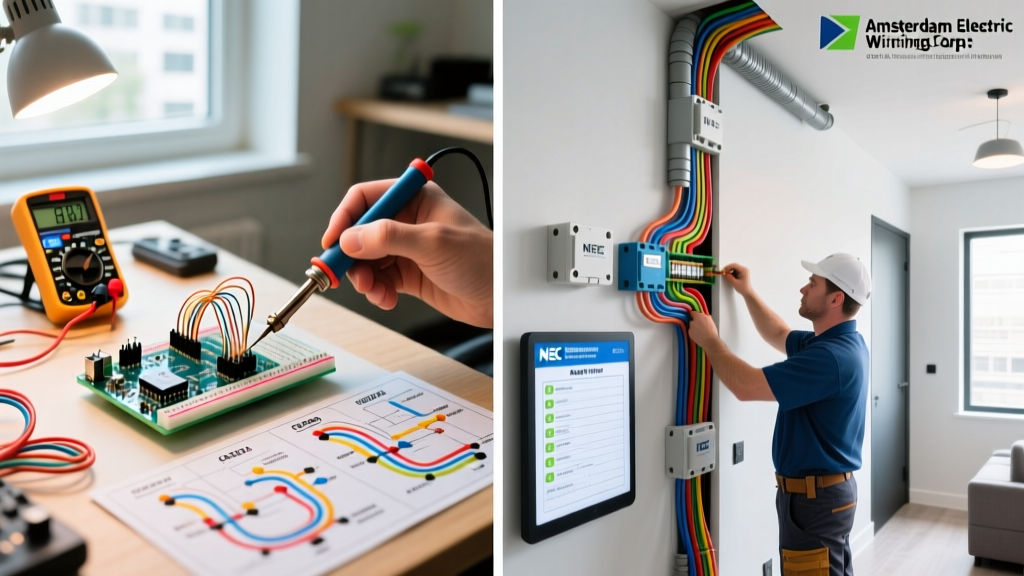

The True Cost and Safety Divide in Modern Electrical Wiring
When homeowners consider upgrading their electrical infrastructure, the initial appeal of a DIY approach is almost always financial. However, as residential power demands surge in 2026—driven by Level 2 EV chargers, heat pumps, and whole-home smart systems—the margin for error has shrunk to zero. Benchmarking amateur installations against the rigorous standards of established commercial and residential contractors like Amsterdam Electric Wiring Corp reveals a stark contrast in execution, code compliance, and long-term safety.
This comprehensive analysis breaks down the real costs, technical failure modes, and code requirements you must consider before deciding to pull your own permits versus hiring a master electrician crew.
Financial Breakdown: DIY Materials vs. Professional Contracting
The most common misconception in DIY electrical work is equating the cost of materials with the total cost of the project. Professional firms factor in utility coordination, load calculations, municipal permitting, and liability insurance. Below is a realistic 2026 cost comparison for a standard 200-amp service panel upgrade.
| Cost Category | DIY Approach (Homeowner) | Professional (e.g., Amsterdam Electric Wiring Corp) |
|---|---|---|
| 200A Panel (Square D QO or Eaton BR) | $215 - $285 | $250 - $350 (Wholesale + Markup) |
| Wire, Conduit & Fittings (2/0 SER) | $350 - $500 | $400 - $600 |
| Municipal Permits & Inspections | $150 - $350 | $150 - $350 (Included in total) |
| Specialized Tools (Torque drivers, benders) | $120 - $250 | $0 (Already equipped) |
| Labor & Utility Coordination | $0 (Your time) | $1,800 - $3,200 (8-14 hrs @ $150/hr) |
| Total Estimated Cost | $835 - $1,385 | $2,600 - $4,500 |
While the DIY route appears to save roughly $2,000 upfront, it entirely omits the value of a workmanship warranty and the mitigation of catastrophic fire risks. According to the National Fire Protection Association (NFPA), electrical distribution and lighting equipment remain a leading cause of home structure fires, frequently stemming from improper terminations and overloaded circuits.
NEC Compliance and the Torque Specification Mandate
The National Electrical Code (NEC) has drastically tightened its requirements regarding mechanical connections. Under NEC Section 110.14(D), any connection to a terminal must be tightened using a calibrated torque tool to the manufacturer's specified values.
Professional crews from firms like Amsterdam Electric Wiring Corp utilize calibrated torque screwdrivers (such as the Klein Tools 32500 or Milwaukee 48-22-2901) and inch-pound torque wrenches. For standard 15A and 20A breakers, the required torque is typically between 20 and 25 in-lbs. For main service lugs handling 200A, the specification often jumps to 45 in-lbs or higher. Over a 5-year period, the thermal expansion and contraction of copper and aluminum wiring will naturally loosen untorgued connections, creating high-resistance hot spots that standard breakers cannot detect.
Risk Matrix: Amateur vs. Professional Failure Modes
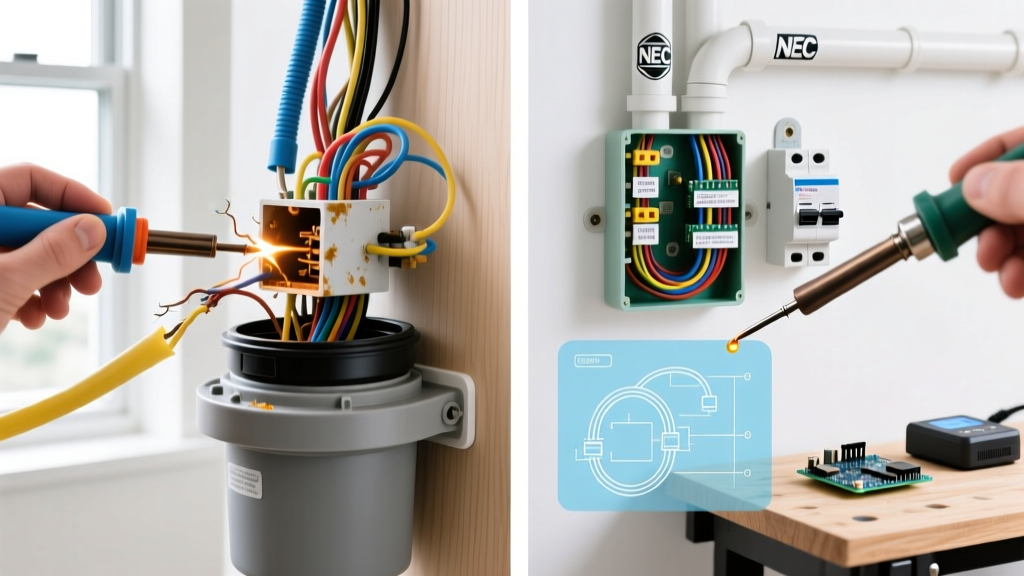
When analyzing field repairs, master electricians frequently encounter specific failure modes unique to amateur installations. Here is a diagnostic matrix of common DIY errors versus professional mitigation strategies.
- Neutral Bar Overcrowding:
- DIY Failure: Landing two or three neutral wires under a single lug screw because the bar is full. NEC 408.41 strictly prohibits this unless the lug is specifically listed for multiple conductors.
- Professional Fix: Installing an auxiliary ground/neutral bar (e.g., Eaton GBKP26) to ensure every neutral has its own dedicated termination point, preventing return-path impedance and potential shock hazards.
- Improper Grounding Electrode Connections:
- DIY Failure: Using standard pipe clamps not rated for electrical grounding, or failing to bond the cold water pipe within 5 feet of the point of entrance.
- Professional Fix: Utilizing UL-listed acorn clamps and exothermic welding (Cadweld) for permanent, corrosion-resistant bonds to the grounding electrode system.
- Box Fill Violations:
- DIY Failure: Cramming five 12-AWG wires and a smart switch into a standard 18-cubic-inch single-gang box, violating NEC 314.16 fill calculations and causing wire insulation damage.
- Professional Fix: Upgrading to deep 22.5-cubic-inch boxes or using stacked masonry boxes to accommodate the physical bulk of modern smart home modules.
Case Study: The 60-Amp EV Charger Circuit
The adoption of electric vehicles has made high-amperage continuous loads a standard residential requirement. The U.S. Department of Energy emphasizes that Level 2 home charging requires dedicated, properly sized circuitry. Let us examine the installation of a 48-amp continuous Level 2 EV charger.
The DIY Miscalculation
An amateur might calculate that a 48-amp charger requires a 50-amp breaker and 6-AWG wire. This is a severe code violation. Under NEC Article 210.20(A), continuous loads (those operating for 3 hours or more) must have the branch circuit rated at 125% of the continuous load. Therefore, 48 amps x 1.25 = 60 amps. The DIYer's 50-amp breaker will nuisance-trip or, worse, overheat and melt the bus bar stabs.
The Professional Execution
A licensed contractor from Amsterdam Electric Wiring Corp will correctly size this circuit to a 60-amp breaker and pull 4-AWG copper THHN/THWN-2 through a dedicated 1-inch EMT conduit. Furthermore, they will ensure the panel has the physical bus-bar space and the calculated load capacity (using NEC Article 220 load calculations) to support this massive draw without overloading the main service transformer.
Navigating Historic and Complex Municipal Grids
One area where professional contractors unequivocally outperform DIYers is in managing utility-side logistics, particularly in older municipalities. Homes built prior to 1970 often feature outdated service drops, lead-sheathed cables, or asbestos-wrapped conduit.
When upgrading a service in these environments, a firm like Amsterdam Electric Wiring Corp handles the intricate dance of municipal coordination: securing street closure permits for bucket trucks, coordinating the utility drop disconnect and reconnect with the local power authority, and safely remediating hazardous materials found at the weatherhead. The Consumer Product Safety Commission (CPSC) heavily warns against homeowners interacting with the service drop and meter base, as the utility-side conductors remain energized and carry unlimited fault current even when the main breaker is switched off.
Final Verdict: When to DIY and When to Hire
Not every electrical task requires a master electrician. Swapping a standard 15-amp duplex receptacle, replacing a worn-out toggle switch, or installing a plug-in smart home hub are well within the capabilities of an informed DIYer equipped with a non-contact voltage tester and a multimeter.
However, any project involving the main service panel, sub-panel feeder installations, high-amperage continuous loads (EV chargers, hot tubs), or knob-and-tube remediation demands professional intervention. The financial savings of a DIY panel upgrade are rapidly eclipsed by the potential costs of failed municipal inspections, voided home insurance policies, and the devastating reality of electrical fires. By investing in the precision, code mastery, and warranty protection provided by established professionals, homeowners ensure their electrical infrastructure is safe, legal, and ready for the power demands of the future.