
The Hostile Environment of Attic Electrical Wiring
Attics are arguably the most hostile environments for residential electrical systems. Unlike the climate-controlled living spaces below, the attic space subjects your circuits to extreme temperature fluctuations, invasive rodent activity, shifting structural loads, and decades of retrofit insulation. When homeowners report intermittent breaker trips, flickering lights, or mysterious burning odors, the root cause is frequently traced back to compromised attic electrical wiring.
Troubleshooting in this space requires more than just a multimeter; it demands a deep understanding of the National Electrical Code (NEC) as it applies to extreme ambient conditions and physical protection. In this 2026 guide, we break down the five most critical attic wiring faults, providing actionable diagnostics, exact code references, and professional-grade remediation strategies.
⚠️ Critical Safety Protocol for Attic Work
Before entering an attic, always perform a Lockout/Tagout (LOTO) procedure on the main panel. Wear an N95 or P100 respirator to protect against airborne fiberglass, hantavirus from rodent droppings, and cellulose dust. Use a non-contact voltage tester like the Klein Tools NCVT-4IR to verify circuits are dead before touching any NM-B or MC cable.
Diagnostic Matrix: Symptom to Attic Fault Mapping
Use the following matrix to quickly narrow down your troubleshooting path based on the symptoms reported by the homeowner.
| Reported Symptom | Probable Attic Fault | Primary NEC Violation | Urgency Level |
|---|---|---|---|
| Nuisance breaker tripping only in summer | Thermal Ampacity Derating | NEC 310.15(C)(1) | High |
| Dead outlets after blowing in insulation | Buried / Inaccessible Junction Boxes | NEC 314.29 | Medium |
| Ozone smell, flickering lights, rodent noise | PVC Jacket Chewed / Exposed Copper | NEC 300.4 | Critical (Fire Hazard) |
| Insurance cancellation notice / Arc faults | Knob-and-Tube Covered by Insulation | NEC 394.12 | Critical |
| Physical cable damage near HVAC ducts | Improper Support / Crushed NM-B | NEC 334.30 / 334.15 | High |
Fault 1: Thermal Overload and Ampacity Derating
One of the most misunderstood aspects of attic electrical wiring is the impact of ambient heat on conductor ampacity. Standard NM-B (Romex) cable is rated for 90°C, but NEC 240.4(D) requires that the ampacity for overcurrent protection be based on the 60°C column. Therefore, a 14 AWG wire is limited to 15 Amps, and 12 AWG is limited to 20 Amps under normal conditions.
The Summer Heat Penalty
In regions like the American Southwest or the Deep South, attic temperatures routinely exceed 140°F (60°C) in July. According to NFPA 70 (NEC Table 310.15(C)(1)), when the ambient temperature exceeds 86°F (30°C), you must apply a correction factor to the conductor's ampacity.
- At 113°F (45°C): Multiply ampacity by 0.82.
- At 131°F (55°C): Multiply ampacity by 0.71.
- At 158°F (70°C): Multiply ampacity by 0.58.
The Failure Mode: If a 15-Amp circuit using 14 AWG NM-B is subjected to 131°F attic heat, its legal ampacity drops to 10.65 Amps (15 x 0.71). If the homeowner plugs in a 12-Amp space heater or hair dryer into a bathroom fed by this attic run, the wire will overheat long before the 15-Amp breaker trips, leading to melted insulation and potential ignition.
The Fix: Upsize the conductors. For long attic runs in hot climates, pull 10 AWG THHN/THWN-2 wires through EMT conduit, or use 10/2 NM-B to ensure the derated ampacity still safely exceeds the breaker rating. Expect to pay around $0.95 per foot for 10/2 NM-B in 2026.
Fault 2: Buried Junction Boxes Under Cellulose Insulation
Energy efficiency retrofits are common, and blowing in cellulose or fiberglass insulation is a standard practice to reach R-49 or R-60 attic values. However, contractors often bury existing electrical junction boxes in the process.
NEC 314.29 strictly mandates that all junction boxes must remain accessible without requiring the removal of any part of the building finish or insulation. A buried box means a loose wire nut connection cannot be inspected or tightened, creating a massive arc-fault risk.
Retrofitting with Box Extenders
Do not simply dig the box out and leave a crater in the insulation. To bring the wiring to code while maintaining the thermal envelope:
- Locate the buried box using a stud finder with AC detection or by tracing the NM-B cable from the soffit.
- Carefully vacuum the insulation away from the box using a HEPA shop vac.
- Install an Arlington Industries BE2 electrical box extender. This heavy-duty plastic ring secures directly to the existing 4x4 metal box and provides a 2-inch to 4-inch vertical extension.
- Mount a blank cover plate with a weather-seal gasket over the extender to prevent insulation from falling back into the box.
Fault 3: Rodent and Pest Damage to NM-B Jackets
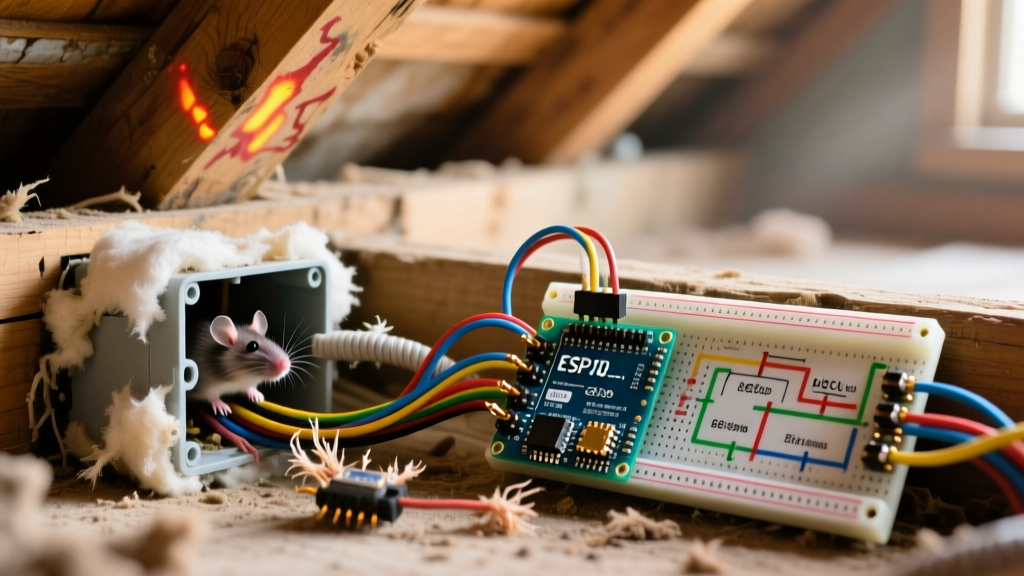
Squirrels, rats, and mice are notorious for gnawing on the PVC jackets of NM-B cable. They do this to file their continuously growing incisors or to harvest the soft PVC for nesting material. According to the Consumer Product Safety Commission (CPSC), damaged wire insulation is a leading cause of residential electrical fires.
Diagnostic Clue: Look for distinct, parallel tooth marks on the cable jacket, or piles of white PVC 'sawdust' beneath the cable runs near soffit vents. If the copper conductor is exposed or nicked, the circuit is compromised.
The Armored Cable Solution
Simply wrapping chewed NM-B in electrical tape is a severe code violation and a fire hazard. You must replace the damaged run. In active pest environments, abandon NM-B entirely and upgrade to Type MC (Metal Clad) cable. Southwire's 12/2 MC cable with interlocking aluminum armor costs approximately $1.15 per foot in 2026 and provides an impenetrable barrier against rodent teeth. Secure it using metal MC cable straps every 4.5 feet per NEC 334.30.
Fault 4: Knob-and-Tube (K&T) Insulation Violations
Homes built before 1950 often retain active Knob-and-Tube wiring in the attic. K&T was designed to dissipate heat into free-flowing air. Modern building practices and NEC 394.12 explicitly prohibit thermal insulation from being installed around or over K&T wiring.
If you are troubleshooting an older home and find K&T wires buried under 12 inches of blown-in cellulose, you have found a critical fire hazard. The trapped heat degrades the original rubberized cloth insulation, leading to bare, energized copper resting directly against combustible cellulose.
Insurance Reality Check: As of 2026, virtually all major homeowners insurance carriers will outright deny coverage or refuse to renew policies if active Knob-and-Tube wiring is detected, regardless of whether it is covered by insulation or not.
The Fix: There is no safe 'patch' for K&T in an insulated attic. The only permanent solution is a complete rewire of the affected circuits using modern, grounded NM-B or MC cable. Budget between $4.00 and $8.00 per square foot for a whole-home K&T replacement.
Fault 5: Improper Support and Physical Damage
Attics are often used for storage and HVAC routing. It is incredibly common to find NM-B cable draped loosely over sharp truss gusset plates, resting on hot metal HVAC supply ducts, or crushed under heavy storage boxes.
- NEC 334.15 (Exposed Work): Cables must be protected from physical damage. Running NM-B across the face of joists where it can be crushed by stored plywood is a violation.
- NEC 300.4(A)(1) (Nail Plates): If cables are bored through attic joists within 1.25 inches of the edge, a 1/16-inch thick steel nail plate must be installed to prevent drywall screws or roofing nails from penetrating the wire.
The Fix: Reroute cables through bored holes in the center of the joists. Where boring is impossible, install 2x4 running boards along the joists and staple the cable to the side of the board, keeping it elevated above the insulation line and safe from physical crushing. Use Gardner Bender GBK-50 cable staples, ensuring you do not pinch or deform the NM-B jacket.
2026 Remediation Cost Guide
When quoting or budgeting for attic electrical wiring repairs, factor in the 'attic premium.' Electricians typically charge 20% to 30% more for attic labor due to the extreme heat, confined spaces, and PPE requirements.
| Remediation Task | Material Cost (2026) | Avg. Labor Rate | Total Est. Cost (per 50ft run) |
|---|---|---|---|
| Upsize 14 AWG to 10 AWG NM-B | $47.50 | $95 - $145 / hr | $285 - $450 |
| Install Arlington BE2 Box Extenders | $8.50 per box | $95 - $145 / hr | $110 - $160 (per box) |
| Replace NM-B with 12/2 MC Cable | $57.50 | $105 - $160 / hr | $350 - $550 |
| K&T Complete Circuit Rewire | $150+ (Panel/Devices) | $95 - $145 / hr | $1,200 - $2,500+ |
Final Thoughts on Attic Troubleshooting
Troubleshooting attic electrical wiring requires a detective's mindset. You are not just looking for the immediate point of failure; you are evaluating how the environment—heat, pests, and insulation—interacts with the electrical system over decades. By strictly adhering to NEC ampacity derating tables, maintaining junction box accessibility, and upgrading to physical armor where rodents are active, you ensure the safety and longevity of the home's electrical infrastructure.