
Building a new home is a massive financial undertaking, and the electrical system is one of the most critical—and often misunderstood—components of the budget. When evaluating the cost of electrical wiring a new home, many builders and homeowners focus solely on the price of copper wire. However, in 2026, the true cost is heavily dictated by National Electrical Code (NEC) compliance, advanced safety mandates, and the rising demand for high-capacity circuits to support electrification.
As a code and standards explainer, this guide cuts through the noise. We will break down the exact material costs, labor rates, and specific NEC articles that drive the final invoice for a modern residential electrical rough-in and trim-out.
The Baseline: Average Cost of Electrical Wiring a New Home
According to industry data and the U.S. Census Bureau, the median size of a new single-family home in the United States hovers around 2,200 square feet. For a home of this size, the total cost of electrical wiring typically ranges from $7,500 to $15,500, translating to roughly $3.50 to $7.00 per square foot.
This wide variance is not arbitrary. It depends on three primary factors:
- Regional Labor Rates: Unionized markets (e.g., Chicago, New York) command journeyman rates of $95–$140 per hour, while right-to-work states may see rates of $55–$85 per hour.
- Home Complexity: A simple rectangular ranch requires significantly less wire pulling and fewer junction boxes than a three-story custom build with multiple wings and vaulted ceilings.
- Electrification Level: Homes utilizing gas appliances require fewer high-amperage circuits than all-electric homes featuring heat pumps, induction cooktops, and Level 2 EV chargers.
How NEC Code Requirements Drive Material Costs
The National Fire Protection Association (NFPA) updates the NEC every three years. The 2023 and 2026 adoptions have introduced stringent safety requirements that fundamentally increase the material cost of electrical wiring a new home.
1. AFCI and GFCI Mandates (Articles 210.8 & 210.12)
Under NEC Article 210.12, Arc-Fault Circuit Interrupter (AFCI) protection is required for nearly all 120-volt, 15- and 20-amp branch circuits supplying habitable rooms. Furthermore, Article 210.8 mandates Ground-Fault Circuit Interrupter (GFCI) protection for kitchens, bathrooms, garages, and outdoor outlets.
In 2026, many jurisdictions require dual-function (AFCI/GFCI) breakers for circuits that overlap these zones, such as a kitchen nook or a bathroom with an adjoining walk-in closet.
Cost Impact: A standard 20-amp single-pole breaker (e.g., Square D HOM120) costs about $8. A dual-function AFCI/GFCI breaker (e.g., Square D HOM120DF) costs between $48 and $62. For a 200-amp panel with 40 circuits, upgrading to code-compliant breakers adds $1,200 to $1,800 to the panel material cost alone.
2. Tamper-Resistant (TR) Receptacles (Article 406.12)
NEC Article 406.12 requires all 15- and 20-amp, 125- and 250-volt non-locking receptacles in dwelling units to be tamper-resistant. While the cost difference per device is marginal—roughly $1.20 for a standard TR duplex receptacle versus $0.60 for a non-TR commercial grade—multiplied by the 60 to 80 receptacles in an average home, this adds $50 to $100 to the trim-out phase.
3. Grounding and Bonding Upgrades (Article 250)
Modern codes require robust grounding systems. While a traditional copper ground rod (NEC 250.53) is still used, many 2026 jurisdictions mandate a Ufer ground (concrete-encased electrode per NEC 250.52(A)(3)) tied to the home's rebar foundation. If a Ufer ground is not installed during the foundation pour, electricians must drive two 8-foot copper-clad ground rods and run a continuous #4 bare copper grounding electrode conductor, adding $150 in materials and labor.
2026 Material Price Breakdown: Wire and Panels
Copper prices remain volatile, heavily influencing the cost of electrical wiring a new home. Below is a realistic 2026 pricing matrix for standard residential materials, based on bulk contractor pricing from major distributors.
| Material / Component | Specific Model / Type | Estimated 2026 Unit Cost | Typical Usage per 2,200 sq ft Home |
|---|---|---|---|
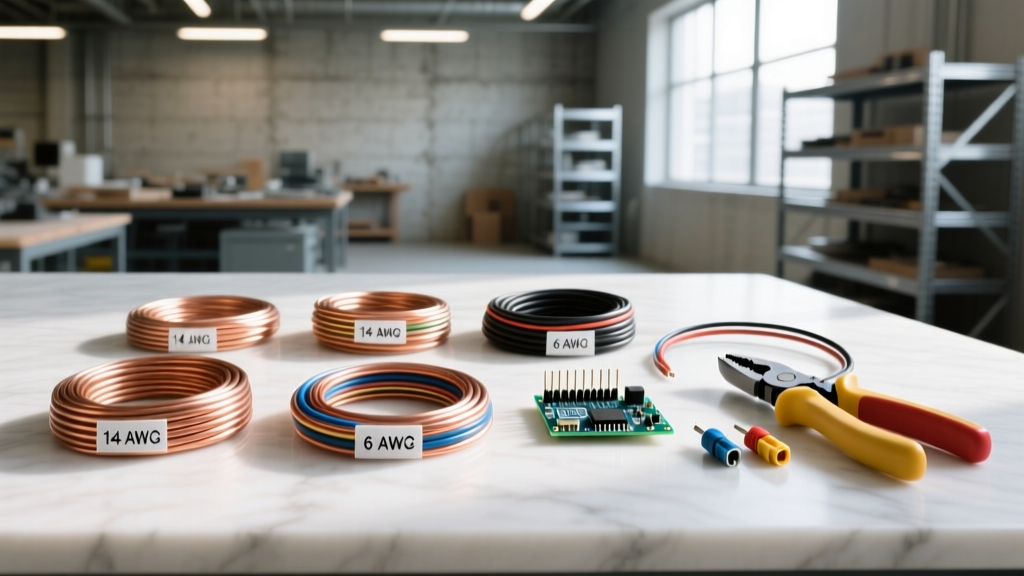
| 14/2 NM-B Wire (CU) | Southwire Romex SIMpull | $0.45 - $0.55 / linear ft | 1,500 - 2,000 ft (Lighting circuits) |
| 12/2 NM-B Wire (CU) | Southwire Romex SIMpull | $0.65 - $0.80 / linear ft | 2,500 - 3,500 ft (Receptacle circuits) |
| 6/3 NM-B Wire (CU) | Southwire (Ranges/Dryers) | $3.50 - $4.20 / linear ft | 100 - 150 ft |
| 200A Main Breaker Panel | Square D HOM3060M200PC | $220 - $280 | 1 (Main Panel) |
| 320A Meter Main (Combo) | Eaton VCC322B14050 | $850 - $1,100 | 1 (For all-electric homes) |
The Shift to 320-Amp and 400-Amp Service Entrances
One of the most significant cost drivers in 2026 is the shift away from the traditional 200-amp service. With the U.S. Department of Energy pushing for whole-home electrification, new builds are increasingly featuring electric vehicle (EV) chargers, 5-ton variable-speed heat pumps, and tankless electric water heaters.
Under NEC Article 230.42, service conductors must have sufficient ampacity to carry the calculated load. When performing an NEC Article 220 Residential Load Calculation, a home with dual EV chargers (Article 511) and an all-electric kitchen often exceeds the 160-amp continuous threshold of a 200A panel.
Cost Comparison: 200A vs. 320A Service Upgrades
- Standard 200A Service: Utilizes 2/0 AWG aluminum or 2 AWG copper service entrance cable. Total material and utility coordination cost: $1,800 - $2,500.
- 320A Continuous / 400A Peak Service: Requires a 320A meter main with twin 200A main breakers feeding two separate 200A interior subpanels. Requires 350 kcmil aluminum or 400 kcmil copper. Total material and labor cost: $4,500 - $6,500.
While the upfront cost is nearly double, installing a 320A service during the rough-in phase prevents a $10,000+ service upgrade retrofit five years down the line when the homeowner purchases a second EV.
Labor Phases: Rough-In vs. Trim-Out
The labor component accounts for 50% to 60% of the total cost of electrical wiring a new home. This labor is strictly divided into two phases, each with distinct code compliance checkpoints.
Phase 1: The Rough-In (60% of Labor)
The rough-in occurs after framing but before drywall. Electricians drill studs, pull wire, and mount nail-on junction boxes.
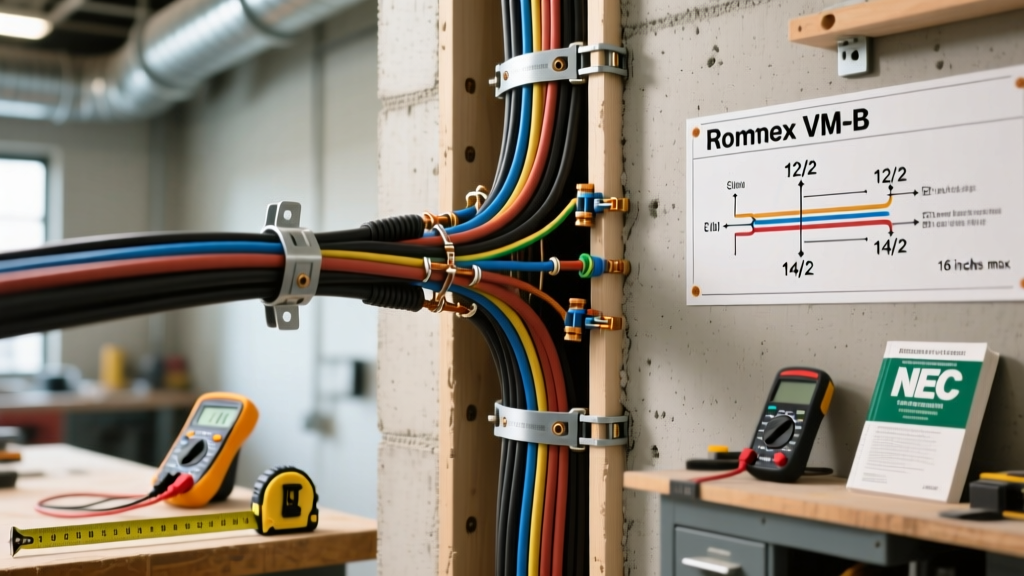
Code Focus: NEC Article 300.4 dictates strict protection against physical damage. Wires running through bored holes in studs must be set back at least 1.25 inches from the edge of the framing. If this setback cannot be maintained, electricians must install steel nail plates (NEC 300.4(A)(1)), adding $0.35 per plate and 2 minutes of labor per installation.
Furthermore, NEC Article 314.16 governs box fill calculations. Electricians must ensure the cubic inch volume of the junction box is sufficient for the number of conductors, clamps, and devices. Overcrowding a single-gang box with four 12/2 cables is a guaranteed code violation that will fail the municipal rough-in inspection, forcing the electrician to tear out the drywall later to install a deeper 22.5 cubic inch box.
Phase 2: The Trim-Out (40% of Labor)
Trim-out happens after painting and flooring. Electricians terminate wires, install receptacles, switches, and light fixtures, and dress the panel.
Code Focus: NEC Article 110.12 requires "neat and workman-like" installation. Inside the panel, conductors must be neatly bundled, tied, and routed without crossing over one another haphazardly. Ground and neutral bars must be strictly separated in subpanels (NEC 250.142), and torque specifications for breaker lugs must be verified using a calibrated inch-pound torque screwdriver (NEC 110.14(D)), a requirement that has drastically reduced panel fires caused by loose connections.
Hidden Code Costs: EV Readiness and Structured Wiring
Modern building codes in states like California, Washington, and Colorado now mandate EV-Ready circuits in all new single-family homes. This requires running a dedicated 240-volt, 60-amp circuit (using 6 AWG copper or 4 AWG aluminum THHN in conduit) to the garage, terminating at a junction box or a hardwired Level 2 charger. This single code requirement adds $400 to $700 to the wiring budget.
Additionally, while low-voltage structured wiring (Cat6a, fiber optic, coaxial) is not strictly governed by the NEC in the same way as line-voltage power, NEC Article 800 dictates separation distances between communication cables and power cables to prevent electromagnetic interference (EMI). Running dedicated 2-inch PVC conduits from the media panel to key living areas for future fiber upgrades adds roughly $300 in conduit and labor but saves thousands in future retrofitting.
Expert Strategies to Optimize Your Wiring Budget
If you are managing the construction of a new home, you can control the cost of electrical wiring without compromising safety or violating code:
- Consolidate 3-Way Switches: Instead of running expensive 14/3 NM-B wire for traditional 3-way switch loops, use smart switches (e.g., Lutron Caséta) that utilize wireless Pico remotes. This reduces wire pulls and junction box fill.
- Standardize Panel Brands: Stick to a single ecosystem (e.g., Square D Homeline or Eaton BR). Mixing panel brands requires buying specialized, expensive breakers and increases the risk of bus-bar connection failures.
- Pre-Wire for Solar: Even if you aren't installing solar panels immediately, have your electrician install a 2-inch PVC conduit from the main panel to the roof attic space during the rough-in. This $150 expense satisfies future solar-ready codes and saves $1,500 when you eventually install the PV system.
Final Thoughts
The cost of electrical wiring a new home in 2026 is a reflection of a safer, more electrified, and highly regulated building environment. While the baseline of $3.50 to $7.00 per square foot provides a solid estimating foundation, the integration of AFCI/GFCI protection, 320-amp service entrances, and EV-ready circuits will push custom and all-electric homes toward the higher end of that spectrum. By understanding the NEC articles that drive these costs, builders and homeowners can make informed decisions that ensure long-term safety, compliance, and electrical capacity for decades to come.