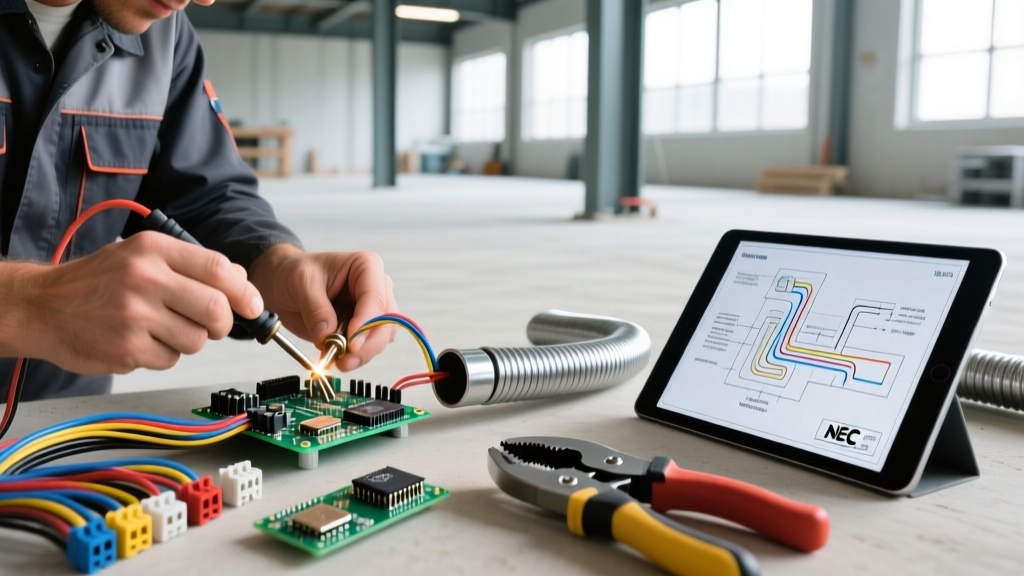

The Foundation: Understanding Commercial Power Distribution
When exploring the basics of electrical wiring, it is crucial to recognize that commercial environments operate on an entirely different paradigm than residential homes. While a standard house relies on single-phase 120/240V power, commercial buildings demand robust, high-capacity systems to run heavy machinery, expansive HVAC networks, and high-density lighting arrays. Understanding these foundational differences is the first step in mastering commercial electrical installations.
The Shift to 3-Phase Power
Commercial facilities predominantly utilize 3-phase power systems. The two most common configurations you will encounter in the field are:
- 208Y/120V: This is the standard for general lighting, standard receptacles, and smaller appliances in commercial spaces. The 120V is derived from the phase-to-neutral connection, while 208V is used for larger commercial appliances and smaller HVAC units.
- 480Y/277V: This higher voltage configuration is the backbone of heavy commercial and industrial wiring. The 277V phase-to-neutral is heavily used for commercial fluorescent and LED high-bay lighting, eliminating the need for step-down transformers. The 480V phase-to-phase powers large rooftop HVAC units, industrial motors, and heavy machinery.
In many large commercial buildings, the utility provides 480V to the main switchgear, and large dry-type transformers are installed on-site to step the voltage down to 208Y/120V for subpanels and general-use circuits.
Raceways and Conduit Systems: Beyond the Studs
In residential wiring, non-metallic (NM) sheathed cable, commonly known by the brand name 'Romex', is the standard. In commercial construction, NM cable is strictly prohibited in most applications due to fire codes and physical vulnerability. Instead, individual conductors are pulled through metal raceways.
Types of Commercial Conduit
Selecting the right raceway depends on the environment, structural requirements, and budget. Here is a breakdown of the primary metal conduits used in commercial projects:
- EMT (Electrical Metallic Tubing): The undisputed workhorse of commercial wiring. EMT is lightweight, unthreaded, and uses set-screw or compression fittings. A standard 10-foot stick of 3/4-inch EMT costs approximately $7 to $10 in 2026. It is used in exposed indoor ceilings and behind drywall.
- IMC (Intermediate Metal Conduit): Thicker and heavier than EMT, IMC features threaded ends. It is often used in outdoor exposed locations or where moderate physical damage is a concern. Pricing averages $18 to $24 per 10-foot stick for 3/4-inch.
- RMC (Rigid Metal Conduit): The heaviest and most robust option. RMC is required in hazardous (classified) locations, areas subject to severe physical damage, and specific burial applications. It is significantly more expensive, running $35 to $45 per 10-foot stick for 3/4-inch, and requires threading with a heavy-duty pipe threader.
Conductor Selection: THHN vs. XHHW-2
Once the raceway is installed, the next core concept in the basics of electrical wiring is selecting the correct conductor insulation. You will primarily pull single-conductor wires rated for 600V.
THHN/THWN-2 (Thermoplastic High Heat-resistant Nylon-coated) is the most common wire found on commercial job sites. The nylon jacket provides excellent resistance to oil and gasoline, and it makes the wire slick for pulling. However, the nylon coating can absorb moisture over time in consistently wet environments.
XHHW-2 (Cross-Linked Polyethylene High Heat Water-resistant) is the superior choice for demanding commercial applications. The XLPE insulation does not have a nylon jacket, making it highly resistant to moisture and chemicals. More importantly, XHHW-2 has a smaller outer diameter than THHN of the same gauge. This smaller profile allows electricians to fit more conductors into a single conduit, potentially saving thousands of dollars in conduit and labor costs on large-scale commercial projects.
Conduit Fill Capacity and Wire Sizing Matrix
Overfilling a conduit causes heat buildup, which degrades insulation and creates a severe fire hazard. The National Electrical Code (NEC) Chapter 9, Table 1 strictly limits conduit fill to 40% for three or more conductors. Below is a quick-reference matrix for EMT conduit fill using standard THHN/THWN-2 copper wire:
| EMT Conduit Size | Max 12 AWG Wires | Max 10 AWG Wires | Max 8 AWG Wires | Max 6 AWG Wires |
|---|---|---|---|---|
| 1/2 inch | 9 | 5 | 3 | 2 |
| 3/4 inch | 16 | 10 | 6 | 4 |
| 1 inch | 29 | 18 | 11 | 7 |
| 1-1/4 inch | 51 | 32 | 20 | 13 |
Conduit Bending Math and Precision Layout
Commercial wiring requires extensive conduit bending to navigate around HVAC ductwork, structural steel, and plumbing. Mastering the math behind bending is what separates an apprentice from a journeyman.
When bending an offset to route conduit over an obstruction, you must calculate both the distance between bends and the 'shrinkage' (the amount the conduit effectively shortens). For a standard 30-degree offset, the multiplier is 2.0, and the shrinkage is 1/4 inch per inch of obstruction depth. If you are clearing a 4-inch ductwork obstacle, your distance between bends is 8 inches, and you must add 1 inch to your initial measurement to account for shrink. Using a digital angle finder and a high-quality mechanical bender (such as the Greenlee 555 series) ensures precise, kink-free bends.
Step-by-Step Commercial Rough-In Workflow
A commercial rough-in is a highly coordinated process. Here is the standard workflow for a commercial tenant improvement (TI) build-out:
- Layout and Laser Leveling: Use a rotary laser level to mark conduit heights and device box locations on the studs. Commercial device boxes are typically mounted at 48 inches to the center of the box, but always verify with the architectural reflected ceiling plan (RCP).
- Support Installation: Install 1-5/8 inch metal framing (commonly known by the brand name Unistrut) and beam clamps to support the conduit. NEC requires EMT to be secured within 3 feet of every box and at intervals not exceeding 10 feet.
- Conduit Bending and Assembly: Cut, thread (if using IMC/RMC), and bend the conduit. Apply thread cutting oil when threading RMC to preserve the die teeth and ensure smooth threads.
- Wire Pulling: Feed the conductors through the raceway. For runs longer than 50 feet or with multiple bends, apply a high-quality wire pulling compound like Polywater J to reduce friction and prevent insulation tearing.
- Terminations and Torqueing: Strip the wires and terminate them at the panelboard bus bars and receptacles. Modern commercial codes strictly require the use of calibrated torque screwdrivers (e.g., Klein Tools torque drivers) to tighten lugs to the manufacturer's specified inch-pound rating, preventing loose connections that lead to arc faults.
Grounding, Bonding, and Code Compliance
Grounding and bonding are the most misunderstood aspects of electrical wiring, yet they are the most critical for life safety. According to the National Fire Protection Association (NFPA), adherence to NEC Article 250 is non-negotiable. In commercial buildings, the grounding electrode system often ties into the structural steel of the building (a concrete-encased electrode or 'Ufer' ground) and the metal underground water pipe.
Bonding ensures that all non-current-carrying metal parts (like the EMT conduit, panelboard enclosures, and device boxes) are electrically continuous. In commercial EMT systems, the metal conduit itself often serves as the Equipment Grounding Conductor (EGC), provided the fittings are securely tightened. However, many commercial specifications now require a separate, insulated copper EGC (green wire) to be pulled with the circuit conductors as a fail-safe against loose set-screws.
Expert Insight: When pulling 480V conductors through long conduit runs, always calculate voltage drop. The NEC recommends a maximum 3% voltage drop for branch circuits and 5% overall from the service entrance to the furthest outlet. Use XHHW-2 wire to maximize conduit space and reduce friction during pulls, and upsize your conductors if the run exceeds 150 feet.
Safety Standards in Commercial Environments
Working on commercial job sites introduces severe hazards, including arc flash risks and high-voltage exposure. Safety protocols during installation are heavily regulated, as outlined by the Occupational Safety and Health Administration (OSHA). Electricians must wear appropriate Personal Protective Equipment (PPE), including voltage-rated gloves with leather protectors, arc-flash rated face shields, and flame-resistant (FR) clothing when working on or near energized commercial switchgear.
Furthermore, for energy efficiency and long-term operational cost savings in commercial spaces, the U.S. Department of Energy recommends integrating smart lighting controls, occupancy sensors, and automated daylight harvesting systems directly into the commercial wiring infrastructure during the initial rough-in phase.
Frequently Asked Questions
Can you use residential NM cable in a commercial building?
Generally, no. The NEC restricts the use of NM cable in commercial buildings, particularly in spaces with dropped ceilings used for environmental air (plenums), in multi-story buildings exceeding specific height limits, or where the wiring is exposed to physical damage. Commercial wiring almost exclusively requires metal raceways and THHN/XHHW conductors.
Why do commercial buildings use 277V for lighting?
Using 277V (the phase-to-neutral voltage of a 480Y/277V system) for lighting allows facilities to power hundreds of high-intensity fixtures without the need for bulky, expensive step-down transformers. It balances the load across the three phases and significantly reduces the amperage draw, allowing for smaller wire gauges and lower material costs.