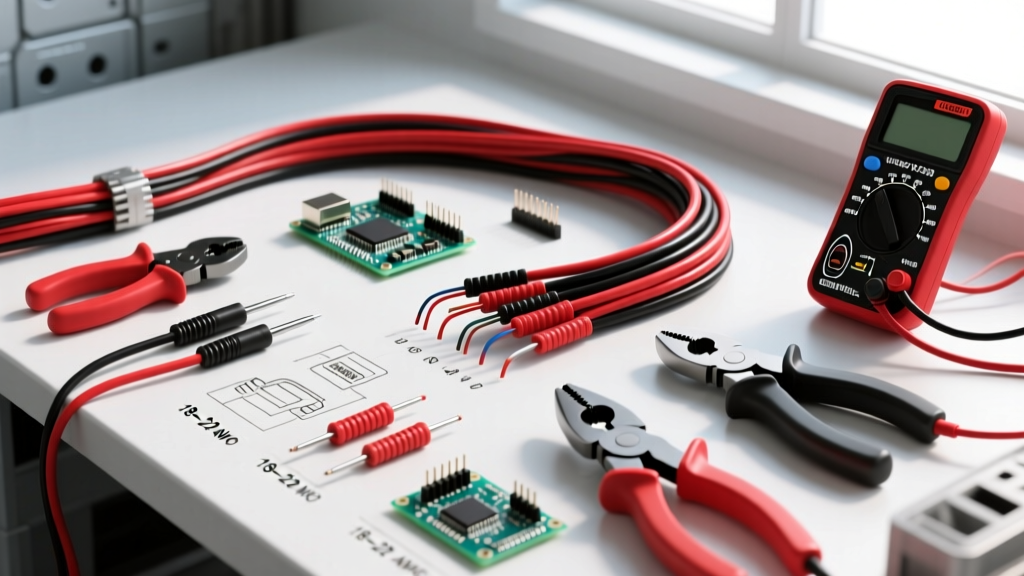

The Commercial Mindset Applied to Residential New Construction
When commercial electrical contractors expand into high-end custom residential builds or large-scale tract developments, the estimating paradigm must shift. While the fundamental physics of electricity remain constant, the methodology for calculating the electrical wiring cost for new house projects requires adapting commercial rigor—such as NECA (National Electrical Contractors Association) labor unit standards—to residential environments. In 2026, with fluctuating copper markets and stringent energy codes, relying on residential 'rule-of-thumb' square-footage multipliers is a fast track to margin erosion.
This guide bridges the gap between commercial estimating frameworks and residential execution, providing a granular breakdown of material, labor, and code-compliance costs for new home construction.
Why Commercial Estimating Frameworks Matter for Home Builds
Residential electricians often bid based on historical averages (e.g., $6.00 per square foot). Commercial estimators, however, utilize unit-price takeoffs. By quantifying every linear foot of wire, every termination, and every strap, commercial firms can identify exact profitability thresholds. When managing the electrical wiring cost for new house projects exceeding 4,000 square feet or featuring complex smart-home integrations, this granular approach is non-negotiable.
Core Cost Drivers: Breaking Down the Electrical Wiring Cost for New House
To accurately forecast the electrical wiring cost for new house construction, estimators must separate the project into three distinct phases: Service and Distribution, Rough-In, and Trim-Out. The table below contrasts standard residential pricing with commercial-grade residential pricing (often required in luxury custom builds or fire-rated assemblies).
| Project Phase | Standard Residential Cost (2026) | Commercial-Grade Custom Cost | Primary Cost Driver |
|---|---|---|---|
| Service Entrance (200A-400A) | $1,800 - $3,200 | $4,500 - $8,500 | Meter mains, CT cabinets, utility fees |
| Rough-In (Per Sq. Ft.) | $2.50 - $4.50 | $7.00 - $12.00 | EMT conduit vs. NM-B cable, framing complexity |
| Panel Termination (Per Breaker) | $65 - $95 | $110 - $160 | Torque sealing, THHN pigtails, labeling |
| Trim-Out (Per Device) | $85 - $125 | $150 - $220 | Dimming modules, smart switches, trim kits |
| Low Voltage / Data Rough-In | $1,500 - $3,000 | $8,000 - $15,000+ | Cat6A, fiber optics, dedicated AV racks |
According to the National Association of Home Builders (NAHB), electrical work typically accounts for roughly 4.5% to 5.5% of total new home construction costs. However, in luxury builds with commercial-grade specifications, this figure routinely scales to 8% or higher.
Material Selection: NM-B Cable vs. THHN in Conduit
The most significant variable in the electrical wiring cost for new house projects is the wiring method. Standard residential construction relies heavily on Non-Metallic Sheathed Cable (NM-B, commonly known as Romex). Commercial contractors are accustomed to pulling individual THHN/THWN-2 conductors through EMT (Electrical Metallic Tubing).
The Cost Delta
- NM-B Cable (12/2 with Ground): Material costs average $0.65 to $0.85 per linear foot. Installation is rapid, requiring only stapling to wood studs.
- THHN in 1/2-inch EMT: Material costs for the conduit, wire, fittings, and supports average $2.80 to $3.90 per linear foot. Labor increases by a factor of 3.5x due to bending, threading, and pulling.
NEC Code Impact: The National Fire Protection Association (NFPA) enforces strict AFCI (Arc-Fault Circuit Interrupter) and GFCI (Ground-Fault Circuit Interrupter) requirements under NEC Article 210.12 and 210.8. In 2026, nearly all 120V, 15A and 20A branch circuits in a new house require combination-type AFCI protection, adding approximately $25 to $45 per circuit in breaker costs compared to standard thermal-magnetic breakers.
When commercial contractors bid on residential jobs, they must consciously suppress the instinct to over-engineer with conduit unless local amendments (such as those in Chicago or New York City) or specific fire-rating assemblies mandate it.
Labor Metrics: Productivity Rates and Burdened Labor Costs
Accurately estimating the electrical wiring cost for new house builds requires applying the correct labor burden. Residential piece-work rates do not apply to commercial firms operating with union agreements or comprehensive corporate benefits packages.
Based on U.S. Bureau of Labor Statistics (BLS) data for electricians, the base median wage hovers around $30.00 per hour. However, a commercial estimator must calculate the burdened labor rate, which includes:
- FICA and Medicare: 7.65% of base wage.
- Workers' Compensation: Varies by state, typically 2.5% to 6.0% for electrical contractors.
- General Liability & Insurance: Allocated hourly overhead.
- Fringe Benefits: Health insurance, retirement matching, and paid time off.
Consequently, the true burdened labor rate for a commercial electrician working on a residential site in 2026 ranges from $85.00 to $125.00 per hour. Estimators must apply NECA Manual of Labor Units (MLU) to determine exact installation times. For example, the MLU dictates that installing a standard single-gang metal box, running 12/2 NM-B, and making up the device takes approximately 0.35 to 0.45 labor hours. At a $95/hr burdened rate, the labor cost per device is roughly $38.00 before overhead and profit.
Advanced Upgrades Impacting the Bottom Line
Modern new construction rarely stops at basic illumination and receptacles. Commercial contractors must account for specialized systems that drastically alter the electrical wiring cost for new house projects.
EV Charging Infrastructure (NEC Article 511 & 225)
With electric vehicle adoption accelerating, new homes frequently require Level 2 EVSE (Electric Vehicle Supply Equipment) installations. This necessitates a dedicated 240V, 50-amp to 60-amp circuit. Estimators must price 6 AWG copper or 4 AWG aluminum THHN, alongside a heavy-duty NEMA 14-50 receptacle or hardwired disconnect. Furthermore, if the main service panel lacks the spare capacity, upgrading from a 200A to a 400A meter-main combination can add $3,500 to $6,000 to the project baseline.
Smart Panels and Energy Management
Products like the SPAN smart panel or Leviton Omni provide circuit-level monitoring and solar/battery integration. While a standard 200A load center costs $250 to $450, a smart panel ecosystem can cost $1,800 to $3,500 for the hardware alone, plus an additional 4 to 6 hours of specialized configuration labor.
Risk Mitigation and Contingency Planning
Commercial estimators never submit a bid without a calculated contingency. When determining the electrical wiring cost for new house builds, a 5% to 8% contingency is standard to absorb:
- Copper Volatility: Wire pricing can fluctuate 10-15% between the bid date and the rough-in phase.
- Architectural Changes: Moving walls or adding custom cabinetry after the rough-in phase requires costly rework.
- Utility Delays: Waiting for temporary power poles or permanent meter sets can cause schedule compression, necessitating expensive overtime labor.
Frequently Asked Questions
How does the electrical wiring cost for new house projects compare to commercial tenant improvements?
Commercial tenant improvements (TI) typically cost between $12.00 and $22.00 per square foot due to 3-phase power, exposed conduit aesthetics, and commercial lighting controls. Residential new construction averages $4.50 to $9.00 per square foot, primarily because NM-B cable is cheaper and faster to install than EMT, and residential lighting fixtures are less complex to commission.
Should I use aluminum or copper for large residential feeder cables?
For service entrance conductors and large sub-panel feeders (e.g., 200A to 400A), compact stranded aluminum (like 4/0-4/0-2/0-4 AL) is the industry standard and perfectly safe when terminated with anti-oxidant paste and torqued to manufacturer specifications. Using copper for these massive feeders will unnecessarily inflate the electrical wiring cost for new house projects by thousands of dollars with no functional benefit.
What is the most overlooked cost in residential electrical estimating?
Patch and repair. When commercial contractors work in residential settings, the finishing standards are much higher. Budgeting for a dedicated finish carpenter or drywall patcher to repair ceilings and walls damaged during fishing wires or cutting access holes is critical to maintaining client satisfaction and protecting margins.