
The High-Stakes Environment of Commercial Kitchen Wiring
Wiring a commercial electric stove is fundamentally different from wiring a residential range. In a commercial kitchen, equipment operates under continuous, punishing duty cycles, often in high-ambient-heat environments filled with grease and moisture. Getting the electric stove wiring size wrong doesn't just mean a tripped breaker; it can lead to melted insulation, catastrophic equipment failure, or a devastating grease fire. For electrical contractors and facility managers, understanding the precise National Electrical Code (NEC) requirements for commercial cooking equipment is non-negotiable.
Whether you are installing a 12kW Vulcan VCREC48-6T six-burner range or a 24kW Garland heavy-duty convection oven bank, the branch circuit conductors, overcurrent protection, and routing methods must be meticulously calculated. This guide breaks down the exact specifications, NEC demand factors, and real-world installation practices required for commercial electric stove wiring in 2026.
The Golden Rule: Nameplate vs. NEC Demand Factors
The most common mistake electricians make when transitioning from residential to commercial work is misapplying NEC demand factors. In residential wiring, NEC Article 220.55 allows you to apply a massive demand factor to household cooking appliances rated over 8.75 kW, significantly reducing the required wire size. You cannot apply this residential rule to commercial kitchens.
Code Alert: According to the National Fire Protection Association (NFPA), NEC Article 220.56 governs Commercial Kitchen Equipment. While 220.56 allows demand factors for feeder calculations (e.g., sizing the main panel feeding six or more commercial appliances), the individual branch circuit wiring for a single commercial stove must be sized at 100% of the nameplate rating per NEC 210.19(A)(1) and 210.20.
If a commercial range has a nameplate rating of 18,000 watts (18 kW) at 208V, 3-phase, the full load amperage (FLA) is exactly 50 amps. Your branch circuit conductors and overcurrent device must be sized to handle this continuous or non-continuous load without the residential 'discount'.
Electric Stove Wiring Size Chart (Commercial Branch Circuits)
When selecting the correct wire gauge, commercial electricians must default to the 75°C column of NEC Table 310.16. Even if you are using 90°C THHN/THWN-2 wire, NEC 110.14(C) dictates that equipment terminals rated 100 amps or less are generally only rated for 75°C. Therefore, your ampacity is bottlenecked by the terminal rating.
| Nameplate Amperage (FLA) | Min. Copper Wire Size (75°C) | Standard Breaker Size | Min. EMT Conduit Size (3ϕ + Ground) |
|---|---|---|---|
| 35A - 40A | #8 AWG | 45A or 50A | 3/4 inch |
| 41A - 50A | #8 AWG (or #6 for voltage drop) | 50A | 3/4 inch |
| 51A - 60A | #6 AWG | 60A | 3/4 inch |
| 61A - 70A | #4 AWG | 70A | 1 inch |
| 71A - 80A | #4 AWG | 80A | 1 inch |
| 81A - 100A | #3 AWG | 100A | 1 inch |
| 101A - 115A | #2 AWG | 125A | 1 1/4 inch |
Note: Always verify the manufacturer's installation manual. Some high-end European commercial combi-ovens and ranges specify internal contactors that strictly require 90°C terminations, but this is rare in standard heavy-duty American ranges.
Conductor Routing: EMT, FMC, and the 'Whip' Requirement
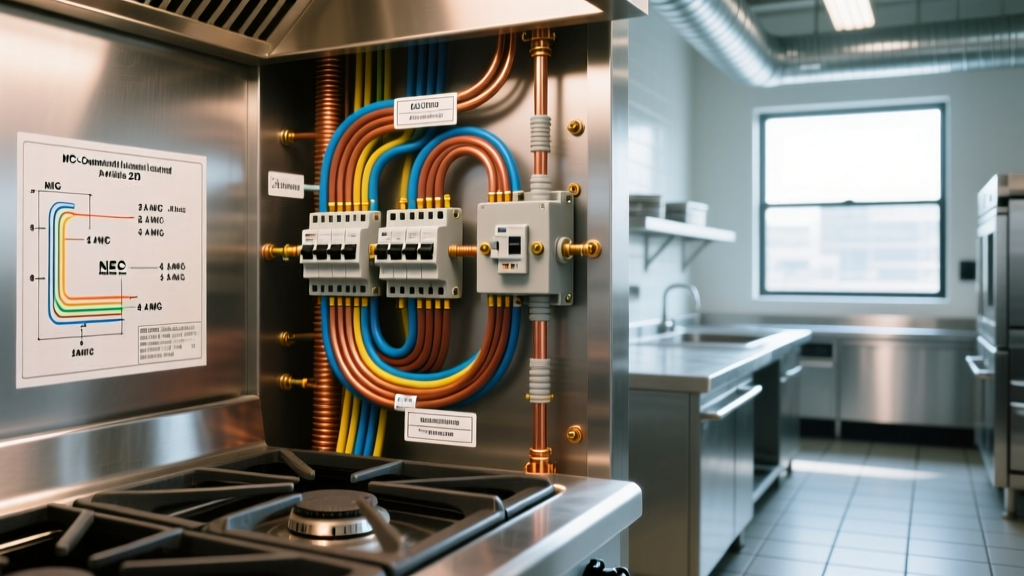
In commercial construction, Non-Metallic Sheathed Cable (NM-B/Romex) is almost universally prohibited by local amendments and commercial building codes. The standard for commercial kitchen wiring is THHN/THWN-2 conductors pulled through Electrical Metallic Tubing (EMT).
The Final 6 Feet: Flexible Metal Conduit (FMC)
Health departments and commercial kitchen consultants mandate that heavy cooking equipment must be movable to allow for deep cleaning, pest control, and grease trap maintenance. Hardwiring a commercial stove directly with rigid EMT is a severe practical and regulatory failure.
To solve this, the industry standard is to terminate the EMT at a junction box mounted 5 to 6 feet above the finished floor, and drop down to the stove using a Liquidtight Flexible Metal Conduit (LFMC) whip. LFMC is preferred over standard FMC (Greenfield) in commercial kitchens because its PVC jacket prevents grease, water, and caustic cleaning chemicals from degrading the conductors inside. Ensure you install an internal green grounding conductor; relying on the flexible jacket for a ground path is a code violation for circuits over 20A or longer than 6 feet.
3-Phase vs. Single-Phase Commercial Ranges
Commercial buildings typically utilize 208Y/120V or 480Y/277V 3-phase power. Heavy-duty electric ranges are almost always ordered in 208V 3-phase configurations to balance the building's load and reduce the amperage per leg.
- Single-Phase (240V): A 24 kW range pulls 100 Amps. This requires massive #3 AWG copper wire and a 100A breaker, putting heavy strain on a single phase of the panel.
- 3-Phase (208V): That same 24 kW range pulls roughly 66.6 Amps per leg. This allows you to downsize to #4 AWG copper wire and a 70A breaker, saving thousands of dollars in copper costs across a multi-unit kitchen buildout.
Always confirm the phase configuration with the kitchen equipment dealer before roughing in the conduit. Ordering a 3-phase range for a building with only single-phase power is a costly logistical nightmare.
Edge Cases and Common Failure Modes
Even when the basic math is correct, commercial kitchens present unique edge cases that can cause wiring systems to fail prematurely.
1. Voltage Drop in Large Footprints
Commercial kitchens are often located far from the main electrical switchgear. NEC recommends a maximum 3% voltage drop on branch circuits. If your 208V 3-phase panel is 150 feet away from a 70A commercial range, #4 AWG wire will result in a voltage drop exceeding 4%. You must bump the wire size up to #3 AWG or even #2 AWG to ensure the stove's solid-state ignition boards and digital convection controllers receive adequate voltage. Low voltage causes contactors to chatter and overheat.
2. Torque Verification (NEC 110.14(D))
Modern commercial electrical inspections heavily scrutinize termination torque. Vibrations from heavy exhaust hoods, foot traffic, and the physical movement of the stove on its casters can loosen poorly torqued lugs. Per NEC 110.14(D), you must use a calibrated torque screwdriver or wrench to tighten the lugs on the stove's terminal block and the panel breaker to the manufacturer's specified inch-pound rating. Loose neutral connections on 208V systems will send 208V directly into 120V control boards, instantly frying the appliance's computer.
3. Harmonic Distortion and Oversized Neutrals
While standard electric ranges are primarily resistive loads, modern commercial kitchens are filled with variable frequency drives (VFDs) on walk-in coolers and LED lighting drivers. These create harmonic distortion. While the stove itself may not require an oversized neutral, the shared feeder panel might. Always consult a power quality study if the commercial kitchen features extensive VFD-driven refrigeration.
Summary Checklist for Commercial Kitchen Inspectors
Before calling for your final electrical inspection, verify the following against OSHA electrical safety standards and local AHJ requirements:
- Nameplate Verification: Does the breaker and wire size match 100% of the range's nameplate FLA?
- Terminal Temperature: Did you size the wire using the 75°C column of Table 310.16?
- Flex Whip Integrity: Is the LFMC whip properly bonded with an internal ground wire and strain relief fittings?
- Working Space: Does the junction box maintain the required 30-inch wide, 36-inch deep NEC 110.26 working clearance, even with the stove pushed against the wall?
- Disconnects: Is there a visible, lockable disconnect switch within sight of the appliance, or is the breaker capable of being locked out per facility safety protocols?
For further reading on commercial kitchen load calculations and feeder sizing, industry professionals frequently reference the technical articles and code quizzes provided by Electrical Construction & Maintenance (ECM). Mastering these nuances ensures your commercial installations are safe, code-compliant, and built to withstand the rigorous demands of the food service industry.